AI Demand Lifts Japanese Machine Tool Distributors, but Second-Half Sales Growth Is Forecast to Slow
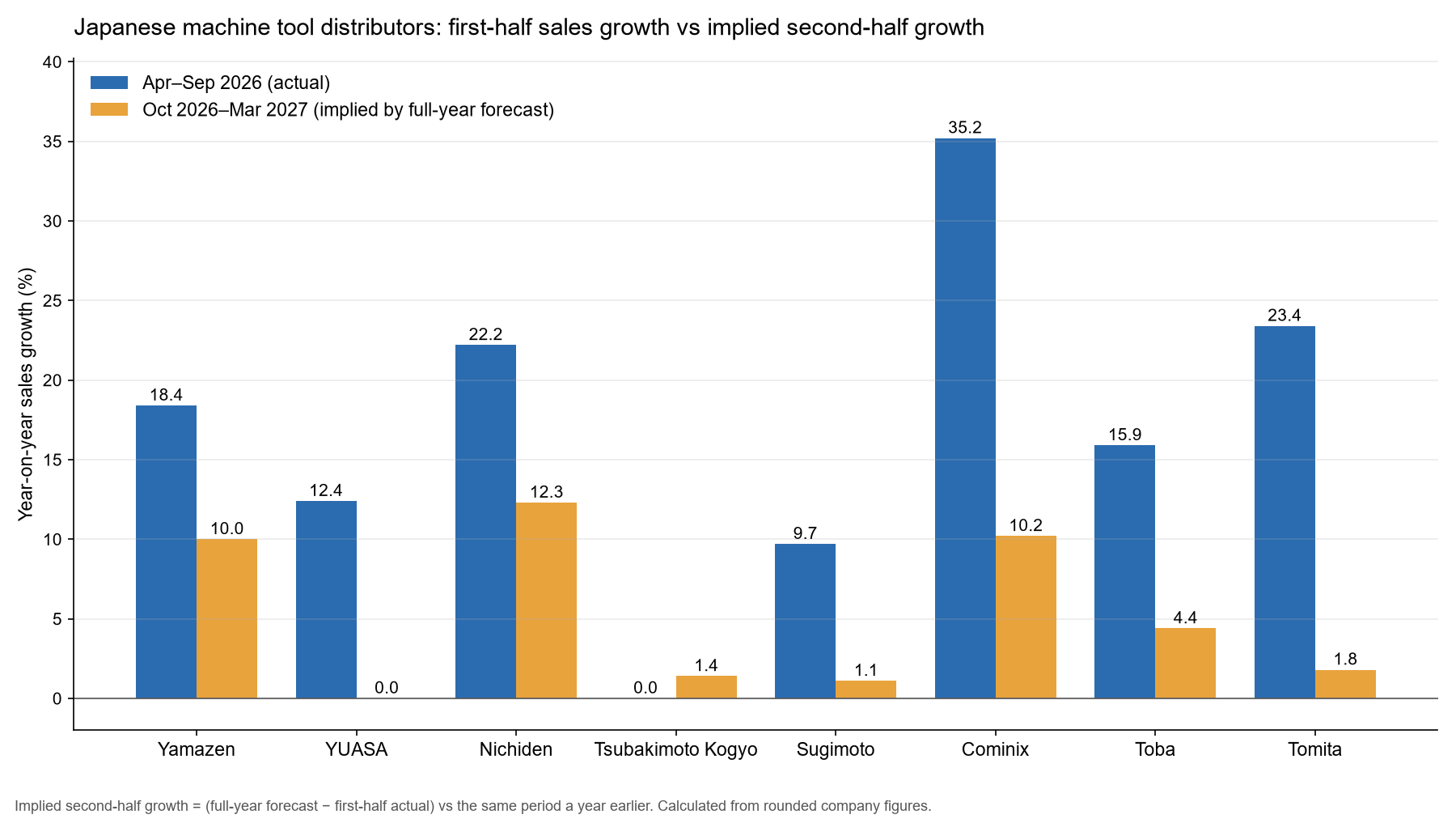
Eight major Japanese machine tool distributors, which also sell cutting tools and other factory equipment, all expect higher sales and operating profit for the year ending March 2027, with semiconductor, AI and data-centre investment leading demand. Yet the first half carried most of the growth: the companies' own full-year forecasts imply slower year-on-year sales growth from October to March than they achieved from April to September at seven of the eight. The forecasts signal caution rather than a downturn, and the next results will need to be read company by company.
Key points
- Result: All eight forecast higher sales and operating profit, with combined sales of about US$10.4bn
- Source of growth: Semiconductor, AI and data-centre investment, plus robots and labour-saving equipment in Japan
- Gap with the plan: Implied second-half sales growth is slower than the first half at seven of the eight companies
- What to watch: Backlog updates from Yamazen and YUASA, and Cominix's demand outlook, in the next quarterly results
Last year's outlook included three operating-profit declines; this year's includes none
The companies are Yamazen, YUASA, Nichiden, Tsubakimoto Kogyo, Sugimoto, Cominix, Toba and Tomita. They are trading houses that buy machine tools, cutting tools, power-transmission parts and other factory equipment from many manufacturers and sell them on to factories. Their factory-equipment businesses give a partial read on manufacturers' capital spending, although consolidated sales also include activities outside machine tools and factory equipment.
For the year ending March 2027, every one of them expects both sales and operating profit to rise. That is a change from the outlook published in May 2025 for the previous year, when all eight also expected higher sales but three projected lower operating profit. Yamazen was one of the three, citing higher selling and administrative costs such as wage increases. This year, net profit is still forecast to fall at Sugimoto and Tomita.
The main drivers are semiconductor, AI and data-centre investment. In Japan, labour shortages are also supporting orders for robots and labour-saving equipment.
Sales rose by double digits at six of the eight in the first half
Together, the eight generated about US$5.13bn in first-half sales, up about 15%, and forecast about US$10.4bn for the full year. Six of the eight increased first-half sales by between about 12% and 35%. The two largest set the pace. Yamazen's sales rose 18.4% to about US$1.93bn, and YUASA's rose 12.4% to about US$1.77bn.
Yamazen's production-goods business, which handles machine tools and other factory equipment, grew faster still. Its sales rose 25.5% to about US$1.29bn. In Japan, equipment demand also rose from aerospace, shipbuilding, defence and construction machinery. Overseas, its North America unit grew on aerospace and data-centre demand, and its Taiwan, China and ASEAN branches all reported sales well above the previous year.
In late October, Yamazen raised the full-year forecast it had published in August. Its latest outlook is for sales of about US$3.88bn and operating profit of about US$112m, up 14.0% and 48.6% respectively. The company said demand from semiconductors and AI, data centres, aerospace, shipbuilding and defence had run well above its expectations, and that inquiries were turning into firm contracts more reliably and more quickly.
Operating profit grew faster than sales at all eight. At Cominix, a cutting-tool distributor, first-half operating profit rose to 5.1 times its year-earlier level as sales increased 35.2%. Nichiden raised operating profit 58.2% on sales up 22.2%.
Japanese machine tool distributors' forecasts imply slower second-half growth at seven of eight
The full-year forecasts tell a more cautious story than the first-half results. Subtracting each company's first-half sales from its full-year forecast gives the sales it expects from October 2026 to March 2027. Comparing that with the same period a year earlier shows the growth each forecast implies (calculations by this publication, based on the companies' rounded figures). For the eight combined, sales growth slows from about 15% in the first half to roughly 5% in the second.
| Company | First-half sales growth (Apr–Sep 2026) | Implied second-half sales growth (Oct 2026–Mar 2027) | |---|---|---| | Yamazen | 18.4% | about 10% | | YUASA | 12.4% | about 0% | | Nichiden | 22.2% | about 12% | | Tsubakimoto Kogyo | 0.0% | about 1% | | Sugimoto | 9.7% | about 1% | | Cominix | 35.2% | about 10% | | Toba | 15.9% | about 4% | | Tomita | 23.4% | about 2% |
At seven of the eight, implied second-half growth is lower than first-half growth. YUASA's forecast implies second-half sales roughly level with a year earlier, after a 12.4% rise in the first half. Only Tsubakimoto Kogyo, whose sales were flat in the first half, forecasts slightly faster growth later in the year.
Some of the first half's strength came from company-specific effects that may not repeat. Cominix said a rush of purchases ahead of price increases by cutting-tool makers lifted its sales, along with growth in its mineral resources business. Although it also raised its full-year forecast, President Shuichi Yanagawa said the outlook for tool prices was uncertain and that demand from October to March was likely to soften. At Yamazen, products it had bought in advance to secure supply and shorten lead times shipped earlier than planned as orders came in above expectations.
Yamazen said it needed to watch market conditions from the third quarter onwards carefully, even as it raised its outlook on the strength of its overseas order backlog and promising inquiries. The slower growth in the table is a caution signal built into the forecasts, not evidence that demand has already weakened.
Backlogs support the outlook at the two largest, while some lead times stretch
Backlogs support the outlook at Yamazen and YUASA. Hideaki Murayama, president of YUASA, said the market environment was now lifting customers' willingness to invest and that its order backlog was at a high level. Sales in YUASA's factory equipment division rose 6.3% in the first half, slower than the company's overall 12.4%.
Strong demand has also lengthened procurement lead times for some products. The distributors aim to keep supply stable and win contracts by working more closely with the manufacturers they buy from.
Tsubakimoto Kogyo shows that growth in AI-related demand does not always lift total sales. The company reported record first-half sales and record highs across all profit measures, although sales rose only marginally from a year earlier. Power-transmission parts and industrial materials for AI-related customers grew. A managing executive officer said machinery orders from heavy industries were also strong.
YUASA plans to double its India network
YUASA is expanding overseas, where its president sees "large room for growth". Under its medium-term plan "Reborn 2031", which runs from April 2026 to March 2031, YUASA plans to expand its sites in India from four to eight. Its current network includes Pune and Chennai, and its Indian headquarters is in Gurgaon. The company is also focusing on ASEAN, centred on Thailand, and North America.
YUASA targets overseas sales of about US$250m by the year ending March 2031 and about US$630m by the year ending March 2036. It has changed its overseas performance measure from transaction volume, which combined sales and purchases, to overseas sales.
Yamazen's overseas growth in the first half came from North America, Taiwan, China and ASEAN.
Where procurement lead times have lengthened, buyers may need to place equipment orders earlier, while cutting-tool price revisions could raise near-term purchasing costs.
The forecasts show caution, not an industry-wide downturn
Demand tied to semiconductors, AI and data centres supported the group in the first half, while Yamazen's advance shipments and Cominix's purchases ahead of price increases provided company-specific boosts. The forecasts point to slower growth at seven companies, but they do not establish a common cause. They imply slower growth, not an industry-wide downturn.
The decisive test will be company-specific: whether Yamazen and YUASA convert their order backlogs into sales in their next quarterly results, and whether Cominix reports weaker tool demand after purchases were brought forward ahead of the price increases.