Humanoid Robot Actuators: Japan's NSK Builds a Range for Most Major Joints and Adds a QDD Unit
Japan's NSK, the world's third-largest bearing maker, said on 26 November 2026 that it has developed small and large humanoid robot actuators to sit alongside the mid-size units it unveiled a year ago, and a new quasi-direct-drive (QDD) rotary actuator. The range now covers most major humanoid joints, and on the same day NSK added its thinnest-section series of single-row deep groove ball bearings for robot makers that design their own actuators, positioning it to pursue both complete-actuator sales after launch and component sales to in-house designers. NSK has disclosed output figures for every actuator in the expanded range, but only the mid-size units announced earlier have published weights and dimensions; the next disclosed milestone is staged sample supply after the RoboNext2026 trade show in early December, when prospective customers can begin evaluating them.
Key points
- What was announced: Small and large rotary and linear actuators join the 2025 mid-size units, plus a new QDD rotary type
- How the parts differ: The new 67 series bearings weigh about 24% to 65% less than NSK's 68 series of the same bore
- Stage: The actuators are still in development, with launch targeted by March 2028, while NSK has already set up supply for the bearings
- What uptake depends on: The small, large and QDD units' weight and dimensions, plus their performance in sample evaluations
From one mid-size pair to a lineup for most humanoid joints
An actuator is the drive unit that turns a motor's rotation into the movement of a robot joint. In November 2025 NSK showed one rotary and one linear actuator, both mid-size, developed with Taiwan's Delta Electronics. NSK designed the mechanism (bearings, ball screws and reducer), while Delta supplied the frameless motor, encoder, motor controller and software, built into the same housing.
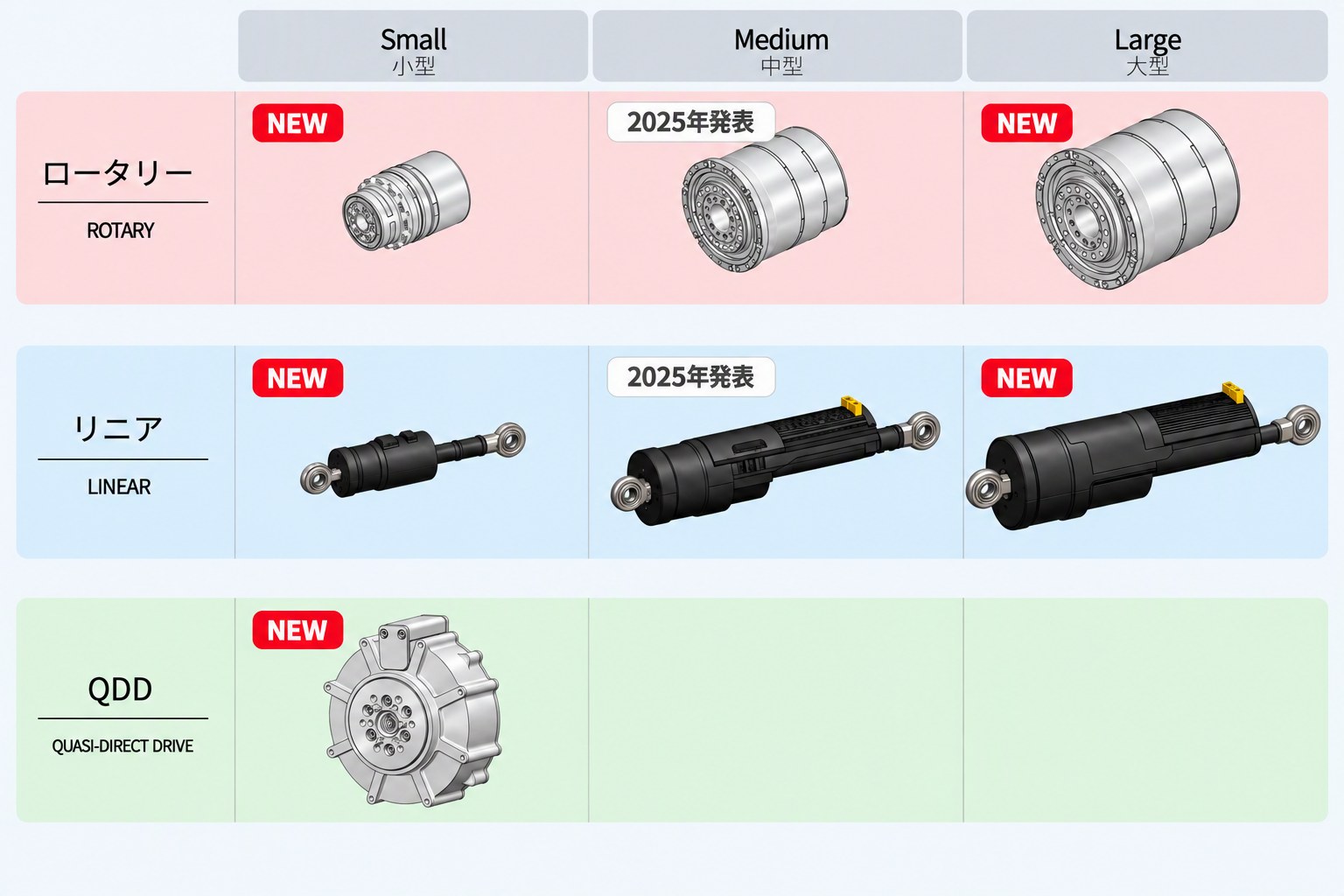
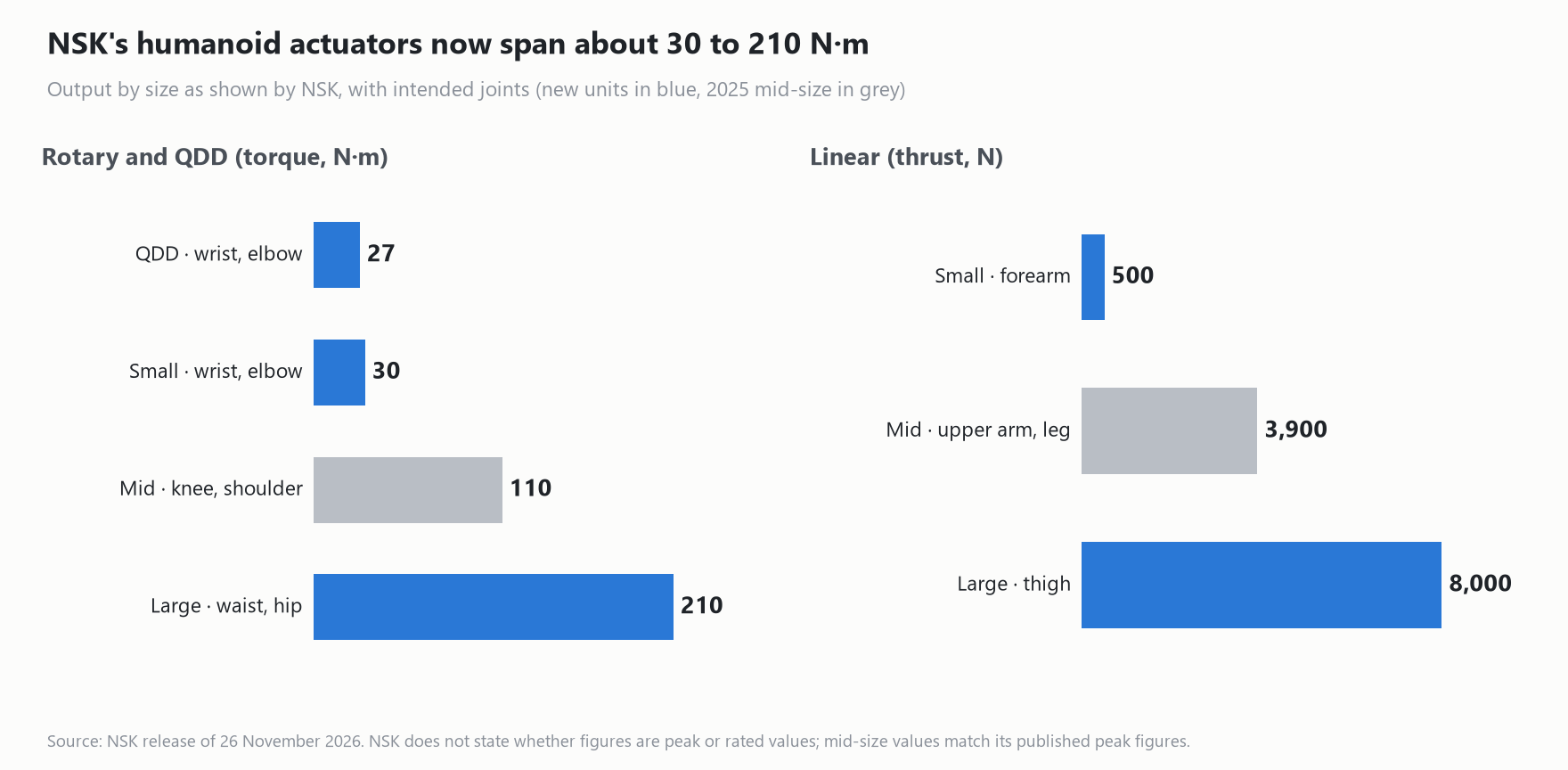
The new announcement adds small and large versions alongside the mid-size pair, although NSK has not said whether they use the same Delta motor and control package. NSK describes the rotary and linear units as having high torque or thrust density. An illustration in the release assigns each size to a part of the body and lists its output:
- Rotary actuators: small (30 newton-metres) for wrists and elbows, mid-size (110 newton-metres) for knees and shoulders, large (210 newton-metres) for the waist and hip joints
- Linear actuators: small (500 newtons) for forearms, mid-size (3,900 newtons) for upper arms and legs, large (8,000 newtons) for thighs
The large units roughly double the output of the mid-size ones. The illustration does not say whether the figures are peak or rated values, although the mid-size numbers match the peak values NSK published earlier.
The QDD actuator is a different drive method rather than another size. It uses a planetary gear with a low reduction ratio, which NSK says gives both fast response and backdrivability, meaning the joint yields smoothly when pushed from outside. NSK names wrists, elbows and the leg joints of four-legged robots as target uses, and lists it at 27 newton-metres, close to the small rotary unit.
The expanded size range matches the timetable NSK's president outlined in August. At a press conference on 26 August, Chief Executive Akitoshi Ichii said humanoids would probably need about three versions of actuator by output, large, medium and small, and that he expected the lineup to be ready within the year. The launch timing has also been restated. NSK's 2025 announcement and a July 2026 technical review both gave 2028. The new release aims for market launch by the end of fiscal 2027, or March 2028, which sets an outer limit rather than signalling a clear acceleration.
Dozens of actuators per robot, with NSK forecasting several million humanoids in 2036
The scale of the opportunity comes from how many actuators a humanoid needs. NSK says a single humanoid carries several dozen actuators. Atom, a Tokyo start-up that agreed in August to validate NSK's actuators on its own machine, told reporters that its humanoid was expected to use about 30, combining rotary and linear units. Atom also said it had received expressions of purchase intent for about 100 humanoids, mainly from manufacturing and logistics companies, which are not firm orders. NSK forecasts humanoid production reaching several million units in 2036.
NSK has attached sales targets to that forecast. It aims for annual sales of about US$630m from its robot business in fiscal 2036, a figure that includes the new actuators. It separately targets about US$63m a year from the 67 series bearings by the same year.
Only the mid-size units have published dimensions. The rotary actuator measures 80 millimetres across and 79 millimetres long, weighs no more than 1.0 kilogram and delivers a repeatable peak torque of 110 newton-metres. The linear actuator, 55 by 200 millimetres and no more than 0.9 kilogram, delivers up to 3,900 newtons of thrust.
The crux: with humanoid design unsettled, NSK is preparing to sell both actuators and components for in-house designs
Two unresolved design choices shape NSK's strategy, and the announcement covers both.
The first is how to make a joint yield to outside force. NSK's mid-size rotary actuator improves backdrivability by estimating load torque. The QDD actuator gets the same property mechanically, by keeping the reduction ratio low. Offering both could reduce the risk of betting on which approach robot designers settle on for each joint.
The second is whether to buy actuators at all. At least one developer treats actuators as core technology. AGIRobots, a robot start-up in Nagoya, said in March 2026 that it had completed a prototype QDD actuator, designed from the reducer upwards, and confirmed its basic operation, with an output target of about 30 newton-metres, the same class as NSK's 27 newton-metre QDD unit. It argues that actuators now define a robot's performance and says supply of QDD actuators depends heavily on overseas products. In-house development of this kind may narrow the opportunity for complete-actuator suppliers while leaving a market for component suppliers, since such designs still need bearings.
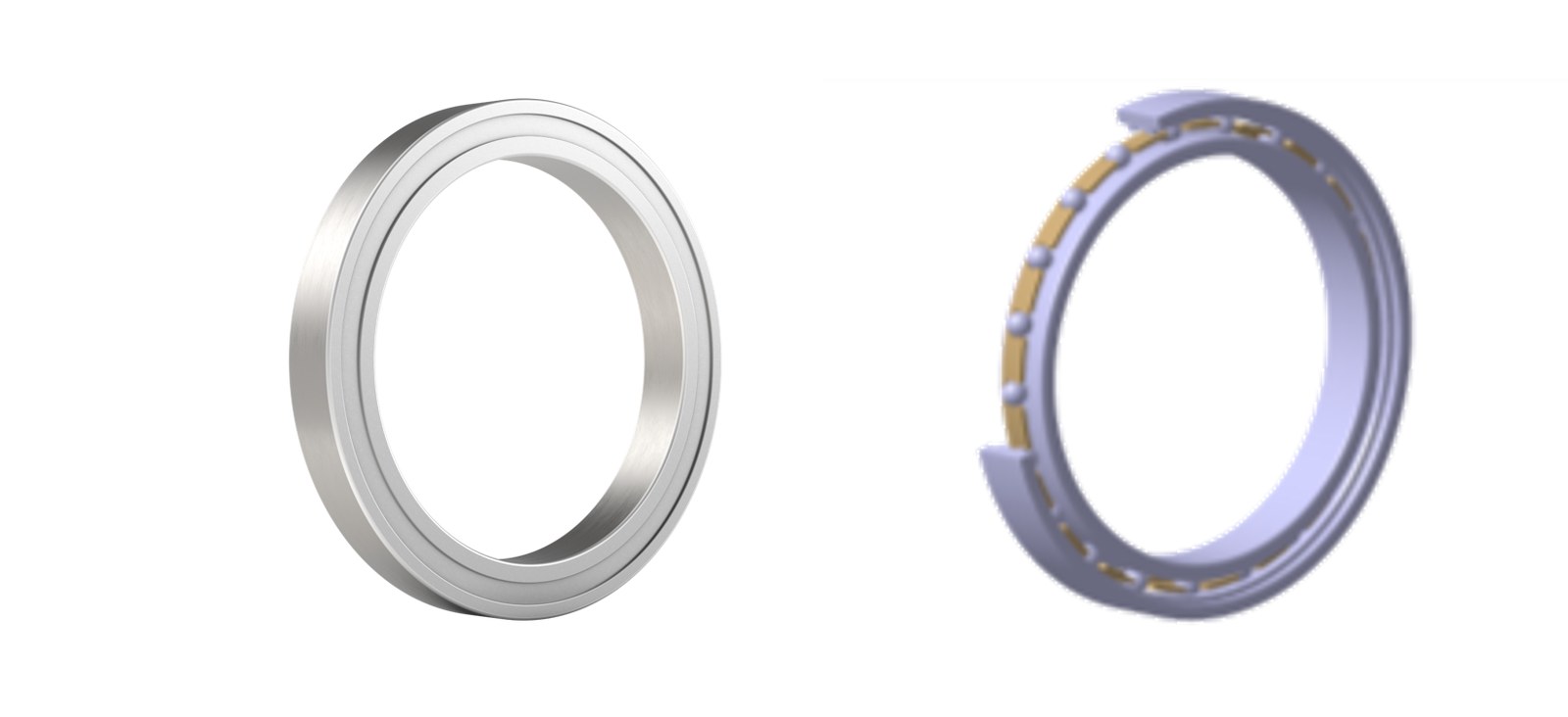
That is where the 67 series comes in. It is the thinnest of NSK's single-row deep groove ball bearings. Against 68 series bearings of the same inner diameter, NSK says the outer diameter is about 5% to 21% smaller, the width about 14% to 43% narrower and the weight about 24% to 65% lower, depending on size. NSK's July technical review described its aim as contributing through both system supply and component supply. The two announcements on the same day put that plan into motion: they position NSK to pursue revenue whether a robot maker eventually buys a complete actuator or sources bearings for an in-house design.
The two 2036 targets are not directly comparable. The US$630m goal covers NSK's entire robot business, while the US$63m goal applies only to the 67 series, and NSK has not said how much it expects complete actuator modules to contribute.
What decides adoption: weight and size, samples and the March 2028 date
Output alone does not settle which joints the units suit. Humanoid designers also need weight and dimensions, because the point of the range is to fit each joint with as light and compact a unit as possible, and NSK has not yet released those figures for the small, large and QDD actuators.
The route to market is samples first. NSK will show the actuators at RoboNext2026 at Intex Osaka from 2 to 4 December, then begin supplying samples in stages. None of the units, including the mid-size pair revealed a year ago, is on the market yet. Under their August memorandum, NSK and Atom plan to fit NSK actuators to Atom's humanoid and use the test results to improve the products and address issues on the path to mass production.
Cost at volume is the remaining condition. NSK has not disclosed prices, and its forecast of several million humanoids is for 2036, so the range's cost competitiveness at production scale cannot yet be assessed from the disclosed information.
Who is affected: robot developers, actuator makers and NSK's own bearing business
For humanoid and four-legged robot developers that plan to buy actuators, NSK is developing rotary, linear and QDD units for most major joints. If they are commercialised as planned, the range could reduce the number of suppliers those developers need.
For developers that build their own actuators, the 67 series offers thinner, lighter bearings. NSK pairs them with greases developed for robot actuators, including types with better durability under small vibrations and types that shed less dust during rotation.
For NSK, humanoids create an additional outlet for bearings and ball screws, products it already supplies widely to industrial robot makers, while actuator sales would move the company further into integrated drive units.
The verdict: a bet that humanoid design stays diverse, still waiting for its numbers
The announcement is best read as NSK preparing for a market in which humanoid designs stay varied for years, with different joints, drive methods and make-or-buy choices. By covering multiple sizes and drive methods while also supplying bearings, NSK is positioning itself to compete across several possible design outcomes.
Whether this approach can support NSK's broader robot business target will depend on three things: the new units' weight and dimensions, their performance in sample evaluations including the planned work with Atom, and whether market launch is achieved by March 2028.