Hybrid Drive Units in India: Toyota Group Raises Capacity to 360,000, with Exports the Test
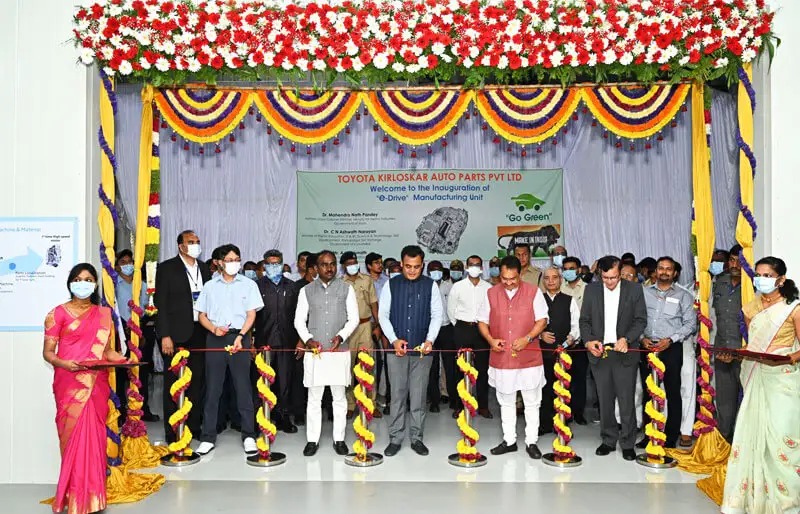
Toyota Kirloskar Auto Parts (TKAP), the Indian component maker backed by Toyota Motor and Aisin among others, opened a new line for its "E-Drive" hybrid drive unit at Bidadi in Karnataka, southern India, on 16 November 2026. The investment of about Rs 4.6 billion lifts annual capacity to 360,000 units, roughly three times estimated Indian hybrid-car sales, based on reported model volumes and market shares. The existing line already supplies the domestic market and exports to Japan and elsewhere, so the question now is output, the models that use the units, and how much is shipped abroad.
Key points
- What was decided: TKAP opened a new line for the fifth-generation E-Drive at its Bidadi plant, following the fourth-generation line
- Capacity and investment: about Rs 4.6 billion adds 200,000 units a year, taking total capacity to 360,000
- The gap: India's hybrid-car sales, back-calculated from press reports, were about 120,000 in FY2025, so capacity is about three times that
- What to check next: first-year output, the models that carry the unit, shipments by destination, and above all export volumes
Total capacity reaches 360,000, with no breakdown of the existing line
TKAP has added a new line with an annual capacity of 200,000 units to the fourth-generation E-Drive line that started up in 2022. The new line runs alongside the existing one. The E-Drive combines a motor and gears and works with the engine to deliver power to the wheels. TKAP was founded in 2002 and is owned by Toyota, Aisin and India's Kirloskar Systems. It has made rear axles, propeller shafts and transmissions.
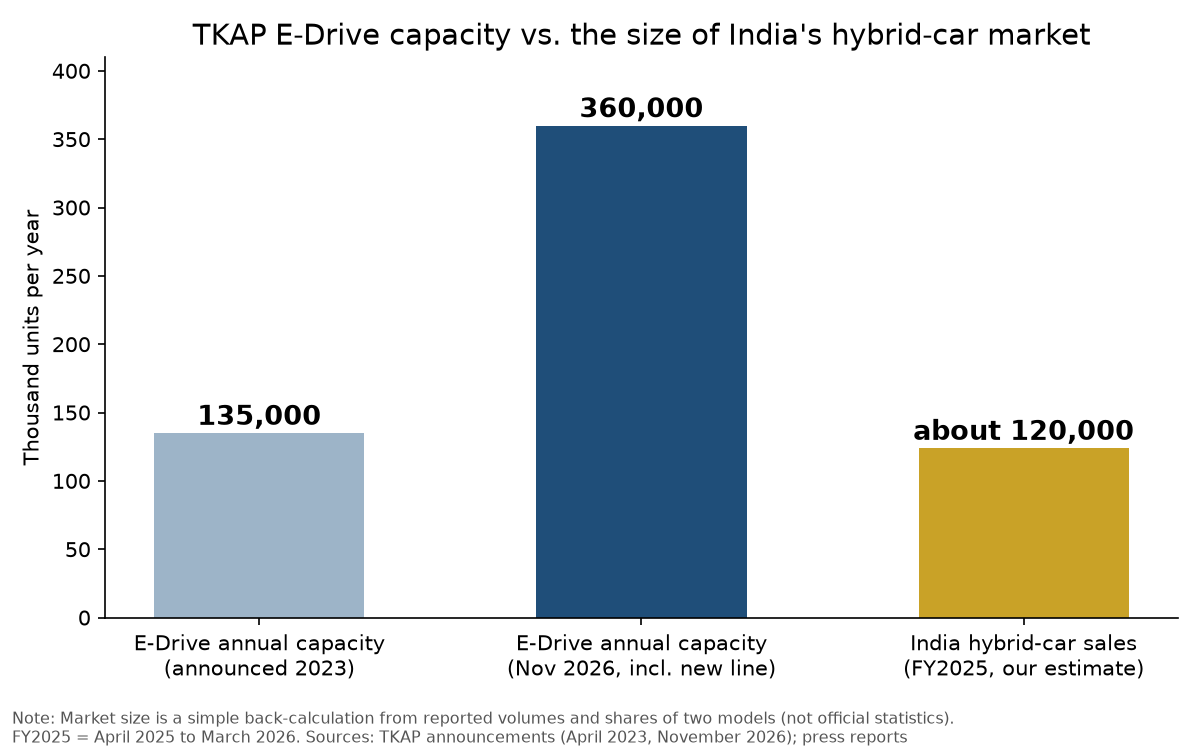
In its April 2023 announcement, the company put the first line's annual capacity at 135,000 units and described it as Asia's first E-Drive production base outside Japan. Subtracting the new line's 200,000 from the combined 360,000 gives 160,000, but that is not a published figure for the existing line. The latest announcement does not explain the 25,000-unit gap from the 2023 figure. Total capacity is about 2.7 times the first line's capacity as announced in 2023 (our calculation).
The 360,000 figure is about three times the reported market size
The scale is easier to grasp against India's sales. According to press reports, in FY2025 (April 2025 to March 2026) Toyota's Innova Hycross multi-purpose vehicle sold 62,586 hybrids, just over 50% of the total. The Urban Cruiser Hyryder SUV sold 35,745, a 28.94% share. A simple back-calculation from those two volumes and shares puts India's annual hybrid sales at about 120,000 (our calculation). This is not an official statistic and does not show actual demand for TKAP's E-Drive, but 360,000 units is about three times that scale.
Toyota hybrid vehicles in India have passed 300,000 units cumulatively, and the company is said to hold about 80% of the strong-hybrid market. Maruti Suzuki's Grand Vitara, Invicto and Victoris share Toyota's hybrid technology, and one report says the two companies together account for more than 90% of hybrid sales. Toyota-group share is high, but which models carry TKAP-built E-Drive units, and in what numbers, has not been disclosed. To judge utilisation, it will be necessary to check not only market growth but also the models served and export volumes.
Where the added capacity will go is not yet disclosed
TKAP has not announced first-year output or the models that will use the units.
The best clue is the role of the first line. At its 2022 start-up and in its 2023 announcement, TKAP said it would not only supply E-Drive units to Toyota Kirloskar Motor (TKM) but also export them to Japan and other Asian countries. In February 2025, Toyota's Indian unit again described TKAP as the first site in Asia outside Japan producing E-Drive for both domestic and export markets. TKM is a vehicle-making joint venture owned 89% by Toyota and 11% by Kirloskar Systems. In the latest announcement TKAP also said the expansion would help reduce import dependence and raise India's standing as a manufacturing base for electrification technology.
Possible future demand includes models that share hybrid technology with Suzuki, and TKM's planned new plant at the Bidkin industrial area in Maharashtra, which is due to start producing a new SUV in the first half of 2029 with annual capacity of 100,000 units. However, the powertrain for that SUV has not been disclosed, and neither Suzuki models nor the new plant have been announced as users of TKAP-built E-Drive. They cannot yet be counted as demand for the 360,000 units.
GST favours EVs, while CAFE 3 gives hybrids a 1.6 multiplier
Indian policy does not treat hybrids uniformly. In the goods and services tax (GST) revision that took effect on 22 September 2025, electric vehicles (EVs) kept a reduced 5% rate. Small hybrid cars fell to 18%, but vehicles longer than 4 metres and similar fall into the 40% bracket that applies to ordinary mid-size and large cars. Executives at Mahindra & Mahindra, a major Indian automaker, have said the government's priority for EVs is now clear.
By contrast, the corporate average fuel economy rules known as CAFE 3, notified at the end of September 2026, will apply from April 2027 to March 2032. Compliance is judged on each manufacturer's fuel economy weighted by sales volume, and in that calculation a strong hybrid counts as 1.6 vehicles (an EV counts as 3). The tax regime relatively favours EVs, while CAFE 3 gives manufacturers an incentive to sell more hybrids.
Locally built PLI-eligible products: the next test is sourcing depth
The new line's product is registered as eligible under the Advanced Automotive Technology (AAT) category of India's production-linked incentive (PLI) scheme for automobiles and auto components. PLI provides incentives tied to increases in production and sales. In its 2023 announcement, TKAP noted that many advanced automotive technology parts are imported because no supply chain exists for them. It said meeting a minimum domestic value addition is one condition for receiving the incentive, which encourages local sourcing.
TKAP Managing Director Tabrez Ahmed said the new line would deepen the local supplier network and help develop a skilled workforce. As E-Drive volumes rise, there may be more room to source its components inside India. The investment is part of a memorandum of understanding worth Rs 48 billion in total, signed between the Toyota group and the Karnataka government.
What the 360,000 units will be used for: actual output and exports will show
The existing line also handles exports to Japan and elsewhere, and the new line may be used for broader supply too. However, the new line's destinations and export volumes have not been disclosed, and 360,000 is equipment capacity, not a production plan. It is too early to call it excess capacity.
The soundness of the investment should be judged by which models use the unit and by how close first-year output, broken down by destination and above all by export volume, comes to the stated capacity once TKAP discloses the figures.