Yaskawa's Robot Margin Sinks to 1.6%: Can It Step Out of the Commodity-Robot Price War?
Japan's Yaskawa Electric saw the operating margin of its robot business sink to just 1.6% in the latest quarter. For a company that ranks among the world's "big four" makers of industrial robots, the core business is barely turning a profit. Group orders, meanwhile, hit their…
Japan's Yaskawa Electric saw the operating margin of its robot business sink to just 1.6% in the latest quarter. For a company that ranks among the world's "big four" makers of industrial robots, the core business is barely turning a profit. Group orders, meanwhile, hit their highest level in 15 quarters. That an order recovery and a profit slump arrived together is what makes the quarter unusual. The 1.6% figure owes much to one-off costs. But the real question is not whether the margin snaps back once those costs fade — it is what Yaskawa intends to rebuild through its new medium-term plan, "Dash 35": the very way its robot business makes money.
Key points
- In the March–May 2026 quarter (Q1 of the year ending February 2027), the robot segment posted revenue of ¥56.7bn but operating profit of just ¥900m — a margin of about 1.6%, down from roughly 9% a year earlier.
- The main causes were disruption from a core IT-system switchover in May (a ¥2.5bn drag on group operating profit) and restructuring charges booked in the European robot business. Both are largely one-off.
- Group orders, by contrast, reached ¥163.8bn, up 29% year on year and the highest in 15 quarters, led by the motion-control segment on the back of AI-related semiconductor demand.
- In "Dash 35", unveiled in May, Yaskawa targets a group operating margin of 15.4% by the year ending February 2030, shifting its centre of gravity towards higher-value work built on physical AI and new actuators.
Orders are booming, yet the robot margin is 1.6%
What stands out is that recovering orders and deteriorating profit appeared at the same time.
Yaskawa Electric's results for March–May 2026, released in July, showed group revenue up 10.6% year on year at ¥139.0bn and orders up 29% at ¥163.8bn, the highest in 15 quarters. A recovery in semiconductor demand tied to generative AI drove the gain, and orders at the motion-control segment — which makes servo motors and controllers — rose for a fourth straight quarter to ¥82.1bn.
Profit, however, did not follow. Group operating profit fell 19% to ¥8.4bn. The robot segment fared worst: on revenue of ¥56.7bn, operating profit was a mere ¥900m, a margin of about 1.6%. With revenue essentially flat (up 2.0%) and operating profit down 82%, that marks a steep fall from around 9% a year earlier.
The company points to two causes. One is the production-and-sales core IT system switched over in May, whose migration disrupted the supply chain and cut group operating profit by ¥2.5bn. The other is restructuring costs booked in the European robot business. Both are largely one-off in character.
Will 1.6% recover, or will thin margins stay?
The question is how far robot profitability returns once the one-off costs are gone.
The size of the fall — from around 9% a year earlier to 1.6% — shows this quarter's figure is amplified by one-off factors; it is too early to treat 1.6% as the normal run-rate.
Whether cost normalisation alone restores adequate margins, however, is another matter. In the year to February 2026, robot revenue of about ¥247bn made the business the group's largest pillar at 47% of sales, yet the segment slipped to a small profit decline even as revenue rose. A shift in product mix squeezed profit: even when volumes hold up, a rising share of thin-margin general-purpose machines drags the whole segment down. Beneath the one-off costs may sit a second layer of low profitability rooted in product mix.
What is really biting is product mix and pricing power
The true source of the thin margin lies not in how many units sell, but in what is sold and at what price.
Six-axis robots for staple tasks such as welding and handling have seen performance gaps narrow, turning them into the main battleground for price competition. Chinese makers are gaining ground here: firms such as Inovance and Estun have risen on the back of their home market and are winning share on price. The margins that Japanese and European makers long held in the general-purpose segment are being steadily eroded.
The cast of competitors has itself changed over the past decade. Germany's KUKA — once ranked alongside FANUC, Yaskawa and Switzerland's ABB among the "big four" — passed into the hands of China's Midea in 2016. In China, the world's largest robot market, the line between foreign and domestic players is itself blurring. Yaskawa's robots are thinly profitable precisely because they sell general-purpose machines inside this pricing squeeze; the more it chases volume, the thinner the margin. Whether it can break out of that is the crux of any earnings turnaround.
Three tests for "Dash 35"
The medium-term plan "Dash 35" (covering the years to February 2030), announced on 22 May, reads heavily as an answer to this structural problem.
It targets a record operating profit of ¥100bn and an operating margin of 15.4% in its final year, to February 2030. The gap with the robot business's current 1.6% is wide — a measure, in reverse, of how much the money-making model needs rebuilding.
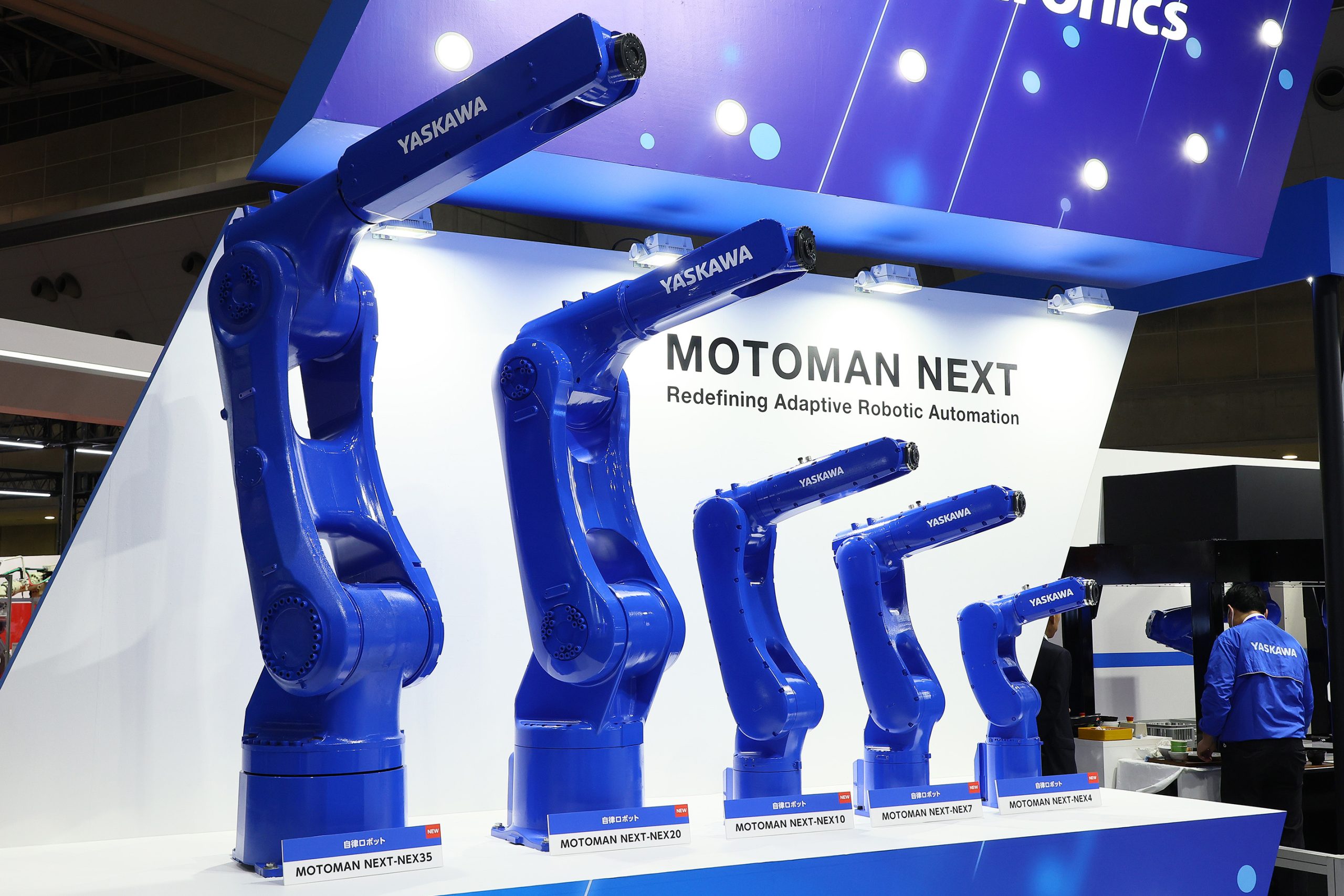
The plan's pillar is "physical AI", which Yaskawa frames as embedding AI in machines that move in the real world. In profit terms, it means shifting the centre of gravity from selling robots as hardware towards higher-value work that combines AI with precise motion control. The autonomous "MOTOMAN NEXT" at its core aims to have AI judge a situation and act, rather than being taught each motion by a human. To this Yaskawa adds its own strength in servo control and newly developed advanced actuators — the drive units that generate motion — targeting new markets that include humanoids.
Yet a fresh concept and actual profitability are two different things. Whether the plan lifts the robot margin can be measured on three tests: first, whether it can hold a price gap over general-purpose machines; second, whether product margins can absorb the up-front AI development burden; and third, when the new markets grow large enough to make up for the scale of the existing robot business. The plan's own description does not yet make this profit path visible.
The numbers that decide it — and the question that remains
The order recovery in motion control buys time for that rebuild. Servos, whose demand is rising for semiconductor-production equipment and the like, are a profit source not easily broken by price alone, and their strength underpins the robot turnaround. How far that earning power translates directly into investment capacity or better robot margins, however, cannot be judged from this quarter's figures alone.
The numbers to watch are few. First, whether the robot operating margin returns to the mid-single digits once the one-off costs fall away in the second half, or stays stuck at a low level. Second, when "MOTOMAN NEXT" and the advanced actuators move beyond concept to show up in results as higher-priced orders.
What Yaskawa must demonstrate is not a vision of physical AI, but when — and how far — that vision will lift its robot business's margin. Whether one of the world's "big four" can climb out of thin profits rests on that single point.