Why Sodick’s AI Data Centre Strategy Matters for India’s Precision Manufacturing Push
The investment boom in AI data centres is beginning to reshape the growth strategy of a Japanese precision machinery maker.
The investment boom in AI data centres is beginning to reshape the growth strategy of a Japanese precision machinery maker.
For Sodick, the opportunity is not simply to sell more machines. The larger opportunity lies in combining ultra-precision machining, injection moulding, automation and after-sales service into integrated production-process solutions.
Sodick is a Japanese precision machinery manufacturer whose core businesses include electrical discharge machining, or EDM, machines, injection moulding machines and food processing machinery. The company will mark its 50th anniversary in 2026. Under its new medium-term management plan, “Grow Forward 2029”, Sodick aims to achieve sales of 100 billion yen, operating profit of 10 billion yen and an operating margin of 10% in the fiscal year ending December 2029.
But the plan is not only about scale.
Sodick is trying to move away from a traditional model centred on selling EDM machines or injection moulding machines as standalone equipment. Instead, it wants to cover a wider range of customer processes, including machining, moulding, material handling, measurement and maintenance.
The clearest entry point for this shift is demand linked to AI data centres.
As generative AI expands rapidly, global investment in servers, semiconductors, cooling systems and power infrastructure is rising. Sodick is not looking only at the servers themselves. It is targeting the precision manufacturing demand behind high-speed optical communication components.
Behind AI infrastructure, optical connectors require extreme precision
When data centre investment is discussed, attention usually turns first to GPUs, servers and power systems. In reality, however, massive data transmission also depends on increasingly dense optical communication components.
One key component is the MT ferrule, a core part of optical connectors. It holds and precisely aligns multiple optical fibres. As optical connectors move towards higher-density multi-fibre configurations, the accuracy of micro-hole positions, pitch and shape directly affects connection performance.
In other words, mould precision is directly reflected in the quality of the moulded component.
This is where Sodick sees an opening. The company combines small-hole EDM machines, ultra-precision wire-cut EDM machines and high-precision injection moulding machines to offer a solution for MT ferrule production. The process covers micro-scale mould machining, resin moulding, automatic part removal, gate cutting and automated alignment.
This is not a proposal for a single machine. It is a proposal for an entire production process.
That direction shows Sodick’s ambition to turn its business into a solution-based model. The company does not only want to sell machines; it wants to become embedded in customers’ core production processes.
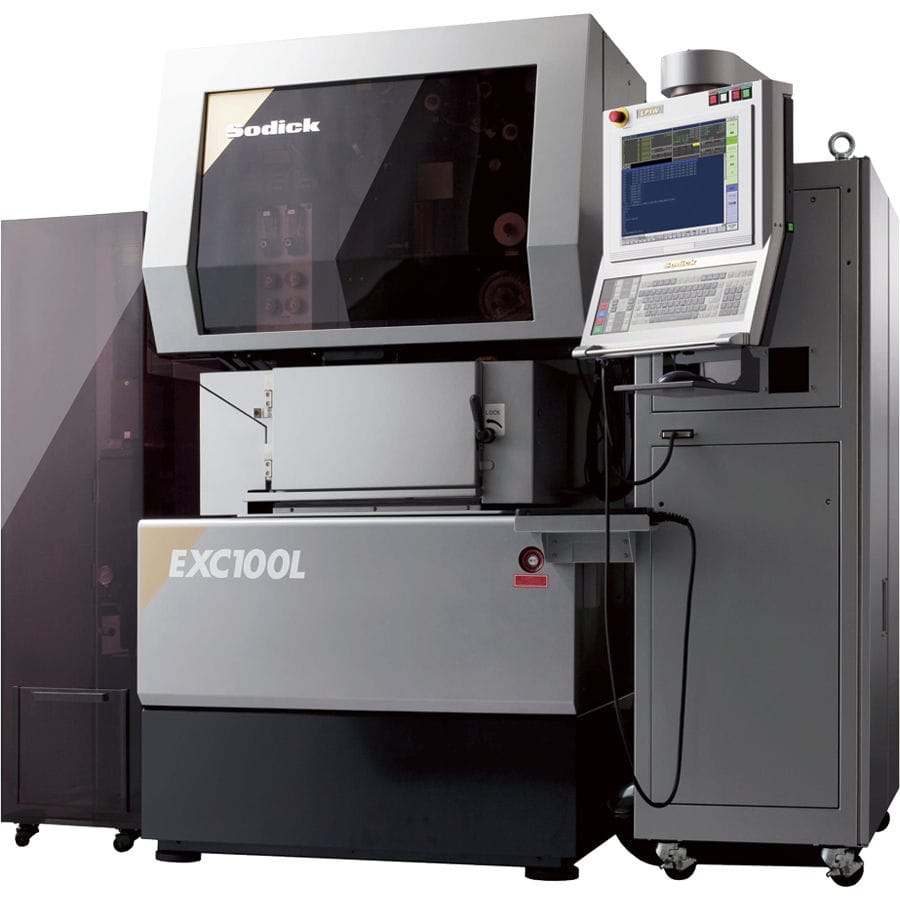
In the first quarter of fiscal 2026, Sodick posted consolidated sales of 21.624 billion yen and operating profit of 1.778 billion yen. Its machine tool business was the main driver of growth. The ultra-precision wire-cut EDM machine “EXC100L+” is positioned to support nano-level machining for optical connector production used in data centres.
However, the sharp increase in net profit cannot be explained solely by demand in the core business. In addition to improved operating profit, foreign exchange gains and gains from the sale of fixed assets also supported earnings.
The key question, therefore, is not only whether quarterly numbers look strong. It is whether Sodick can raise its underlying profitability after excluding temporary factors.
Rebalancing away from China and focusing on high-value applications
To understand Sodick’s new growth strategy, it is necessary to look at how the company is repositioning its China business.
In the past, Sodick grew on the back of expanding demand in China. At the same time, high dependence on that market and declining production efficiency became major challenges.
In its medium-term plan, the company states that it will optimise production scale in China, restructure its workforce and shift towards higher value-added machine models.
This does not mean Sodick is exiting China.
Rather, the company is moving from volume-driven markets towards applications that can generate stronger margins. AI data centres, semiconductors, aerospace, energy, medical devices and robotics are all fields that require high precision and are less vulnerable to simple price competition.
China remains part of Sodick’s strategy. But the way the market is viewed is changing, from scale-first to profitability-first.
Yuji Akutsu, Sodick’s new president, has long experience in the company’s US sales operations. The company has also described the management change as part of a broader effort to reduce overdependence on China and rebuild its production and sales structure.
The next question is how Sodick will balance North America, Europe, China and Japan. At the same time, India is one of the markets where this shift could become particularly important.
For India, the relevance is clear. The country is trying to move beyond assembly-led growth and build deeper capabilities in electronics, automotive components, precision tooling, medical devices and food processing. As global companies diversify supply chains and expand production outside China, demand for high-precision machine tools, automation and technical support is likely to rise.
But in emerging manufacturing markets, simply selling a high-performance machine is not enough.
Many factories face shortages of skilled operators, inconsistent process quality and limited maintenance capability. For Indian suppliers trying to move from assembly to precision component manufacturing, process stability and operator-independent quality will become increasingly important.
What customers need is broader support: machining conditions, jigs and fixtures, automation, remote assistance, training and maintenance.
Sodick’s integrated production-process solution model fits that kind of market requirement.
Machine tool business targets a 14% margin
In Sodick’s medium-term plan, the machine tool business remains its largest pillar. The company aims to raise sales in this segment to 71 billion yen by fiscal 2029, with segment profit of 10.2 billion yen and a margin of 14%.
By comparison, in fiscal 2025, the segment generated sales of 59.1 billion yen, segment profit of 5.6 billion yen and a margin of 9.6%. Raising the margin from 9.6% to 14% cannot be achieved simply by selling more machines.
Sodick needs three changes.
First, it must deepen its high-precision and high-repeatability technologies. In AI data centre and semiconductor applications, even small deviations in machining can affect yield. Technology that reduces dependence on operator experience and stabilises machining conditions becomes a key source of value.
Second, it must integrate production processes. Customers do not need only machining equipment or EDM equipment. They need systems that link material handling, measurement, moulding and downstream processes. If a supplier can help shorten production ramp-up, that becomes an important factor in investment decisions, especially in factories facing labour shortages.
Third, Sodick must strengthen its after-sales business. Machine sales are exposed to economic cycles. If remote support, maintenance, consumables and training can be converted into recurring revenue, Sodick can reduce the volatility of an order-driven business.
What Sodick is trying to become is not a supplier whose role ends when the machine is delivered. It wants to become a partner that continuously supports machining quality and machine utilisation.
Food processing machinery as a third pillar
Another area to watch is food processing machinery.
Sodick aims to grow this business to sales of 10 billion yen by fiscal 2029, with segment profit of 1.3 billion yen and a margin of 13%. In addition to noodle-making equipment and aseptic packaged rice production systems, the company is expanding into confectionery, bakery products and ready-to-eat meals.
This direction makes strategic sense.
As dual-income households and single-person households increase, demand for ready-to-eat meals, frozen foods and convenient processed foods is expanding. Food factories need more labour-saving equipment and higher standards of hygiene management.
Compared with machine tools, food processing machinery is less exposed to economic cycles. It therefore has the potential to become a stabilising pillar for Sodick’s earnings.
In June 2026, Sodick’s continuous vacuum cooling system won an Excellence Award at FOOMA AWARD 2026. The equipment helps food products pass quickly through temperature zones where bacteria can easily grow, using continuous vacuum cooling.
Compared with batch-type systems, such equipment can reduce labour requirements and help lower the risk of foreign matter contamination and secondary contamination.
In the short term, however, the food machinery business is not free from pressure. In the first quarter of fiscal 2026, slower sales of packaged rice production equipment weighed on the segment.
Over the medium to long term, the business has growth potential. But in the near term, performance will still depend on the timing of large equipment orders and the degree of concentration in specific applications.
For India, this area is especially relevant. The country’s food processing industry is moving from fragmented operations towards more standardised industrial production. Equipment that improves hygiene, cooling, automation and process control could become increasingly important as the sector modernises.
If Sodick wants to make food processing machinery a stable earnings source, it will need to broaden the business from noodles and rice into bakery, ready-to-eat meals, cooling systems, washing systems and inspection systems.
M&A as a way to fill missing capabilities
Sodick has also set aside a strategic investment framework that includes M&A. The aim is to acquire capabilities that are difficult to build only by extending existing businesses.
Possible target areas include next-generation NC systems, IoT, remote maintenance, automation systems, technologies around food processing machinery and digital talent. These capabilities are essential for moving from standalone machine sales to integrated production-process solutions.
But M&A is not a magic tool.
For a mid-sized machinery maker, post-acquisition integration is difficult. Even if the company acquires good technology, the impact will be limited if that technology cannot be connected to existing sales networks, service systems and development capabilities.
The key question for Sodick is not simply which company it will buy. It is how acquired technologies and people can be embedded into its solution framework across machine tools, industrial machinery and food processing machinery.
Can a demand boom become recurring revenue?
At first glance, Sodick’s medium-term plan looks like a growth story riding on AI data centre demand. But the core issue is not simply chasing a short-term demand surge.
Demand related to data centres is large, but investment cycles can fluctuate. If equipment investment for optical communication components slows temporarily, demand for machine tools could also be affected.
That is why Sodick needs to use high-precision manufacturing as its core and shift its business model towards supporting the customer’s entire production process.
In May 2026, Sodick also disclosed unauthorised access to the company’s servers. The company said it had not confirmed any serious impact on operations. But as remote support and data utilisation become more important, cybersecurity will no longer be just an IT department issue. It will become part of the business infrastructure.
The targets of 100 billion yen in sales and 10 billion yen in operating profit are clear. But the more important question is not whether Sodick can achieve a 10% operating margin in the short term.
The real issue is whether it can improve earnings stability through after-sales service, production-process solutions and food processing machinery, while its machine tool business remains exposed to cyclical swings.
Sodick has captured the growth momentum created by AI data centres.
The next test is whether it can turn that momentum into a business structure capable of generating sustainable revenue.