Tenfold Accuracy, Aimed at Dedicated AM Machines: FANUC Adapts a Machining Robot for Large-Format Metal Additive Manufacturing
Japan's FANUC has adapted its high-precision "M-800 Series" machining robot for metal additive manufacturing (AM) — the process of building parts by melting metal and depositing it layer by layer. The company has raised the robot's rigidity and absolute accuracy while leaving…
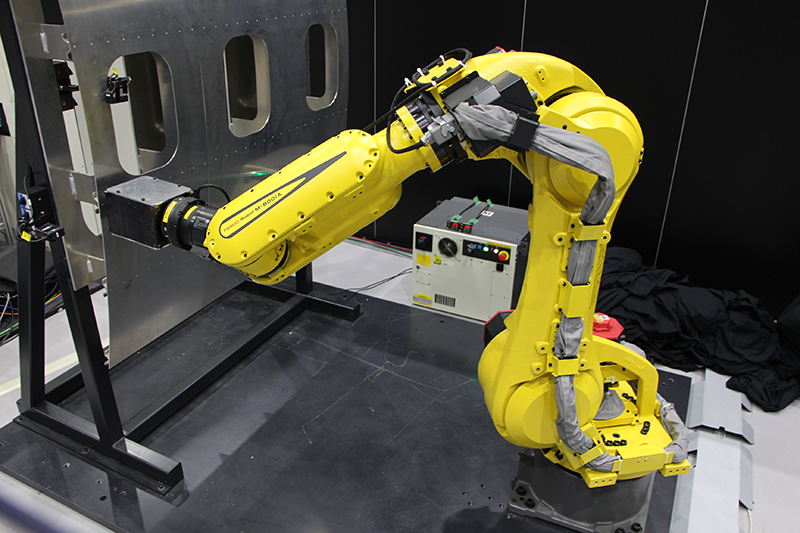
Japan's FANUC has adapted its high-precision "M-800 Series" machining robot for metal additive manufacturing (AM) — the process of building parts by melting metal and depositing it layer by layer. The company has raised the robot's rigidity and absolute accuracy while leaving the deposition itself to a third-party tool. The target is large parts with complex geometries that dedicated AM machines struggle to handle. Yet better positioning accuracy is only one of the factors that determine final part quality, and how far a robot can move into territory long held by dedicated equipment is the real question.
Key points
- FANUC has adapted its "M-800 Series" machining robot for metal AM, pairing it with a third-party directed energy deposition (DED) tool — which melts metal powder or wire with a laser — and proposing it as an integrated system.
- The robot's absolute accuracy has been raised roughly tenfold from the company's previous products, to ±0.1 mm; path accuracy along straight lines and arcs also reaches ±0.1 mm.
- Where dedicated machines are limited to parts that fit on a build platform, the wide reach of a robot arm is aimed at large components with complex geometries.
- The deposition tool is external; the precision, rigidity and control are FANUC's own. How overall system quality is assured becomes the strategic question.
- The accuracy gain is a precondition, not a guarantee: deposition speed, build quality and material stability still have to be proven on production parts.
A machining robot paired with a third-party DED tool
What FANUC has developed is a metal AM system built around the "M-800 Series", a six-axis vertical articulated robot. The directed energy deposition (DED) tool — which uses a laser to melt metal powder or wire and build it up — is sourced from another maker; the robot moves that deposition head to lay down metal layer by layer.
The robot itself has been substantially upgraded. Through a proprietary analysis method and calibration technology that measures and corrects the individual variation of each robot, the company says it has achieved high rigidity and ±0.1 mm absolute accuracy — roughly ten times the absolute accuracy of its previous products. Path accuracy, as the tip traces straight lines and arcs, also reaches ±0.1 mm. Kenichiro Abe, senior managing executive officer, says that high-precision metal AM is possible even for parts with complex geometries "through simple teaching by numerical input alone".
The M-800 began as a machining robot for cutting and grinding — work that removes material. FANUC has now extended it to the additive side and set its sights on large components with complex geometries.
Bringing machining-grade accuracy to a deposition process
Accuracy has long been the weak point of using a robot for machining. An articulated structure flexes, so the commanded position and the actual position tend to drift apart. This is where "absolute accuracy" matters. Distinct from repeatability — how faithfully the same motion is reproduced — absolute accuracy refers to how close the tip actually comes to the commanded coordinates. The higher it is, the more the robot can follow the numbers on the drawing without hand-fitting adjustments. The roughly tenfold gain, together with correction for individual variation, reduces trajectory adjustment and makes teaching by numerical input alone more practical.
This, though, concerns only the accuracy of moving the tip to a targeted position. The dimensions and build quality of the finished part — formed by melting and depositing metal — are governed by the DED process itself. The accuracy gain supports high-quality metal AM as one condition among several; it does not by itself determine how the part turns out.
Why a robot rather than a dedicated machine
Most metal AM is done on dedicated machines that move an energy source or material feed across a build platform. Build quality tends to be stable, but part size is confined to what fits inside the machine. A robot arm, by contrast, has a wide working envelope and more freedom of movement. Even for large parts, or parts whose surfaces face in many directions, the arm can change its pose and apply the head without being constrained by angle. That is the gap FANUC is exploiting by targeting the large, complex geometries that dedicated machines handle poorly.
The market may add momentum. Japan's Ministry of Economy, Trade and Industry projects that by 2040 the metal AM market will expand to roughly four times its 2025 size at the low end — about €14.9bn — and about ten times, roughly €42.5bn, at the high end. Metal AM is not set to replace cutting, casting and forging wholesale, but to take on the complex shapes and low-volume parts those methods handle poorly. What the robot targets within that is the large, high-value, low-volume work that dedicated machines cannot accommodate by size. Applications are moving from prototypes towards production parts: a subsidiary of Sodick, for one, has developed a metal-AM surface-treatment system for automotive brakes.
Tool outside, precision inside — who owns the integration?
The telling point in this arrangement is that FANUC does not supply the DED tool itself; it combines a third-party tool and offers the result as a system. The core deposition technology is left to an outside supplier, while FANUC creates value through the precision, rigidity and control that are its own strengths. The flip side is that, by not owning the tool that largely governs build quality, it faces the question of who takes responsibility for matching the two and assuring the quality of the whole system. Higher robot accuracy does not, on its own, settle how the metal AM system performs.
For existing M-800 users, the same robot could in principle be redirected from cutting to metal AM. But that requires adding a DED tool and developing the deposition parameters, and machining equipment cannot necessarily be repurposed for AM without further work. This is better treated as a challenge still to be verified than as an established advantage.
What to watch: turning path accuracy into stable part quality
DED's practicality turns on deposition speed, build quality and the range of usable materials. Even with higher robot accuracy, how stable the melting-and-solidification process remains, and how far part-to-part variation can be suppressed, will only be clear from a track record on production parts. The focus is on those three — speed, quality and materials — and each is decided not by the robot alone but by its pairing with the DED tool.
In the end it comes down to a single point. Can ±0.1 mm of tip-path accuracy be turned into stable dimensions and quality in production parts? How well FANUC's robot accuracy and a partner's deposition process can be made to mesh as a system is where the answer lies.