Protecting Safety with Pointing and Calling
POINT: You only realize the value of safety after an accident occurs. "Pointing and calling" originally started as a safety action by drivers of the former Japanese National Railways; it is a work confirmation action immediately before work to protect safety. Even knowing it's a…
Q
Leader Koishi is racking his brains over how to ensure thorough confirmation in on-site operations. He gives specific warnings every day until he is hoarse, but he cannot eradicate misunderstandings and careless mistakes. Recently, an operational error nearly caused a major accident.
A
An effective method in this case is "Pointing and Calling" (Shisa Kosho).
(1) Confirm firmly at key points of the work
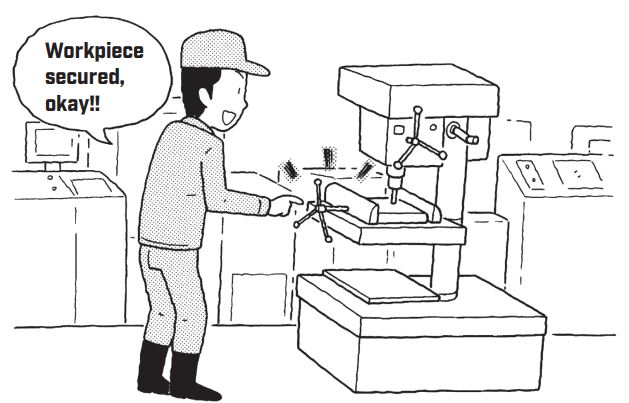
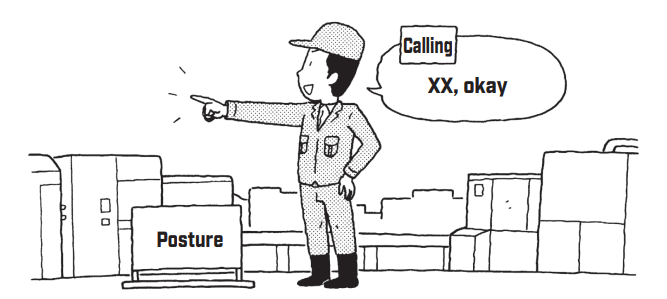
Workers gaze at the object they need to confirm at key points in their work, point firmly, and call out loudly to confirm, for example, "Lathe, workpiece secured, okay!"
(2) Make it a habit for everyone
Train everyone to tackle it together, blowing away any feelings of hesitation, until the habit of doing it proactively is acquired. It is good to follow the next steps.
① Confirmation of the significance and method of pointing and calling
Significance: It is a method to prevent errors by concentrating consciousness through vision, pointing action, vocalization, and hearing to confirm at key points of work.
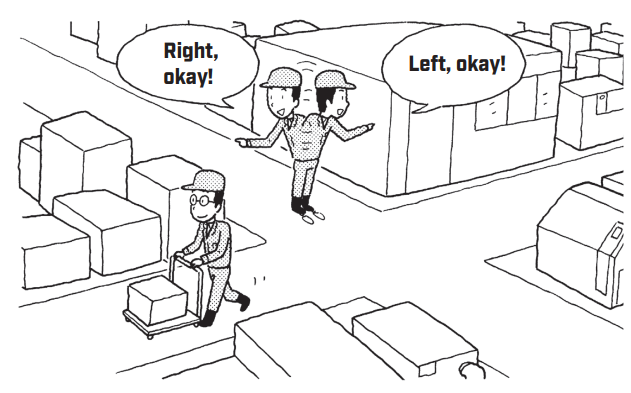
Method: Confirm, correct your posture, point clearly at the object, tighten your stomach, and briskly point and call out as loudly as possible, "XX, okay!"
② Selection of key points of work
Select key points of work that are problematic, such as areas prone to omission of confirmation. It is best to decide on these together with all on-site workers.
③ Demonstration of a model by a representative
④ Implementation by each person
If inadequate, make them redo it. Then, patiently repeat the training until everyone can do it with confidence. To ensure thoroughness, the factory manager must show a resolute determination, and the entire workplace must implement it. It may also be good to appoint a loud-voiced subordinate as an execution leader. Even after it has taken root, conduct occasional checks.
Commentary
(1) How to read "Shisa Kosho" (Pointing and Calling)
Depending on the workplace, it is pronounced "shisa koshō" or "yubisashi koshō". It is also called Shisa Kanko or Shisa Shoko.
(2) Necessity of confirmation
Humans are animals prone to making mistakes due to assumptions and misunderstandings. Especially as they get used to things, it becomes a rut and confirmation becomes negligent. When a worker starts their work, a firm confirmation action is necessary.
(3) Effects of pointing and calling
It is a good confirmation action that each worker does when facing their work to prevent operational errors. It prevents malfunctions in the thinking and judgment circuits in the brain. Immediately before work, not only by visual confirmation but also by pointing, one strongly focuses their consciousness on the target, further vocalizes it, and confirms that voice audibly. Multiple neural circuits are mobilized to firmly confirm.
(4) Reliability of pointing and calling
According to some statistics, there is data showing that compared to confirmation by visual inspection alone, calling out aloud halves the errors, and furthermore, adding a pointing action to the calling reduces errors to one-fourth. Of course, pointing and calling alone does not result in 100% reliability. Along with the promotion of pointing and calling, we must not forget to improve the level of safety awareness.
Yasuhiko Inoue (Professional Engineer (Chemistry, Comprehensive Technical Management))