Okuma Launches a Three-Year Plan to Rebuild Earnings with High-Margin Machines and Service, Physical AI Next
Okuma has launched a three-year business plan running to the year ending March 2029. With labour shortages shifting demand from mass-production machines towards those that consolidate processes and run with less staffing, the company plans to raise the share of high-margin…
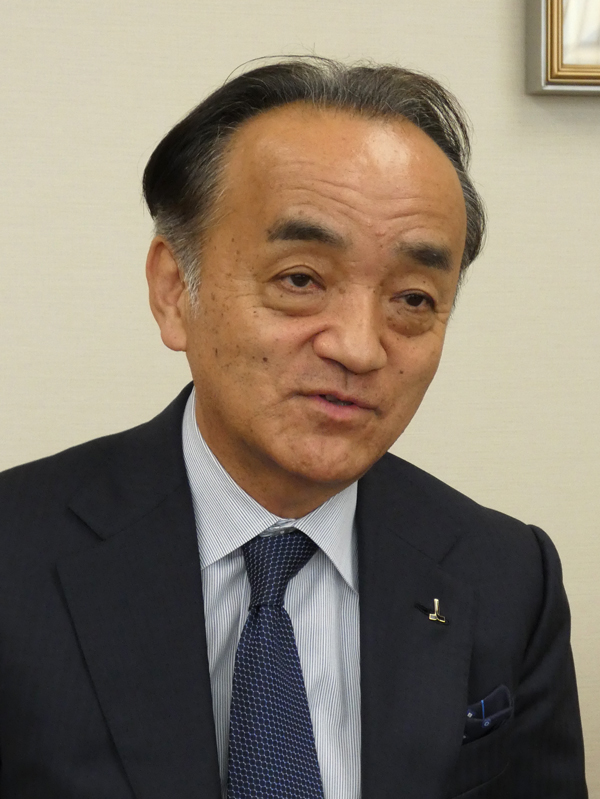
Okuma has launched a three-year business plan running to the year ending March 2029. With labour shortages shifting demand from mass-production machines towards those that consolidate processes and run with less staffing, the company plans to raise the share of high-margin machines such as five-axis and multitasking models, and build up after-sales service revenue, to remake an earnings structure long exposed to market swings. It targets consolidated sales of ¥270bn (¥235.8bn in the year ended March 2026) and a return on equity (ROE) of 8% or more (from 5.3%). It frames physical AI — where AI autonomously controls equipment — as a step towards the broader goal of automating the whole machining process. In an interview, president Atsushi Ieki set out how he reads demand, the plan's direction, and the outlook for using AI.
Key points
- The plan rests on "customer-centric value creation" and "rebuilding the business base," targeting sales of ¥270bn, ROE of 8% or more, and a dividend payout ratio of 35% or more.
- Labour shortages and rising precision are shifting demand from mass-production machines to process-consolidating, automated ones; a higher share of five-axis and multitasking machines is the starting point for the earnings improvement.
- Over the plan, the earnings improvement rests on selling more high-margin machines and strengthening after-sales service; Okuma will bring its new US repair plant into full service in 2026.
- Physical AI is a medium-to-long-term move to build competitiveness: aimed at autonomy across the machining cell and process, with people handling requirement definition and final verification for now.
- Okuma has joined Noetra (Shibuya, Tokyo), which is developing a domestic physical-AI foundation model, as one of its investors.
Demand shifts from mass production to "machines that maintain accuracy without operators"
Ieki describes current demand as "a different mode from before, where changes in industrial and social structure overlap." Across growth areas — aerospace, shipbuilding, AI data centres (DCs), humanoid robots — the requirements of manufacturing are changing: precision demands rise while the workforce on the floor shrinks.
What is needed, he says, is not a plain mass-production machine but one that consolidates multiple processes into a single unit and, through automation, holds stable precision without an operator present. For Okuma, that shift works to raise the sales share of its high-margin five-axis and multitasking machines.
The Japan Machine Tool Builders' Association (JMTBA) reports that monthly orders remain at record-high levels. But what drives Okuma's earnings is less the sheer size of total demand than how far demand moves to high-margin machines. Ieki sees "the most advanced machines from Japanese makers becoming important, and the tailwind continuing."
Lifting ROE from 5.3% to 8%-plus through product mix and service margins
The plan's two themes are "customer-centric value creation" and "rebuilding the business base." Capturing growth industries and customer needs, Okuma aims, in Ieki's words, "to grow faster than the wider economy, or at least to withstand the swings even if demand weakens."
The targets: consolidated sales of ¥270bn (up 14% on the year ended March 2026) and ROE of 8% or more (from 5.3%) by the year ending March 2029, with a dividend payout ratio of 35% or more.
Lifting ROE from 5.3% to 8%-plus will take more than a 14% rise in sales. The design is to raise margins — and thus capital efficiency — by improving the product mix towards high-margin machines and by smoothing revenue through service. High-margin machines address the mix, service the stability of income; together they feed the margin and ROE improvement.
Earning after the sale: localising repair to hold the post-installation relationship
The two drivers of the earnings improvement are product and service. One is expanding sales of high-margin machines such as five-axis and multitasking models. The other is strengthening after-sales service; Ieki says the company "will bring its new US repair plant into full service in 2026."
Okuma has invested about ¥3.7bn to build and start up a "Global Repair Center" at its US subsidiary in North Carolina to repair spindles and other core parts. Localising repair shortens shipping time and equipment downtime and helps sustain customers' maintenance contracts. Beyond one-off repair sales, whether it can maintain customer relationships after installation — and capture parts-replacement and renewal demand — is the focus of the earnings-structure shift. In an industry with large capital-spending cycles, layering steady maintenance income onto machine sales can also cushion earnings swings.
Physical AI as cell-wide autonomy: turning skilled knowledge into a "systems contest"
Physical AI, where AI autonomously controls equipment, is drawing attention in the machine-tool industry too. Ieki frames it as "a decisive tool for raising productivity as the working population and skilled workers decline, one that draws out the latent capability the shop floor already has."
The aim, though, is not the machine alone but autonomy across the whole — from setting cutting conditions, to detecting and correcting anomalies during machining, to transferring work to the next process. Targeting the entire machining cell, rather than the intelligence of a single machine, is what sets it apart. Building on years of work on autonomous, intelligent machine tools, Okuma is widening the scope. For now, people handle the requirement definition of the tasks assigned to AI and the final verification of outputs, and the company is promoting an "accountable AI" grounded in accumulated engineering knowledge.
If skilled knowledge can be embedded in control software, competition can shift from the performance of a single machine to integrated systems that guarantee the machining result. Combining hardware strength with the shop floor's skilled knowledge is a Japanese-maker advantage — but whether it can be turned into pricing power or recurring revenue is a separate question.
What to watch: the line drawn with a shared AI base, and whether the earnings transformation is delivered
Autonomy is hard to complete alone. Okuma has joined Noetra (Shibuya, Tokyo), which is developing a domestic physical-AI foundation model, as one of its investors. Noetra is backed by 44 companies including SoftBank, Sony Group, NEC and Honda; its work has been selected for a foundation-model development project run by the Ministry of Economy, Trade and Industry (METI) and the New Energy and Industrial Technology Development Organization (NEDO), and it aims to build a multimodal foundation model that handles real-world information — images, sound, physical properties — in an integrated way. Ieki calls building "a trustworthy AI infrastructure that protects customers' vital knowledge" something "no single company can do alone." Whether Okuma can use a shared base while protecting the machining data and skilled knowledge that are its competitive edge — where it draws the line between shared and proprietary — will also shape the outcome of its physical-AI strategy.
The checkpoints are clear. In coming results, the mix of five-axis and multitasking machines, service revenue and its margin, the operating-profit margin, and the trend in invested capital will gauge the plan's progress. For physical AI, the question is whether it moves beyond demonstration to installation on commercial machines, unit numbers, and maintenance and software revenue. Near-term ROE improvement rests on high-margin machines and service; physical AI's contribution to earnings comes later. Whether Okuma can move from a cyclical business of selling machines to one that keeps monetising maintenance and autonomy after installation — ROE of 8%-plus will be the first test of how far that shift has gone.