NSK-NTN Merger: Japan's Bearing Makers Plan to Deliver 70% of Synergies Before Integrating Domestic Production
Japan's NSK and NTN, two major bearing makers, signed the final agreement for the NSK-NTN merger, a business integration under a joint holding company, on 20 November 2026. They target about US$315m–380m in additional operating profit in the year to March 2031. Yet the integration of their production functions in Japan is targeted for April 2032, after that target year. The question is how far they can advance procurement and logistics reforms and make more effective use of production sites, which are expected to deliver 70% of the gains, before then.
Key points
- What was decided: A joint holding company, NSK-NTN Ltd., is scheduled to be set up in October 2027, with NSK naming the CEO and NTN the co-CEO
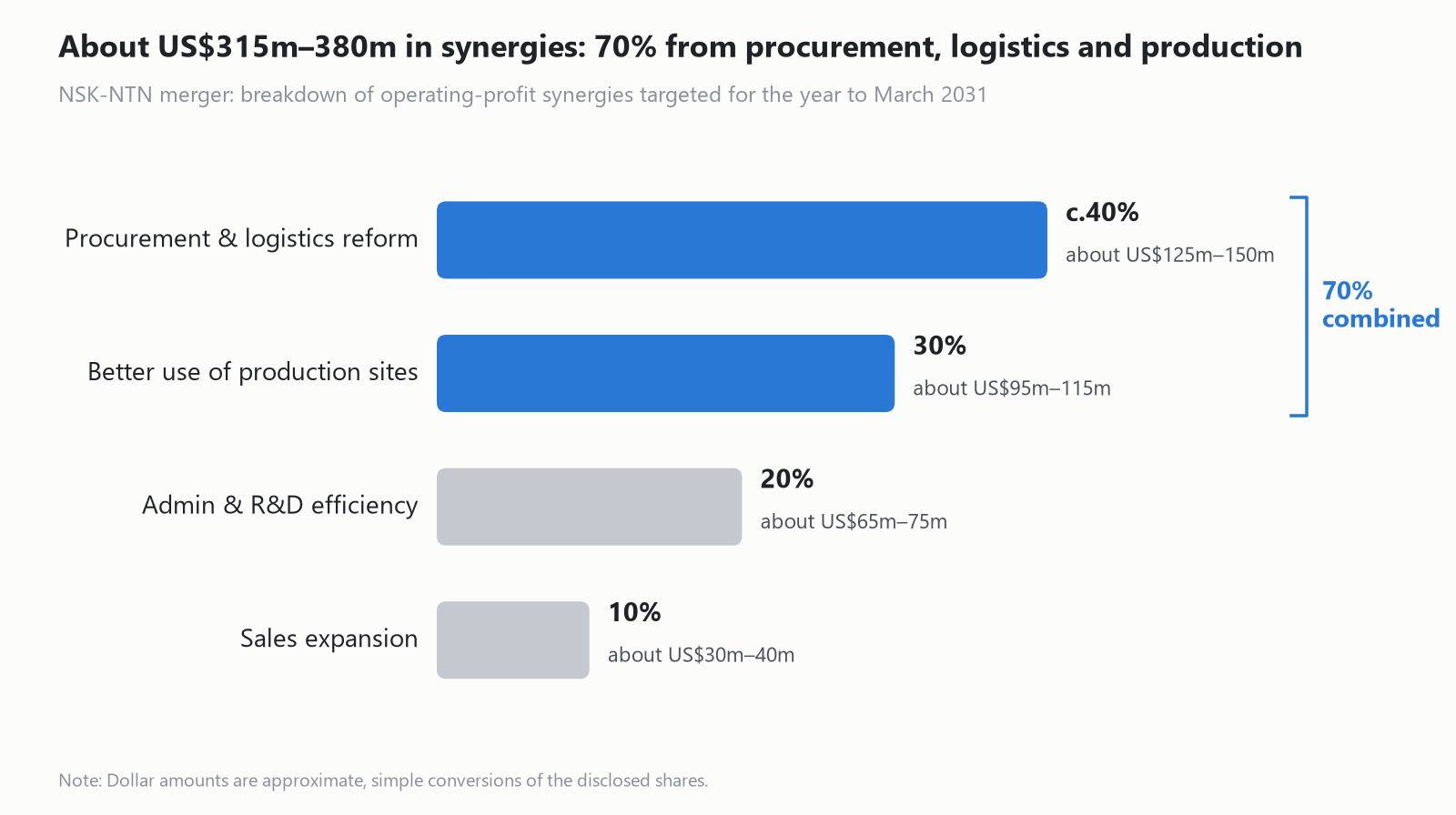
- What the synergies consist of: About US$315m–380m in additional operating profit in the year to March 2031, 70% of it from procurement, logistics and production sites
- The gap: The companies target April 2032 for integrating production functions in Japan, after the synergy target year
- What to watch: Concrete procurement and logistics measures, and the scope, timing and financial contribution of production transfers
The ratio and timetable are set, and NTN now names a co-CEO rather than a vice-president
When the two companies signed a Memorandum of Understanding on 12 May 2026, they left the share transfer ratio and the name of the holding company to be decided later. Under the final agreement, NSK shareholders will receive one holding-company share for each NSK share, and NTN shareholders 0.353 shares for each NTN share. A simple calculation based on the number of shares to be issued suggests that former NSK shareholders will own about 70% of the holding company and former NTN shareholders about 30%.
The companies have also disclosed the size and make-up of the expected synergies and a phased integration timetable. The management structure has changed as well. At the memorandum stage, NTN was to nominate a vice-president. Under the final agreement, NTN will instead nominate a representative executive officer serving as co-CEO. NSK President Akitoshi Ichii is due to become CEO and NTN President Eiichi Ukai co-CEO, and NTN will also nominate the chair of the board. The holding company, whose English name is NSK-NTN Ltd., plans to apply for a technical listing on the Prime Market of the Tokyo Stock Exchange, a streamlined procedure for a new holding company that takes the place of listed companies.
Synergies equal 70–90% of current operating profit, a scale aimed at improving profitability
In the year to March 2026, NSK posted operating profit of about US$245m and NTN about US$195m, a simple combined total of about US$440m. Synergies of about US$315m–380m work out at 72–86% of that figure. The official baseline for the synergies is combined operating profit in the year to March 2028, immediately after the holding company is established, so this ratio is only a guide.
The two companies cite slowing growth in China, weakness in European manufacturing and uncertainty created by US tariff policy, and say they are aiming for long-term profit growth rather than greater scale. A simple calculation from sales and operating profit puts NSK's operating margin at about 4.3% and NTN's at about 3.8%. At those levels, the deal appears aimed more at improving profitability than at adding scale. Bearing output in Japan was 2.3 billion units in 2025, down 13% over three years, according to Japan's Ministry of Economy, Trade and Industry.
Adding the full synergies to results for the year to March 2026 would lift the combined operating margin from about 4.0% to 6.9–7.5%. That is a simple estimate that ignores sales growth and integration costs, and the two companies also use different accounting standards (NSK reports under International Financial Reporting Standards, NTN under Japanese standards). Their official financial target is a return on equity (ROE) above 10%.
70% of the NSK-NTN merger synergies are planned before domestic production is integrated
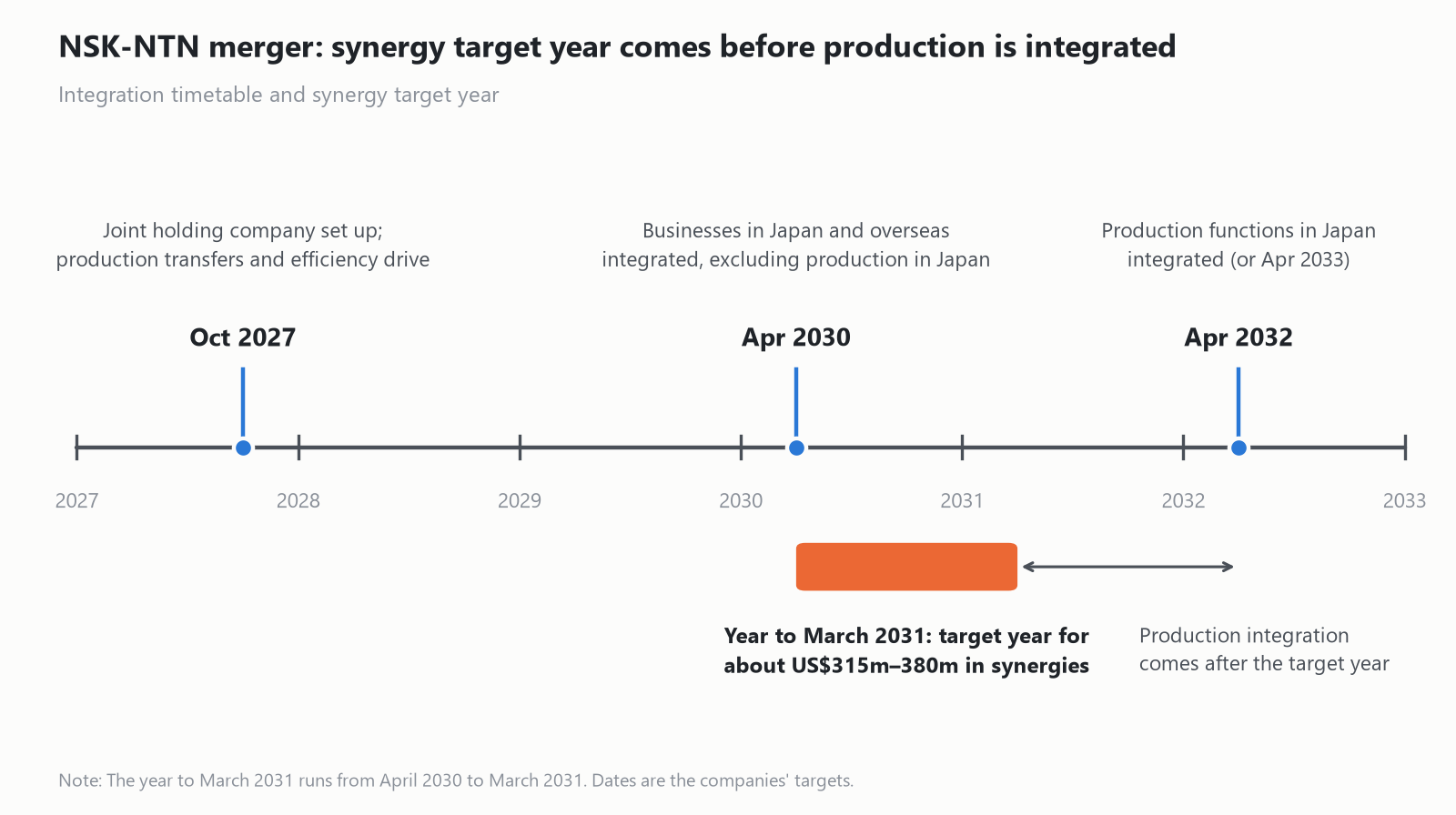
The integration will proceed in three stages. The holding company is scheduled to be established in October 2027, subject to the required approvals. By April 2030, the companies aim to integrate their businesses in Japan and overseas, excluding production functions in Japan (including Japanese production subsidiaries). Integration including those production functions is targeted for April 2032, or April 2033 depending on circumstances. The companies say they split the process into stages to realise synergies sooner.
The target year ending March 2031 therefore falls before production functions in Japan are integrated organisationally. Even so, the plan expects about 40% of the synergies to come from reforming procurement and logistics and 30% from using production sites more effectively. A simple calculation applying those disclosed shares to the total gives about US$125m–150m and about US$95m–115m respectively. Sales expansion accounts for only 10%.
To generate gains before the organisational integration, the roadmap calls for production transfers and efficiency measures to begin soon after the holding company is established. The two companies already make certain products for each other under OEM (original equipment manufacturer) arrangements, in which one company manufactures products sold under the other's brand. That could provide a basis for a broader allocation of production between them. However, they have not disclosed whether the production-site gains will be generated in Japan or overseas, or through which transfers.
Shareholders and regulators must approve, and execution depends on joint decisions
Completion requires approval at both companies' shareholder meetings on 25 June 2027 and permits from the relevant authorities in Japan and overseas. The countries and regions where competition authorities will review the deal, and the units of assessment, have not been disclosed. By one estimate of 2024 global market shares, NSK held 13.3% and NTN 10.7%; their combined 24.0% exceeds the 17.7% of Sweden's SKF, the market leader. A simple sum of global shares, however, is not enough to judge the effect on any competition review.
After completion, execution will depend on how decisions are made. Former NSK shareholders are calculated to hold about 70% of the capital, but for the time being important matters handled by the management committee will be decided by agreement between the CEO and the co-CEO, and the company will have twin head offices in Tokyo and Osaka. The design keeps both companies involved, but decisions whose burden falls mainly on one side's sites or employees, such as production transfers, could take longer to agree. The companies say they will work out specific measures in stages, including after the integration, while observing competition-law limits on information sharing.
Overseas businesses join the integration in 2030, but plans for Asian production sites are undisclosed
Overseas businesses fall within the April 2030 stage of the integration, and the roadmap calls for optimising production systems in Japan and overseas from 2030 onwards. Both companies have production sites in Asia, including in India, Thailand and China. However, they say the treatment of their subsidiaries and affiliates will be discussed separately, and they have not said which sites will be subject to optimisation.
On the sales side, the companies plan to use their combined product ranges and dealer networks to expand sales in the aftermarket for repair and replacement parts and in product lifecycle management (PLM), which supports products throughout their service life. The holding company will have a division overseeing sales.
For carmakers and industrial machinery makers that continue to buy from both companies, their suppliers will become part of the same corporate group. In the global market, two of Japan's largest bearing makers will become one, facing European rivals such as SKF and rising Chinese competitors.
Procurement and production moves before 2032 will decide whether the synergy target is met
Whether the synergies materialise will depend less on the corporate structure than on how far procurement and production can be reorganised before production functions are integrated. The plan expects 70% of the gains to come from procurement and logistics reform and the use of production sites, and most of that must be delivered before production functions are integrated in 2032. The test will be the concrete procurement and logistics measures, and the scope, timing and financial contribution of production transfers, that the two companies set out after the holding company is established. Without that detail, it will not be possible to judge whether the synergy target of about US$315m–380m and the goal of an ROE above 10% are achievable.