Let's Learn About Production Management
What kind of activity is "production management," which covers a broad scope and tends to have an ambiguous definition? We will explain it simply using everyday examples. Let's understand the big picture of production management.
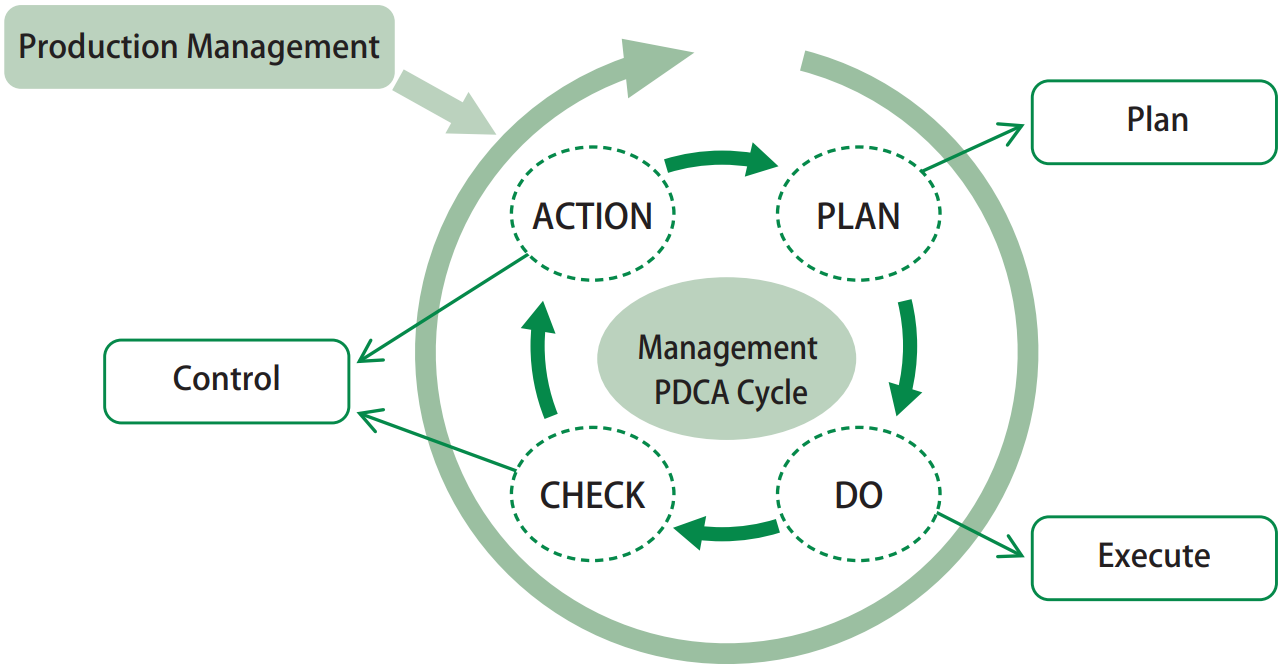
What kind of activity is "production management," which covers a broad scope and tends to have an ambiguous definition? We will explain it simply using everyday examples. Let's understand the big picture of production management.
1. What is "Production" in Production Management?
The terms "production" and "manufacturing" are often heard in the manufacturing industry. These two are similar, but their meanings are actually slightly different. By understanding this difference, you will be able to more clearly visualize the scope that "production management" covers.
First, "production" refers to all activities that create goods (products) and services. For example, growing crops in agriculture or developing software are also part of "production." Furthermore, generating energy and providing services in the service industry are included in production in a broad sense.
On the other hand, "manufacturing" mainly refers to the activity of processing raw materials to make goods (products). For example, processing materials in a factory to build a car is manufacturing. In other words, manufacturing is a part of production, specifically limited to the act of making physical goods.
Why is the word "production" used in the manufacturing industry? In the manufacturing industry, the activity of making goods (products) is certainly central, but the term "production management" is widely used instead of "manufacturing management." There are several reasons for this.
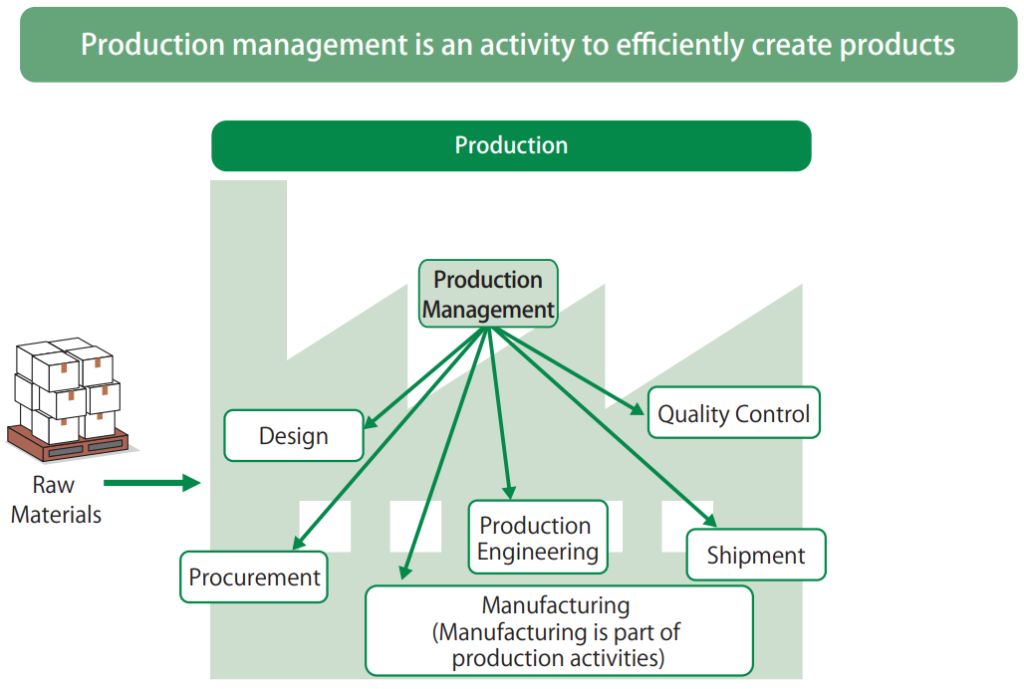
In the manufacturing industry, many activities are involved in making a product, starting from product design, procurement of raw materials, quality control, to logistics. For example, quality control is the activity to meet the required quality of the product, and logistics is the delivery of raw materials and the activity of delivering the finished product to the customer. The word "production" is used in a broad sense to include all these activities.
In short, the work of the manufacturing industry is not just "manufacturing"; it includes various tasks to create a product,such as product design, raw material management, and preparation for shipment, which is why the term "production management" is appropriate.
Let's consider the automotive industry, a typical example of the manufacturing industry. It involves many activities, from car design, selection of raw materials, and product inspection, to the logistics required to deliver the product to the customer on time. The term "production management" is used to manage all of these.
In this way, "production management" is not simply "management of the manufacturing process alone," but targets the management of all activities that create a product — that is, the entire process "from procurement to product shipment." It is an effort to efficiently produce products that meet the customer's desires at the appropriate timing.
2. Let's Learn the 3 Elements of Production Activities
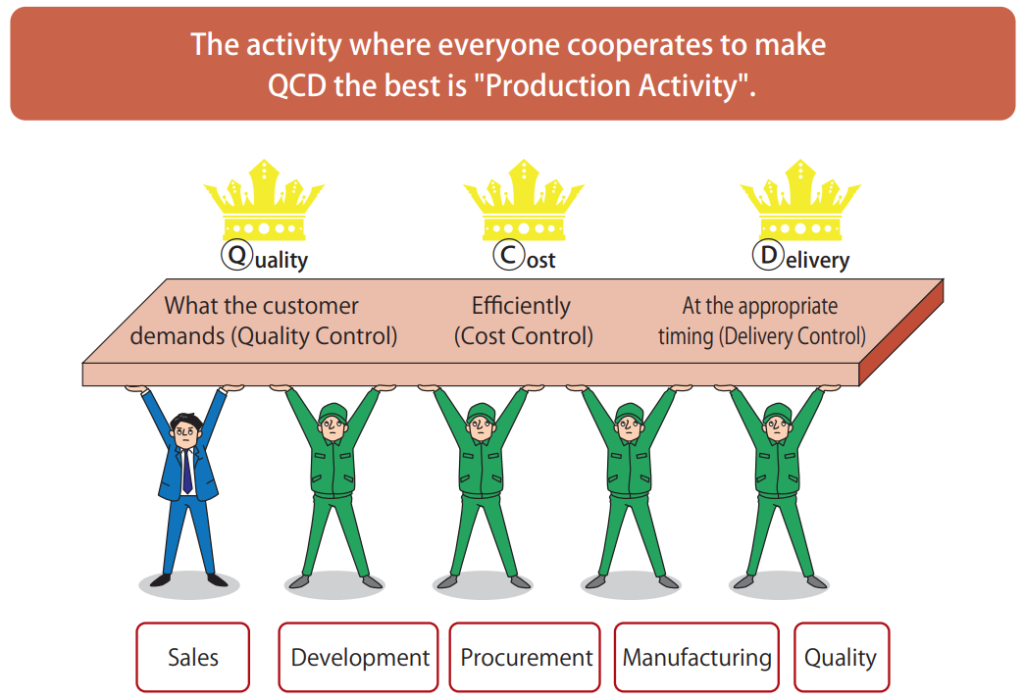
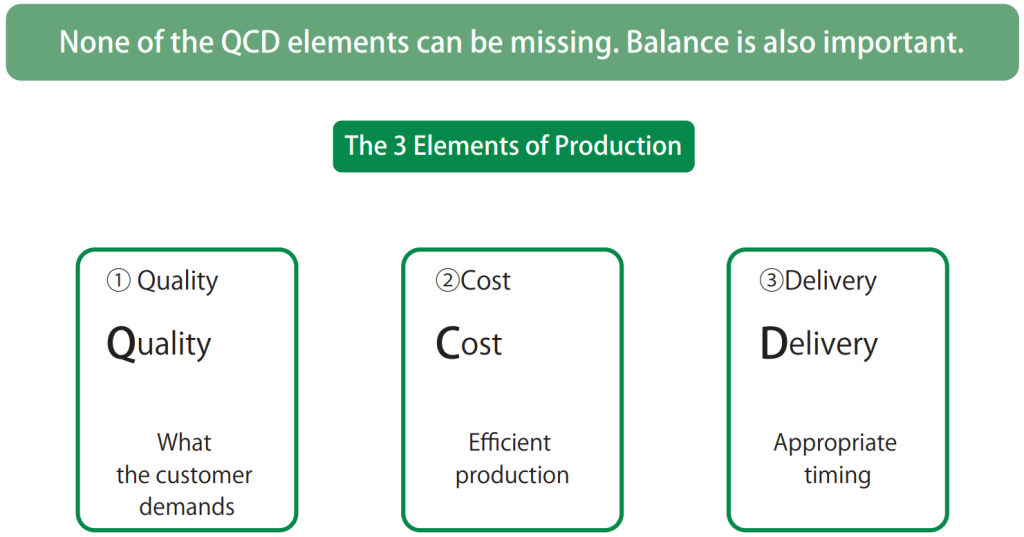
There are three elements you must remember to carry out production activities. They are "Quality," "Cost," and "Delivery." In English, they correspond to Quality, Cost, and Delivery, respectively, so they are often called "QCD" by taking their initials, a term used in any company within the manufacturing industry.
Production is not just simply making things. Remember what production management is. Production management is an effort to efficiently produce (Cost) products that meet the customer's desires (Quality) at the appropriate timing (Delivery). These three — "Quality," "Cost," and "Delivery" (QCD) — are also called the "3 elements of production."
These three elements of quality, cost, and delivery are central to production activities, and it can be said that the activity of production management is to reliably achieve the target quality, cost, and delivery.
First, "Quality" refers to the performance and characteristics of the product that the customer demands. Taking a car as an example, engine performance and exterior finish relate to quality. If the quality is high, customer satisfaction increases, and the reliability of the product also improves. However, if the quality is poor, the product may be returned or require repairs, resulting in a huge waste of cost and time for the company.
Next, "Cost" refers to all the expenses incurred to make a product. This includes material costs, labor costs, and maintenance costs for machinery (production equipment). If costs can be reduced efficiently, it becomes easier for the company to increase profits, but conversely, if costs are too high, profits will decrease.
And "Delivery" means delivering the product to the customer at the promised time. If the delivery time is not met, the customer will feel dissatisfied and trust will be lost. In particular, delivery management is extremely important for made-to-order products or parts needed at a specific timing.
These three elements are closely related to each other. Trying to improve quality may increase costs, and aiming to reduce costs may sacrifice quality. Also, rushing manufacturing to meet a delivery deadline may affect quality. In this way, all aspects of QCD are indispensable, but on the other hand, balancing QCD is one of the most important roles of production management.
3. Let's Understand Quality
The first of "QCD" is Q, or "Quality." Shipped products must satisfy the "Quality" demanded by the customer. By the way, what exactly is this "Quality"?
Quality mainly has two aspects: "Function (Performance)" and "Appearance." First, "Function (Performance)" refers to how effectively a product operates for its intended purpose. Having a problem with the function is called a "functional defect." If you set the air conditioner to heating but only cold air comes out of the vent, the air conditioner's function is not fulfilled. In this way, functional defects immediately cause customer dissatisfaction and lead to returns and complaints.
Next, "Appearance" refers to the look and finish of the product (sometimes called grade or dignity). If the surface of a newly purchased smartphone has scratches or dirt, the customer will consider the product "defective." Having a problem with the appearance is called an "appearance defect." Appearance defects also directly link to customer satisfaction. If the appearance of a product is not satisfactory, its value is greatly impaired.
Furthermore, quality is not limited to function and appearance. In recent years, consideration for product "safety" and the "environment" has also come to be regarded as part of quality. Products that have dangerous parts for small children to touch or products that do not use environmentally friendly materials are considered to have quality problems.
Moreover, "services" and "customer support" related to the product are also increasingly considered as quality. If the usage of a product cannot be properly explained, or if questions from customers cannot be adequately answered, the quality is also considered poor.
Quality has many aspects, but the manufacturing industry is required to achieve quality that satisfies customers. If the quality is low, no matter how efficiently production is carried out, customer trust cannot be gained.
In production management, efforts to prevent the occurrence of defects and the shipment (outflow) of defective products to customers are important. For example, steady activities such as procuring raw materials of appropriate quality and preventing defects from occurring in the manufacturing process are required.
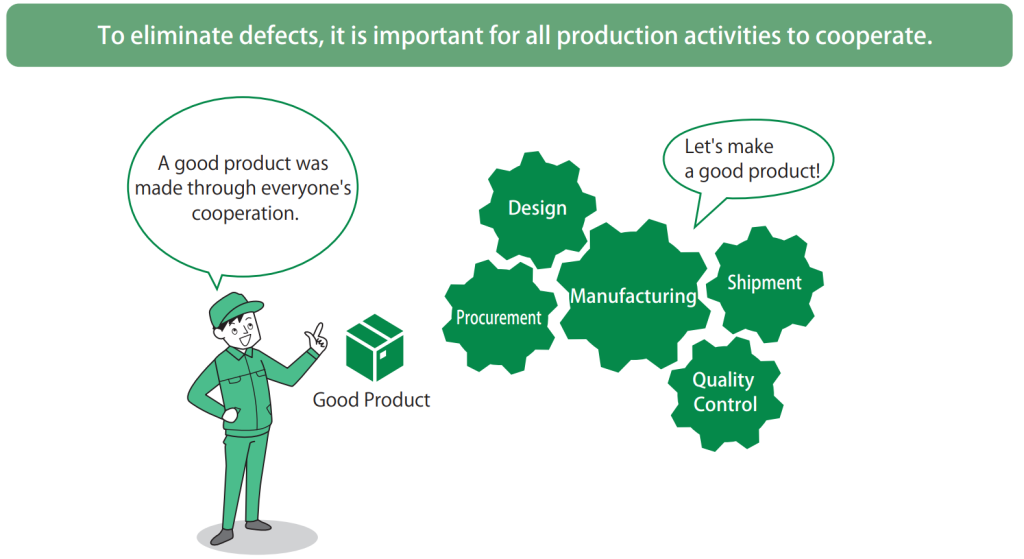
To protect quality, a consistent cooperative system is necessary from the product design stage through raw material procurement, production, and final inspection. In the manufacturing industry, making products that ensure the quality demanded by the customer is the most basic goal, and the role played by production management is very important.
4. Let's Understand Cost
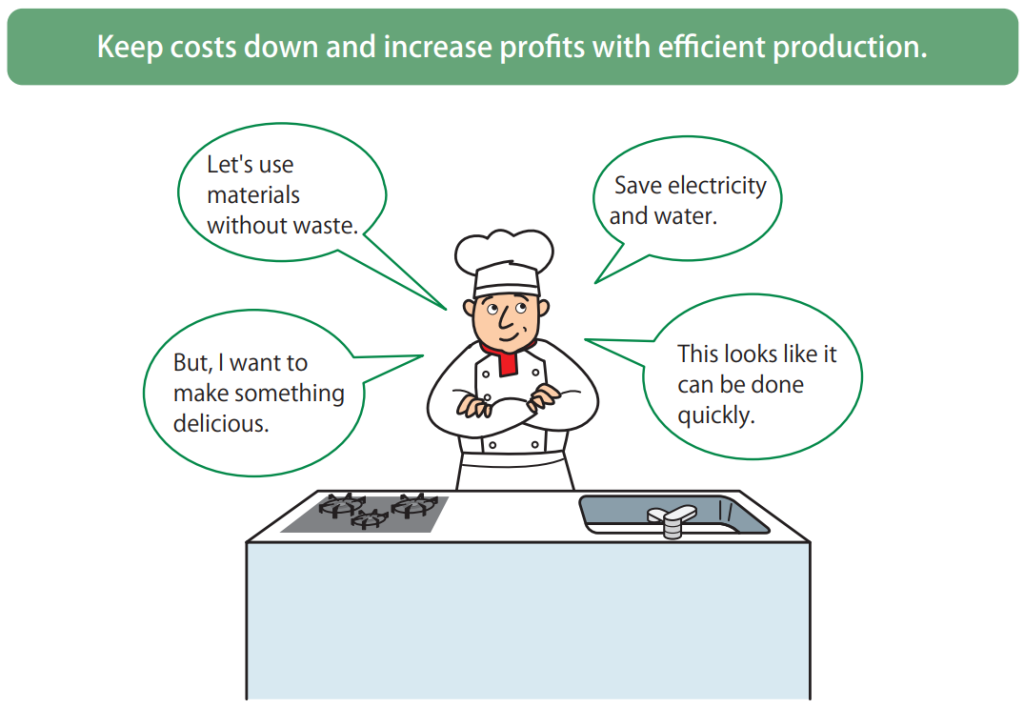
Next in "QCD" is C, or "Cost." No matter how many products can be produced, production must not cost an excessive amount of money. Cost refers to all the "expenses" incurred to produce a product.
Expenses are the expenditures (money) necessary to produce a product, such as raw material costs and labor costs. In order for a company to sell products and make a profit, it is very important to manage this cost so that it does not exceed the selling price.
Let's take a local bakery as an example. For a bakery to make bread, it first needs to buy raw materials like flour, sugar, and butter (called raw material costs). Also, making bread incurs electricity and water bills for the oven (called utility costs). Furthermore, if you hire a part-time worker to help bake bread, their wages (called labor costs) also occur. These expenses are called "costs."
Suppose it costs 100 yen for a bakery to bake one piece of bread, and they sell it for 120 yen. In this case, the bakery can make a profit of 20 yen per piece. However, if the cost of baking bread increases to 130 yen due to rising raw material prices or increased labor costs, the bakery will incur a loss of 10 yen per piece. In this way, when costs exceed the selling price, the shop runs into a "deficit," and the business becomes unsustainable.
A deficit is a state where expenditures (money paid by the company for various expenses) are greater than income (money coming into the company through sales activities, etc.). Conversely, a surplus is a state where income is greater than expenditures. Of course, a surplus is definitely better.
In production management, properly managing costs is a very important job. No matter how good a product you make, if it costs too much, you will suffer a loss instead of making a profit. Conversely, if you can appropriately reduce costs, you can also increase profits.
For example, if it's a bakery, the costs required for production can be reduced by "using cheaper flour," "finding a work method that can make many at once," or "using an energy-saving oven." Successfully managing these costs is the key to increasing profits.
5. Let's Understand Delivery
The last element of "QCD" is D, or "Delivery." No matter how good the quality is and if the cost is appropriate, business will not be viable if the product is not delivered at the timing the customer wants.
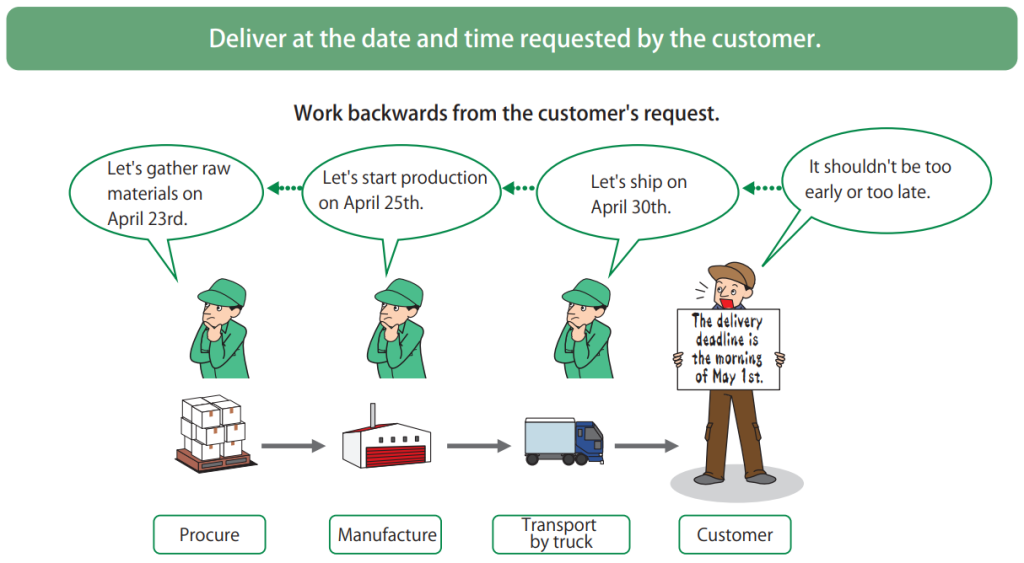
Delivery date means the "delivery deadline," that is, the day the customer should receive the product. Delivery date has several meanings, including the delivery date requested by the customer, the date the product is shipped from the factory, and the date the sales department instructs production to be completed. All are important dates indicating "when the product needs to be completed."
Keeping the delivery date also means keeping the customer's request (the promise with the customer), and it is very important to maintain a trusting relationship between the company and the customer. Failing to keep the promised delivery date betrays the customer's expectations and causes great damage to the company's credibility.
Sometimes products are delivered earlier than the delivery date, but it can also be a problem if it does not match the customer's schedule. For example, a delivery that is too early not only fails to match the timing when the customer will use the product, but it also becomes a source of dissatisfaction for the customer because it means more things are in the way.
Conversely, if a delivery delay occurs, the customer will not be able to use the product on the planned day, which will hinder their business. For example, if parts or machinery used at a construction site cannot be delivered on time, the entire construction will be delayed, causing trouble for other contractors and related parties.
And if delivery delays continue, there is a possibility that the customer will avoid purchasing products from that company again. Losing a customer's trust due to delayed delivery may sever business relationships with the customer in the future and could lead to losing other customers as well. A breakdown in a trusting relationship is a huge loss for a company.
Furthermore, the additional costs incurred due to late delivery cannot be ignored. In order to recover from a late delivery, it may be necessary to add extra manpower or machinery if production is rushed. In addition, logistics costs may increase due to urgent delivery arrangements. The accumulation of these wasteful costs will squeeze the company's profits and increase the likelihood of ultimately having a negative impact on management.
Also, risk management is important — such as keeping backup inventory and creating production plans with leeway — so that even if trouble occurs, such as being unable to obtain raw materials, it will not affect the customer's delivery date.
Meeting delivery deadlines is not only essential for maintaining trusting relationships with customers, but it is also a very important element in company management.
6. What Production Management Can Do to Protect QCD
"QCD" is the most important element in the manufacturing industry. Please consider that reliably protecting each of them is indispensable for maintaining the company's competitiveness. Production management plays a very important role as a control tower to ensure these.
The main purpose of production management is to ensure that the product meets the quality demanded by the customer, minimizes costs, and meets the delivery date. The company's production management manages the overall production activities to achieve these.
Production management aims for quality to meet certain standards. For example, checking whether the raw materials and parts used in the factory meet the required quality, confirming whether quality is maintained from the procurement of raw materials to production and shipment, and immediately taking countermeasures if a problem occurs. These activities are called "Quality Control."
Production management aims to produce products efficiently and achieve appropriate costs. It grasps the raw materials and labor costs necessary for production, and implements improvement measures to reduce wasteful expenses. For example, it checks whether raw materials are consumed excessively or whether work is progressing efficiently, and takes immediate countermeasures if a problem occurs. These activities are called "Cost Control."
And production management aims to meet the delivery date promised to the customer. It checks the progress of production activities and shipping activities so that the product is completed and shipped as scheduled, and immediately takes countermeasures if a problem occurs. These activities are called "Delivery Control."
The most important role in production management is to adjust so that the three elements of QCD are properly balanced. Balancing means preventing excessive pursuit of quality from resulting in higher-than-planned costs, or preventing the attempt to secure a delivery date from resulting in poor quality. It would be ideal if all of QCD were at their best, but in reality, improving one thing often worsens another. Production management plays the role of grasping these elements as a whole and balancing them to smoothly advance the company's production activities.
In order to balance QCD, cooperation among related departments in the company is also indispensable. The department responsible for quality control protects product quality, the department responsible for cost control works on cost reduction, and the department responsible for delivery control works together to meet delivery dates. Production management is the activity that enables smooth production activities while cooperating on how to prevent cost increases to improve quality, and how to minimize the impact on delivery dates.