Japan's Mitsui Seiki Adds Turning: Five-Axis Machining Centre Targets Re-Clamping Error in Case Parts
Japan's Mitsui Seiki Kogyo, a precision machine tool manufacturer, has developed a version of its "HU63A-5X" five-axis horizontal machining centre (MC) with built-in turning, and has begun taking orders. The aim is to finish aircraft-engine and power-generation turbine cases in…
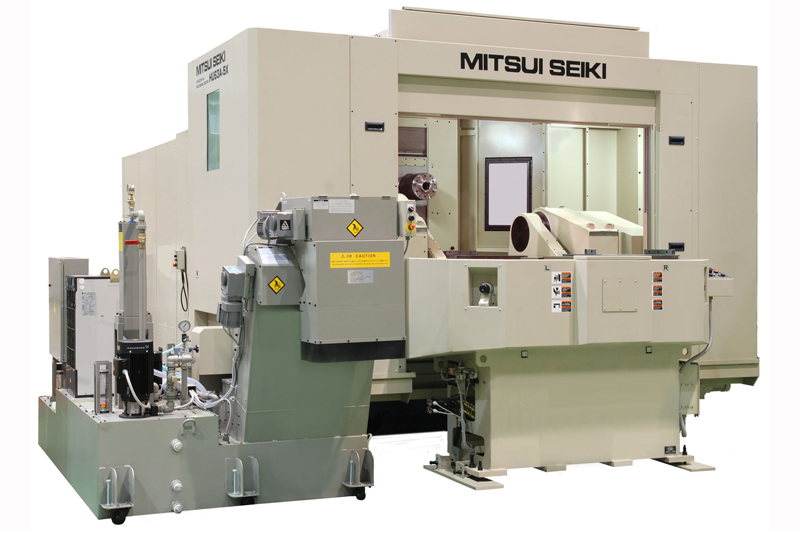
Japan's Mitsui Seiki Kogyo, a precision machine tool manufacturer, has developed a version of its "HU63A-5X" five-axis horizontal machining centre (MC) with built-in turning, and has begun taking orders. The aim is to finish aircraft-engine and power-generation turbine cases in a single clamping, reducing the error that can be introduced when a part is moved between machines. There is a clear limit, however: turning is possible only up to 500 millimetres in diameter, which makes it necessary to examine the conditions under which process consolidation is effective.
Key points
- Mitsui Seiki Kogyo (Kawajima, Saitama Prefecture) has developed the "HU63A-5X Turning" by adding turning capability to the B-axis table of its "HU63A-5X" five-axis horizontal MC. The machine made its debut at IMTS 2026, the International Manufacturing Technology Show in Chicago, in September 2026, and the company has begun taking orders.
- Roughing, finishing and turning are completed on one machine in a single chucking (clamping of the workpiece), reducing the small errors and set-up time that come with re-clamping.
- The maximum workpiece is 950 millimetres in diameter by 900 millimetres high, weighing up to 800 kilograms, for milling, but is reduced to 500 millimetres in diameter by 600 millimetres high, weighing up to 500 kilograms, for turning.
- Figures such as the B-axis rotational speed and torque during turning, or concentricity after combined machining, have not been published.
Turning capability built into the flagship's table
Mitsui Seiki Kogyo, founded in 1928, makes machine tools and air compressors. The new model takes the company's flagship five-axis horizontal MC, the HU63A-5X, and gives the B-axis table that carries the workpiece the ability to turn. In the United States it is designated the "HU63A-5XT", and Mitsui Seiki USA, the company's US arm, exhibited it at IMTS 2026, held from 14 to 19 September 2026.
A five-axis horizontal MC rotates the tool on a horizontally mounted spindle while tilting (A-axis) and rotating (B-axis) the table carrying the workpiece, so complex shapes can be cut from many directions. The HU63A-5X uses a trunnion structure, a cradle-like tilting table, with the A-axis centre of rotation set above the pallet, which provides greater rigidity under cutting loads.
The new model brings together operations in which the tool rotates, such as milling, drilling and boring, and turning, in which the workpiece rotates, on a single machine. A two-pallet changer and a 60-tool automatic tool changer come as standard, supporting long continuous runs and unmanned night-time operation.
Aerospace and energy demand strengthens in North America
The choice of a US trade show for the machine's first public showing reflects the concentration of demand in North America. In the final report for August 2026 from the Japan Machine Tool Builders' Association, orders from North America rose 71.8% year on year to ¥49.9 billion, a record high. Large space-related orders contributed, and demand from AI and data centres and from oil and gas was described as strong.
Capital investment is also increasing in power generation. Japan's Mitsubishi Heavy Industries is increasing its annual gas turbine production capacity from 36 to 50 units, and sees orders for large turbines surging across the Americas on the back of electricity demand from AI and data centres. That could be a tailwind for a machine intended for applications including turbine cases, but no direct link to Mitsui Seiki's sales talks or orders has been disclosed.
The target: re-clamping error in case parts
The machine is intended for large, complex components such as aircraft-engine cases and power-generation turbine cases. Such case parts are typically turned on a lathe for their cylindrical inner and outer diameters, then moved to an MC to machine flange holes and bosses (raised features). When the work is split across two machines, each re-clamping introduces small positional shifts, which can degrade the fit between mating parts and lead to defects.
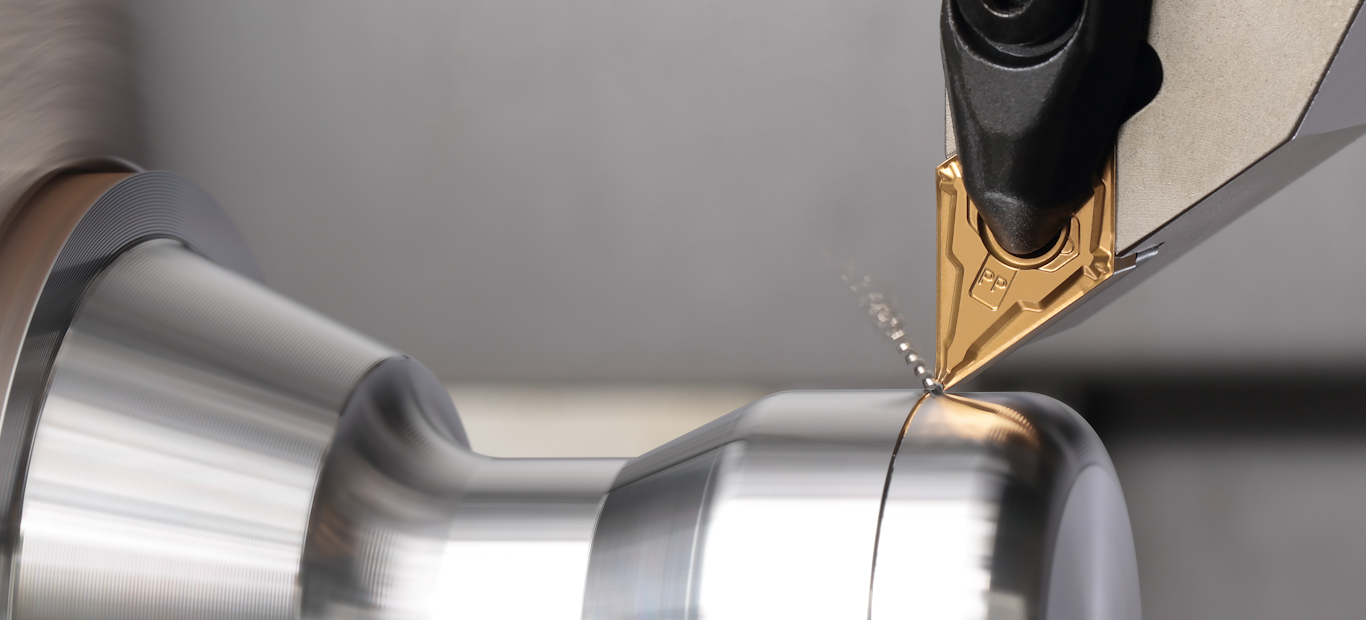
When an MC performs turning, the tool spindle is generally stopped, the B-axis table rotates the workpiece, and a turning tool is fed in along the linear axes. Because the machine can switch to rotating-tool operations without unclamping the part, one major source of those positional shifts can be eliminated. Many of these parts are made from difficult-to-cut materials such as titanium and Inconel, a nickel-based heat-resistant alloy, and the company says the machine has the rigidity to support heavy cutting of such materials. Travel on the X, Y and Z axes is 900 millimetres each.
What the published figures show, and what they do not
The company cites as its strength the geometric accuracy built up over more than 70 years of producing jig borers, ultra-precision boring machines that finish hole positions to the micrometre. On the new model, skilled technicians hand-scrape the mounting surfaces of the guideways, removing thin layers of metal by hand to perfect flatness and contact.
The US specifications give a maximum tool-spindle torque of 1,081 newton-metres and positioning accuracy of ±0.001 millimetres on the X, Y and Z axes. These, however, describe the tool side and the linear axes, not turning performance directly. The maximum speed and torque of the B-axis during turning, and the concentricity and thermal displacement after a sequence of turning and milling, cannot be confirmed from published materials.
Turning is limited to 500 millimetres in diameter
The conditions for adoption are clear. The maximum workpiece shrinks from 950 millimetres in diameter by 900 millimetres high and 800 kilograms for milling to 500 millimetres in diameter by 600 millimetres high and 500 kilograms for turning. When the table spins the workpiece, size and weight appear to be restricted to keep centrifugal force and runout in check.
Completing every process in one clamping is therefore possible only when the turned part falls within that range. Larger-diameter engine cases may still require a combination with dedicated machines such as vertical lathes. Pricing and figures for cycle-time reduction have not been published either.
The 500-millimetre limit is not the only factor that will decide adoption. The question is whether B-axis speed and torque during turning, together with concentricity and cycle time after combined machining, can bring total cost below that of running a separate lathe and MC. The published specifications show the machine's potential for process consolidation, but judging its economics in volume production will require customers' own trial-machining data.