Japan's Injection-Moulding Machine Orders Nearly Double in July: Exports Lead, Small Machines Grow Fastest
Japan's injection-moulding machine orders jumped 92.2% year on year in July to 1,728 units, the eleventh straight monthly rise. Exports did the heavy lifting, more than doubling to 1,407 units — over 80% of all orders. Makers attribute the surge to demand for electronic…
Japan's injection-moulding machine orders jumped 92.2% year on year in July to 1,728 units, the eleventh straight monthly rise. Exports did the heavy lifting, more than doubling to 1,407 units — over 80% of all orders. Makers attribute the surge to demand for electronic components for AI data centres, connectors above all. The sharpest gains came in the small and very small machines used to mould those connectors. This article sets out how far the figures confirm the momentum, and where it rests only on makers' reading.
Key points
- July orders for injection-moulding machines, compiled by the Japan Society of Industrial Machinery Manufacturers and the Japan Plastics Machinery Association, rose 92.2% year on year to 1,728 units — the eleventh consecutive monthly increase.
- Exports led, more than doubling to 1,407 units and accounting for over 80% of orders — an eleventh straight monthly rise. Domestic orders also grew 40.8% to 321 units, up for a fourth month.
- The gains were concentrated in the smaller classes: very small machines with under 20 tonnes of clamping force rose to 9.9 times the year-earlier level, 100-tonne-class small machines were up 96.0%, and 20–99-tonne machines up 90.2%.
- Makers say demand for AI data-centre connectors, having lifted the 100- and 200-tonne classes, has spread to the smaller classes. The growth is centred on China, they say, with limited pick-up in the United States.
- Very large machines with 1,000 tonnes or more of clamping force fell to 14 units, from 16 a year earlier.
What happened: orders nearly doubled, exports over 80%
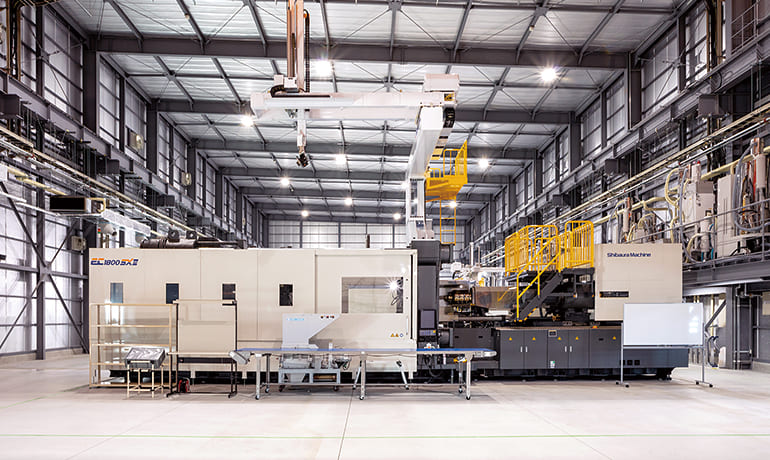
An injection-moulding machine forces molten resin into a mould under high pressure and cools it to shape a part. It is essential equipment for mass-producing plastic components, and its order book is a leading indicator of investment in resin-parts production.
July orders compiled by the two industry bodies totalled 1,728 units, up 92.2% year on year — close to a doubling, and the eleventh straight monthly gain. Exports drove it: continuing from June, they rose to 2.1 times the year-earlier level, at 1,407 units — over 80% of all orders and an eleventh consecutive monthly rise. Domestic orders also rose 40.8% to 321 units, a fourth straight month of growth, so demand grew both at home and abroad.
Why it rose: makers point to "connector demand"
Growth was uneven across machine classes. It is not the large machines but the small ones that stand out. Very small machines with under 20 tonnes of clamping force — the force that holds the mould shut — reached 9.9 times the year-earlier level; 100-tonne-class small machines rose 96.0%; and 20–99-tonne machines 90.2%. Unit counts for each class are not disclosed, however, and multiples such as 9.9 times tend to run large where the base is small, so they should be read with that in mind.
Makers link this jump in the small classes to AI data-centre use. As generative AI spreads, data-centre build-outs are advancing, lifting demand for the connectors that join servers and networking gear. Many connectors are small parts moulded from resin, and their mass production uses small and very small moulding machines.
This class usually sees strong demand from pharmaceutical applications. This time is different, in the makers' view. One major manufacturer says demand for AI data-centre connectors, "after driving the 100-tonne and 200-tonne classes, has now spread to the next size down." The reading is that AI data-centre demand, which first moved the mid-size classes, has reached the moulding equipment for smaller connector parts.
On geography, makers say the growth is centred on China. Orders for AI data centres are rising in China, while "the United States does not feel like it is growing that much," according to one major maker. Order counts by country and region are not disclosed, so the regional mix cannot be confirmed from the figures.
A slow-starting home market, and large machines going the other way
Even as exports led, the home market has begun to stir. Domestic users, who had been cautious and inclined to wait, appear to be moving on investment, if belatedly. Alongside data-centre demand, one major maker says, "with several models selected for energy-saving subsidy schemes, orders for those models are rising." The fourth straight month of domestic growth appears to owe something to the subsidy support.
While almost every class rose, the exception was very large machines of 1,000 tonnes or more, which fell to 14 units from 16 a year earlier. Very large machines are used for large automotive resin parts and are often discussed alongside electric-vehicle (EV) trends. But one major maker sees it "less as a drop in EV-related demand than as a one-off." With a base of only a dozen or so units, a swing of one or two units is too small to read as a trend.
What to watch: whether momentum holds after the equipment cycle turns
July's orders showed a clear rise in unit terms. But the causal link — that AI data centres drove it — is for now the makers' reading, not something the disclosed unit figures alone can confirm. Exports, which account for most of the gain, are not broken out by country or region. What the numbers establish is this far: overall orders nearly doubled, with the small classes and exports leading.
What comes next turns on whether the makers' reading is borne out in the unit counts that follow. First, whether growth in the small and very small classes runs on for several months, or settles once parts makers' capacity build-out has worked through. Investment in connector-moulding equipment tends to soften once a round of additions is complete. Second, whether the domestic increase spreads beyond the subsidy-eligible models to others; subsidy-linked demand can fade once a scheme runs its course.
The eleven-month run of gains is real, but the recent momentum leans heavily on a single use and on exports. More than the sheer size of the numbers, the question is how far this rise can broaden across uses and regions. Only when the coming monthly figures show that will the momentum look structural rather than temporary.