Japanese Die & Mold arethe Best in the World
The Japan Die & Mold Industry Association uses the slogan "Japanese Die & Mold are the Best in the World!" for the global market. However, Japan does not boast the world's highest mold production volume or the largest number of mold companies. Those quantitative figures are…
The Japan Die & Mold Industry Association uses the slogan "Japanese Die & Mold are the Best in the World!" for the global market. However, Japan does not boast the world's highest mold production volume or the largest number of mold companies. Those quantitative figures are likely lower than those of China or India. The number of people employed in the mold industry is similar and is not the highest in the world.
Then, the questions arise: "Why can we say 'Japanese Die & Mold are the Best in the World!'?" and "Why can we confidently use that as a slogan?" Actually, the reasons we can confidently say "Japan's molds are the best in the world!" are the following two points:
- The variety of molds/dies manufactured is the largest in the world!
- The breadth of the mold customer base (industries) is the largest in the world!
The reason why the Japanese mold industry was able to reach this situation lies in the history of Japanese manufacturing (Monozukuri).
History of Japanese Manufacturing
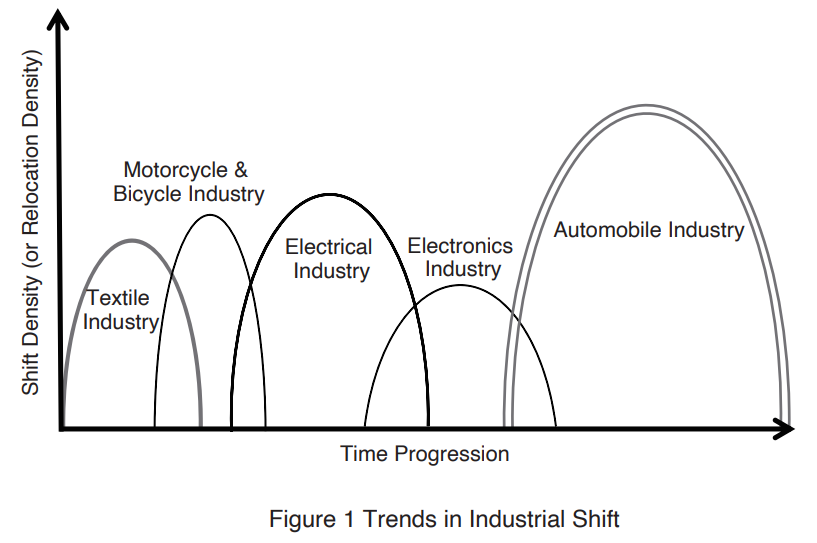
Usually, the evolution of industrial development progresses through the stages shown in Figure 1. For any emerging country, the first industries start with "manufacturing export textiles" utilizing cheap labor and "manufacturing daily miscellaneous goods" for domestic demand. Next, after the motorcycle and bicycle industries, which produce higher value-added products, develop, the manufacturing industry for electrical appliances such as home appliances becomes the center of the industry by utilizing that manufacturing technology base. As the country's economy grows further, the industrial structure shifts to the electronics industry, which has higher added value than home appliances, and finally to the "automobile industry," which is positioned as the star industry among manufacturing industries.
This "automobile industry," which can also be called a final product industry, continues to grow as functions are added year by year, and once the automobile industry becomes the core industry of a country's manufacturing, its position continues without declining. Therefore, every country will continuously implement policies to "establish an automobile industry" as its ultimate goal. Japan has achieved development exactly according to this theorem of industrial development.
Japan after its defeat in the war was a burnt-out ruin, completely in a state of having "nothing!", lacking even the pots and pans to cook daily meals. The history of reconstruction that started from there and the history of mold manufacturing overlapped, and Japan followed the path of industrial development shown in Figure 1. With each stage of that development, companies that make the molds necessary for new industries were born. A country that has walked such a history is rare in the world.
With the progress of the global economy, a trend has taken root where, rather than starting with low value-added textile or motorcycle industries, countries make the electronics industry (like smartphones)—which has high added value despite a small number of parts—their core industry from the beginning, or they focus on manufacturing the products in highest demand at the time through assembly-centric (knock-down) industries while supplementing necessary parts through overseas procurement.
As a result, the way of thinking became, "It is inefficient to make all parts from molds domestically. If the volume is small, it is better to import the parts," eliminating the need to make many types of molds within their own country. Therefore, although it is not well known, in the automobile industry sector, the astonishing situation is that "Japan is the only country in the world capable of mold manufacturing that can make all of the 30,000 parts that make up an automobile."
For example, even for tires, which are indispensable components of an automobile, the countries capable of manufacturing molds for those tires are limited. Even in Brazil, which produces nearly 3 million cars a year, there are no tire mold manufacturing companies. "There is no mold that cannot be made in Japan!" This is Japan's pride and an absolute "World's Best in a position of absolute superiority!" that must never be let go.
A Wide Variety of "World's Best"
Moreover, this "Japanese Die & Mold are the Best in the World!" is not just about the large variety of molds. In each mold field, there are many "World's Best!" companies. Examples of these are introduced below.
The World's Highest Quality Plastic Molds
Plastic products used for high-end cosmetics containers are expected to be of the highest grade not only in design but also in everything from surface quality to tactile feel, and within the mold industry, it is positioned that "molds for cosmetics containers are among the molds requiring the highest quality." World-famous luxury brand products, in particular, are particular about the quality of their containers, and almost all container molds for these global luxury brand cosmetics are made in Japan.
The reason for this is partly the high reliability that "Japanese mold companies will absolutely not leak confidential information about new products," but also because the "highest-grade plastic molds" required for luxury brand cosmetics can only be manufactured in Japan.
Ultra-Precision Motor Core Dies
In the past, refrigerators and air conditioners inevitably made a harsh "buzzing" noise as soon as they were switched on. Today, when motor performance has improved and "quietness and energy saving" have become essential elements for high-end home appliances, motors that produce noise have become rare.
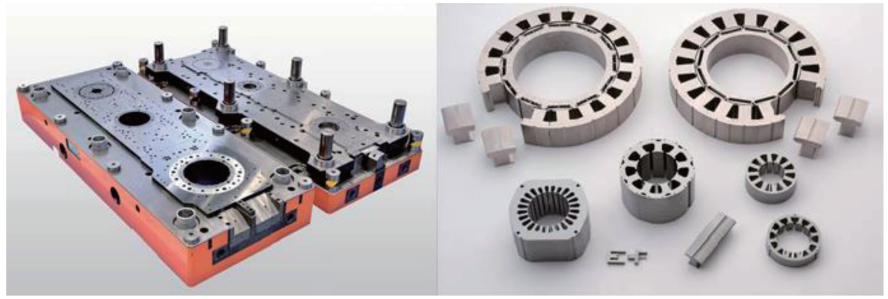
Also, in the early days of development, EVs had issues with harsh motor noise and cruising range, but these have now been resolved. Rather than saying motor performance has improved, this is due to the improved precision and performance of the press dies used to make the motor cores that constitute the motor. The ultra-precision motor core dies used to manufacture these top-grade motor cores are dies that can only be made in Japan (Photo 1).
Molds for Top-Grade Housing Equipment
Recently, having high-end modular baths and high-end modular toilets is a prerequisite for a luxury home. That luxury extends not just to design, but also to "meticulous considerations" unique to the Japanese, such as "floors that drain well and are not slippery" and "mirrors that don't fog up." It is Japanese molds that are able to provide these modular products for luxury homes, and only Japanese mold companies can keep up with the constantly evolving demands for luxury housing.
The Mold for the "Painless Syringe Needle" Also Originated in Japan!
It is famous that the "painless syringe needle" was successfully developed by Masayuki Okano of Okano Industrial Corporation, a downtown mold shop (Sumida, Tokyo), utilizing precision mold technology. Unfortunately, for medical devices required in massive quantities like syringe needles, commercialization is difficult unless it is by a major company with financial strength and global sales capabilities. Therefore, he completely transferred the rights to the major medical device company he co-developed it with, but there is no doubt that the technology was created by a mold company representing "Japan's proud downtown factories (machi-koba)."
The evolution of this "painless syringe needle" toward the next generation continues even today, and by using Japanese mold technology, the day is not far off when an incinerable plastic "painless syringe needle" will appear, instead of metal needles that pose problems as medical waste. In fact, Sayama Mold Manufacturing Co., Ltd. (Saitama Prefecture) is developing production molds for resin syringe needles for insulin. The types of medical devices are enormous and various developments continue, but the product development is supported by Japanese mold companies capable of providing "meticulous attention tailored to the patient."
Lead Frame Dies that Bring Cutting-Edge Semiconductor Products to Life
No matter how excellent a semiconductor is manufactured, its functions cannot be demonstrated without a "lead frame," which serves as the lead wires connecting the semiconductor chip to external circuits and the frame fixing the semiconductor package to the board. Lead frames are components that support the high integration and high functionality of semiconductor devices, and are usually made by ultra-precision press dies called lead frame dies.
Since the precision of this die determines the performance of the semiconductor, highly reliable Japanese-made dies are used, and in this aspect as well, Japan is the "world's greatest lead frame die manufacturing powerhouse."
Other "World's Best Molds/Dies"
There are many other examples of "world's best molds/dies" in Japan. For example, creating molds for dialyzers (dialysis machines) that even German mold meisters couldn't make, molds for manufacturing aluminum cans represented by beer and coffee cans, cold forging dies that brought about a major revolution in automobile parts manufacturing, and fine blanking dies (dies for thick metal materials) that can process thick steel plates without burrs (unintended "protrusions," "jagged edges," or "thorns" generated during metal processing). Not only these, but in all fields, such as special molds using "decorative technology" to create special patterns, almost all molds called "top-class molds" are made in Japan.