How to Use Kanban
POINT: A "kanban" is an indispensable tool for Just-In-Time devised by Taiichi Ohno of Toyota Motor Corporation, inspired by supermarket operations and product management. The "Kanban System" is one management method within the Toyota Production System (way of making things).
Q
Leader Koishi wants to learn about how to use "kanban."
A
(1) Kanban
To realize "Just-In-Time," making what is needed, when it is needed, and in the amount needed, Toyota Motor Corporation adopts a system where the subsequent process goes to the preceding process to pick up parts. The tool used when going to pick them up is the "kanban."
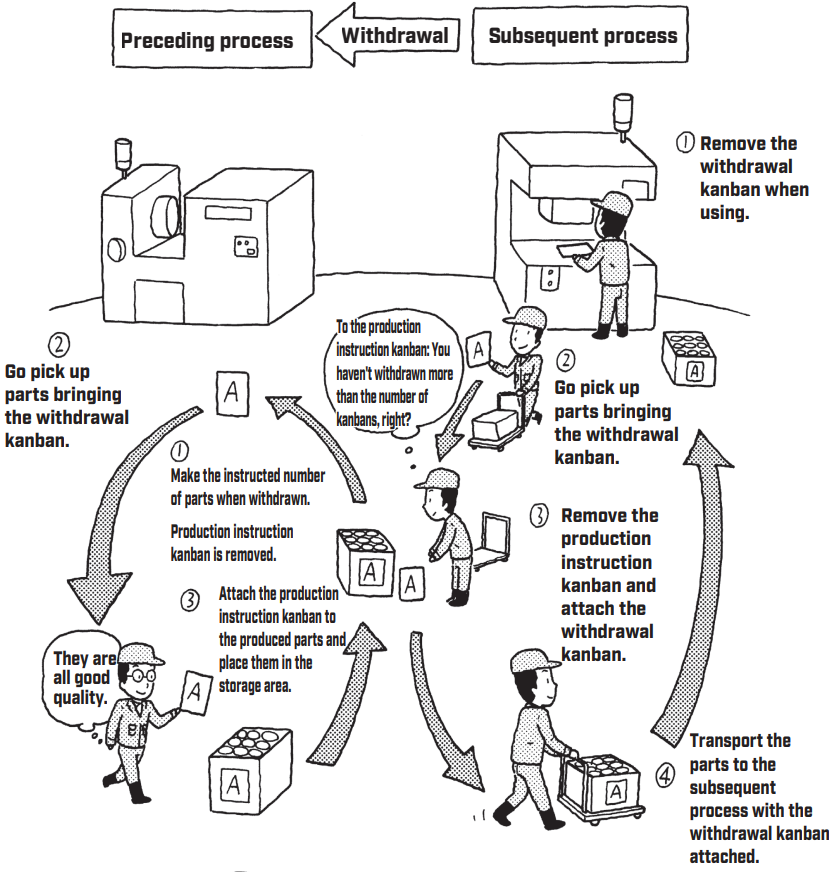
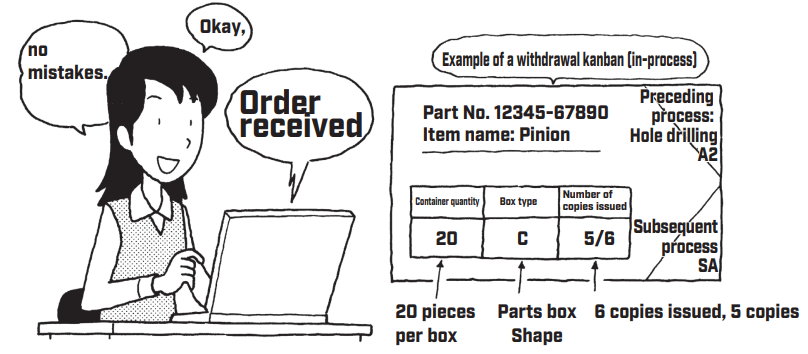
When the subsequent process takes 10 parts with a slip called "kanban," it becomes work instruction information at the preceding process instructing that line's slip to make 10 parts. Item name, part number, quantity, transport container, production volume, transport timing, preceding process, subsequent process, etc., can be immediately understood by looking at the kanban.
(2) Kanban System
According to a book by Taiichi Ohno, when he went to America around 1951-52, there were several pictures of supermarkets where there was only a woman at the exit, and customers pulled a cart like a baby carriage, buying as many goods as they wanted and paying at the exit. This served as a hint for the idea of going to the preceding process to pick up parts to be used in the subsequent process, and it is said that they started doing it under the name "Supermarket System" at the time.
(3) Types of Kanban
① Withdrawal kanban: Represents the type and quantity of parts when the subsequent process withdraws products made in the process from the preceding process, serving as delivery instructions.
② Production instruction kanban (Shikake kanban): When the subsequent process withdraws products from the preceding process, they remove the "production instruction kanban" and attach the "withdrawal kanban." In the preceding process, this becomes a production instruction to make the number of parts indicated on this "production instruction kanban."
③ Subcontractor kanban: A kanban attached upon delivery from a supplier; since the subsequent process withdraws it, it serves as a "withdrawal kanban."
(4) How to Use Kanban
Rules are necessary to circulate kanban smoothly.
① Do not send defective products to the subsequent process. Everything withdrawn by the subsequent process must be non-defective. The subsequent process is the customer.
② The subsequent process comes to pick up. When the subsequent process comes to pick up, they must not do so without a kanban. They must not withdraw more than the number of kanbans. Also, always attach a kanban to the actual item.
③ Make only the amount withdrawn by the subsequent process. What is important here is not to produce more than the number of kanbans. It is also important to produce in the order the kanbans were issued.
④ Level production. This is a rule to eliminate waiting time and advanced production in each process.
⑤ Kanban stabilizes and rationalizes the process.
Commentary
Kanban is work instruction information. It provides information on "what, by when, how much, and by what method to produce and transport." Moreover, because kanban moves with the actual item, it is a tool for "visualization," and its power is demonstrated by how well it is mastered.
Yasuhiro Tomita (TOMIT@ Environmental Consultant)