Hardware Beats the Human Hand, the AI Doesn't Yet: Honda and RIKEN Bet ¥10bn on Dexterous Manipulation
Japan's Honda R&D and the government-backed research institute RIKEN are committing ¥10 billion (around US$65 million) to a single problem: the intelligence needed to control a multi-fingered robotic hand.
Japan's Honda R&D and the government-backed research institute RIKEN are committing ¥10 billion (around US$65 million) to a single problem: the intelligence needed to control a multi-fingered robotic hand.
The hardware has already surpassed the human hand — stronger, yet able to turn a 1.6-millimetre screw. What is missing is an AI that can wield it without a human at the controls.
The five-year national project targets the frontier robots have never crossed: "dexterous manipulation" — threading a soft component into a tight space, picking the right part from a jumble and setting it the right way round. Its endpoints are concrete: the manual work that still keeps 2,000 people busy in a single car plant, and the assembly of wiring harnesses that automation has never reached.
In brief
- RIKEN and Honda R&D (Wako, Saitama) have launched a physical-AI project for a multi-fingered hand, selected under a programme of Japan's New Energy and Industrial Technology Development Organisation (NEDO); ¥10 billion is allocated over five years.
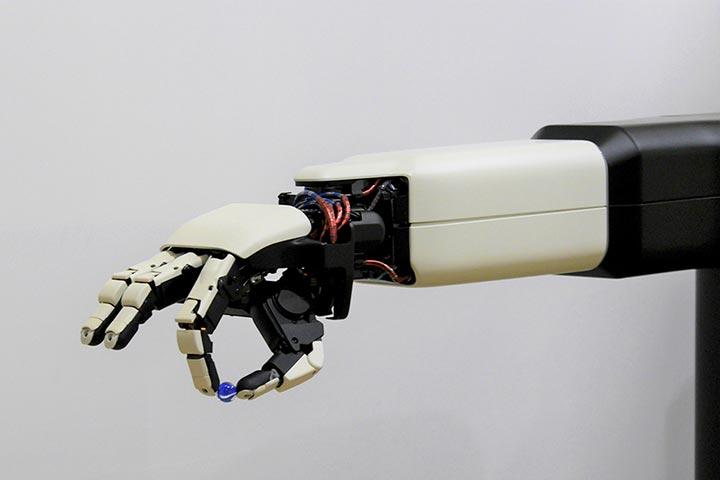
- Honda has already built a four-finger hand with 16 driven joints. Fingertip force reaches 5 kilogram-force (12 kgf momentarily, about twice a human hand), it can turn a 1.6-millimetre screw, and the drive mechanism is rated for more than 8 million cycles. The bottleneck has shifted from hardware to the intelligence that controls it.
- The targets are the "set-pack" kitting step — gathering parts and orienting them — and wiring-harness assembly. Both involve deformable objects and multi-point contact, the very tasks robots handle worst.
- The hardest part is training data. Multi-point contact and fine force control are difficult to reproduce in simulation, so RIKEN aims to differentiate at the point of collecting real-world data, using thin, durable tactile sensors.
- Multimodal models that fuse touch, force and vision with motion are the subject of an intensifying race involving the US and China. No decisive model has emerged, and the two partners are betting on a strong hand and a real shop floor to test it on.
The hardware has surpassed the hand; the intelligence to run it has not
RIKEN and Honda R&D are developing the physical AI that would give a multi-fingered hand dexterous manipulation — fine, adroit handwork. The project was selected under a NEDO programme to build foundation models for physical AI, with ¥10 billion over five years. RIKEN takes the tactile sensors, the AI and its integration with the robot; Honda takes the hand and its deployment.
The starting point is a judgement that the hardware is finished. "The hardware itself is already at an ideal level; what we need now is the intelligence to operate this hand," says Takahide Yoshiike, an executive chief engineer at Honda R&D. The company's hand has four fingers and 16 driven joints. Fingertip force is 5 kilogram-force, rising momentarily to 12 kgf — roughly twice that of a human hand — while still fine enough to turn a 1.6-millimetre screw. By housing the actuators (the drive units) in the forearm, it combines dexterity, strength and an endurance rating above 8 million cycles; it was shown publicly in June 2026. The hand integrates a mass of sensor signals to control about 20 joints in real time. In nature, dexterous finger movement is thought to have driven the evolution of the primate brain; here the order is reversed. The hand came first, and the brain to move it has yet to catch up.
Mounted on a teleoperated dual-arm robot, the hand has already been used to demonstrate battery installation and gearbox assembly. Under human control, "it can be done" is settled. The remaining wall is the intelligence to do it autonomously.
What "dexterity" really means: deformable objects and multi-point contact
So what kind of hand is the goal? The answer lies in what "dexterous manipulation" involves. Robots are good at moving large, rigid objects to fixed positions, but poor at handling soft, shape-shifting ones. A rigid body keeps its form and is easy to compute; a deformable object — a cable, a wire, a connector — changes shape with every force applied. The number of possible states explodes, and the next motion becomes hard to predict.
Harder still, contact is rarely a single point. In assembly, fingers touch the part, and the part touches its destination, at several places at once. Reading that multi-point contact while changing grip for each part and reorienting it in a cramped space — what a human does without thinking — cannot be achieved by precise position control alone. It needs a "soft dexterity" that adjusts force from the feel of contact even when things are slightly off. The set-pack kitting step and harness assembly the project has chosen are precisely where deformable objects, multi-point contact and fine force control all converge — the hardest cases of all.
The aim, in short, is not a single-purpose rig for one task but a "general-purpose hand" that can handle diverse parts adaptively, as a human hand does. That is where it departs fundamentally from the conventional industrial robot repeating a fixed motion.
Wiring harnesses: automation's final boss
The choice of wiring harnesses as a target carries weight. Harness assembly is the textbook case of the process automation has left behind.
The wiring routed through a single car is said to run to several kilometres in total length, with a vast number of connection points. The routing differs by model and specification, and a bundled cable changes shape the moment it is gripped. It will not wait obediently in a fixed position like a rigid part, so its state has to be read by sight and touch, and the bundle teased apart by the fingertips and guided into connectors. Because of this delicacy and high mix, harness assembly still depends heavily on manual labour, and as a labour-intensive process it has been widely offshored to lower-cost countries. Conversely, if it could be mechanised, the very logic of where to locate production could shift — a point that will bear watching across the Asian manufacturing hubs that today absorb such labour-intensive work.
The ripple runs beyond one process. "The car industry has led automation — painting, welding — and yet a single plant still employs 2,000 people," Yoshiike notes. "Assembly, sorting and other work that only human hands can do remains in abundance." Large, simple motions have been taken over by robots; what is left is delicate handwork. If a dexterous hand arrives, factory automation shifts in philosophy — from "special-purpose automation," in which dedicated equipment is designed from scratch for a line, to "general-purpose-hand automation" that simply takes over the human task. For a Japan where labour shortages are becoming structural, this is more than headcount reduction; it reaches the question of where production is done at all.
Why the contest is about tactile data, not hardware
The fate of the intelligence rests on how the AI is trained.
Robot AI is increasingly built on "multimodal models" (multimodal foundation models) that fuse vision, language and motion into one. Tell it to "put the red part in the box" and it sees, understands and moves — an effort to carry the leap that generative AI showed in language and images over to machines with bodies, known as physical AI. But in precise handwork, vision alone is not enough. Just as a person can turn a screw inside a dark toolbox, fine force and contact states are information better sensed by touch than sight. Here touch becomes decisive.
The problem is how to collect that tactile data. Multi-point contact between hand, part and destination is hard to compute precisely, and fine force control cannot be used for learning if the simulation is inaccurate. The usual route of mass-generating data in a virtual space does not carry over well here. That is why data must be taken from the real world, and the key becomes the thinness and durability of the sensor. "Today's data-collection gloves are as thick as ski gloves and can't do fine work," explains Tatsuya Harada, a group director at RIKEN's Center for Advanced Intelligence Project (AIP). "We differentiate from the data-collection stage itself, with thin, tough sensors." Recording the touch of fine handwork without dulling it through a thick glove — the aim is to secure data quality at the very entrance to learning.
To train on the data, the team combines AIP's accumulated techniques: few-shot learning that learns from small samples, domain adaptation that bridges differences in environment, and continual learning. The bulk of the budget goes to the computing resources for a multimodal AI model that binds touch, force and vision. The strategy on show is to compete not on hardware completeness but on the design of data and learning.
Against a US–China push on general models, Japan bets on "hand and touch"
The race in multimodal models is heating up worldwide. In the US, Tesla has begun putting its humanoid "Optimus" into its own plants, and Figure AI is regarded as leading on hand dexterity with its in-house vision-language-action model; specialist foundation-model start-ups keep appearing. In China, investment in embodied AI is swelling, with new entrants emerging in sensors and hands. The contest for control of the models that drive robots is already a cross-border one.
Japan's position is delicate. On the scale of general models, the volume of data and the number of units produced, it has ceded a lead. But no decisive model exists yet. Precisely because it is an opening game, an advantage lies with a camp that holds all three of strong hardware, a real production floor to test on, and basic research. "We have the world's best hand and researchers who can compete globally," Harada says. Taking high-quality tactile data with good hardware and connecting it to learning with cutting-edge AI — that end-to-end setup is placed at the core of the differentiation. For a Japan that has long led the world in hardware, the contest moving to "the intelligence that operates the hardware" is both a risk of eroding that strength and, in this line-up, a bet on turning the accumulation into opportunity.
What to watch: whether five years yield a "usable hand"
The thing to watch is how far, within ¥10 billion and five years, this intelligence reaches its targets. Two factors decide it: how much tactile data can be gathered in quality and quantity, and how well the trained model generalises across differences in parts and processes. If generalisation fails, the work slides back into task-by-task engineering and the premise of a general-purpose hand collapses.
The other gate is cost. To replace manual work, the combined outlay for the hand and the AI must match the labour it displaces. A technical target such as dexterity or endurance is a different thing from the economic case for entering a real line. The hand has already surpassed the human. The question is whether, in five years, the intelligence to operate it can be raised into a "usable hand" — and that single point will set where Japan's physical AI stands in the global contest.