From Utilisation to Storage: Mitsubishi Heavy's ~70% Lead in CO2 Capture Faces Its Real Test in CCS
Mitsubishi Heavy Industries' (MHI) carbon dioxide (CO2) capture business is at a turning point as decarbonisation gathers pace. The framework for storing captured CO2 underground — carbon capture and storage (CCS) — is falling into place in Japan, and electricity demand from AI…
Mitsubishi Heavy Industries' (MHI) carbon dioxide (CO2) capture business is at a turning point as decarbonisation gathers pace. The framework for storing captured CO2 underground — carbon capture and storage (CCS) — is falling into place in Japan, and electricity demand from AI (artificial intelligence) data centres is generating fresh enquiries. Yet only one of the company's CCS projects is operating today; many remain at the order, front-end engineering design (FEED) or memorandum-of-understanding (MOU) stage. The question is whether MHI can carry the roughly 70% global share it built in CO2 "utilisation" (CCU) into a "storage" (CCS) market with very different economics and risks. Cost will decide it.
Key points
- MHI's CO2 capture business is shifting "from demonstration to deployment". Japan's CCS Business Act, enacted in 2024, came fully into force in May 2026, putting the underground-storage framework in place.
- Even so, 17 of the company's 18 capture projects have been CCU; the only operating CCS project is one in Italy, running since 2024. Its roughly 70% share by capture volume was built mainly on CCU.
- Demand is emerging to pair CO2 capture with the gas-turbine combined-cycle (GTCC) plants that supply AI data centres. With US utility Entergy, MHI signed an MOU in July 2026 that sets a target of halving total cost — an aim, not an achieved advantage.
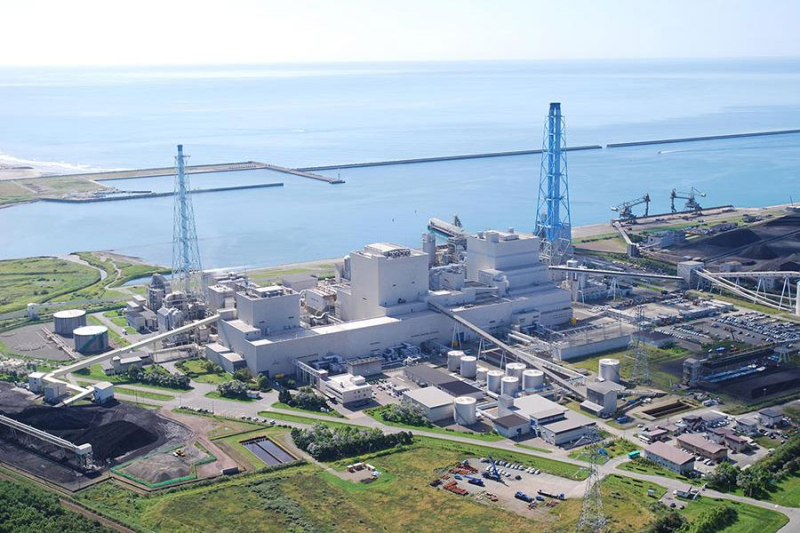
- In Japan, MHI has won the front-end engineering design for a capture facility at a Hokkaido Electric Power plant. At 5,200 tonnes a day, it would be one of Japan's largest capture volumes once complete.
- The competitive axis is cost. Standardised, modular design is expected to cut delivery times by six to twelve months, and group expertise in gas turbines and compressors lifts operating efficiency. UK-based Shell and US-based SLB are moving in.
A storage framework that has begun to move "from demonstration to deployment"
"On CCS, we have shifted from demonstration to deployment," says Yoshinori Keino, who heads the fuel-and-environment division at Japan's Agency for Natural Resources and Energy, reviewing the past few years of work on capturing CO2 from factory and power-plant flue gas and storing it underground.
Building on demonstrations in Nagaoka, Niigata, and Tomakomai, Hokkaido, the government compiled a "CCS Long-Term Roadmap" in 2023, enacted the CCS Business Act — which includes a permit system for storage — in 2024, and brought it fully into force in May 2026. The roadmap casts CCS as indispensable for hard-to-abate sectors such as materials and thermal power, and targets full-scale rollout from 2030.
Projects are following the framework. In 2024 the Japan Organization for Metals and Energy Security (JOGMEC) selected nine advanced projects, aiming to store 6 million to 12 million tonnes of CO2 a year by 2030. In the Tomakomai area, a plan to capture CO2 from Idemitsu Kosan's Hokkaido refinery and Hokkaido Electric's Tomatoh-Atsuma power plant, with Japan Petroleum Exploration (JAPEX) storing it underground, is among the most advanced; a second exploratory well was spudded in August 2026. That the framework for the storage "exit" after capture is taking shape matters. Actual investment still hinges on subsidy schemes, carbon pricing, transport-and-storage infrastructure and final investment decisions. Even so, it is a tailwind for MHI, which has the capture equipment.
AI and data centres pull in demand to pair generation with capture
A second source of enquiries is the data-centre electricity demand swelling with the spread of AI. In the US, plans are emerging to supply data centres with "lower-emission" power by pairing gas-fired generation with CCS. Generation uses a gas-turbine combined cycle (GTCC), which spins a steam turbine on the gas turbine's exhaust heat, raising efficiency and lowering CO2 emissions per unit of power generated.
In 2025 Google agreed to buy power from a CCS-equipped gas plant in Illinois. Commercial operation is planned by early 2030, supplying a data centre while capturing and storing about 90% of its CO2 emissions. This is not an MHI project, but it shows demand appearing for generation and capture as a package.
MHI is moving to offer exactly that package. With US utility Entergy (Louisiana), it signed an MOU in July 2026 to advance technology combining GTCC and CCS. The two will now work on a roadmap to cut the total cost of CCS deployment by half. Entergy's service area is a strong candidate for AI data centres, sits close to the largest CO2-transport pipeline network in the US, and has geology suited to storage. "Two years ago, we had one or two enquiries about adding CCS to a GTCC," says Ryuto Nagayasu, an executive at MHI. Now, with some customers weighing CCS across all their thermal plants, enquiries are "clearly rising".
Taking on the "cost wall" with standardisation and group strength
Even with demand in view, cost is what governs uptake. "Deploying CO2 capture equipment requires a substantial cost reduction," Nagayasu repeats.
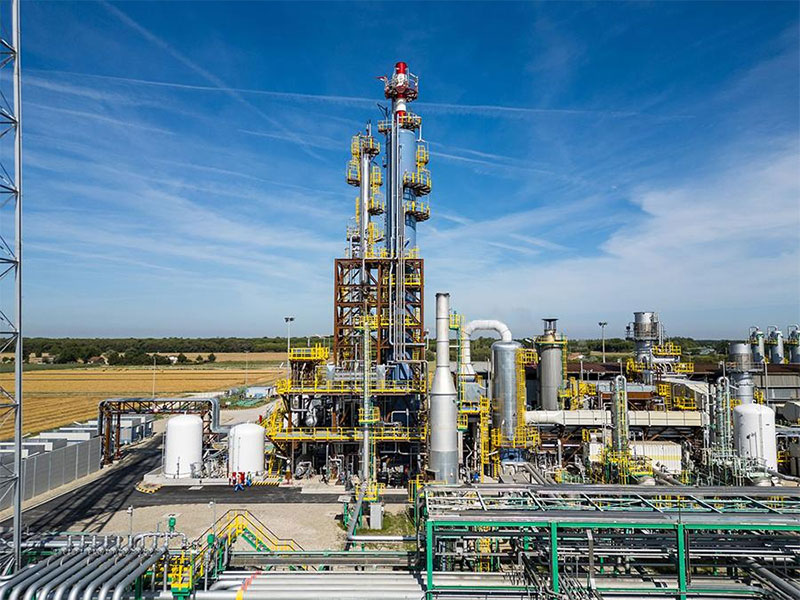
MHI's capture equipment uses a chemical-absorption method with a proprietary amine solvent. At its core are the "KM CDR Process", co-developed with Kansai Electric Power since 1990, and the "Advanced KM CDR Process", which uses an improved solvent. The system comprises three towers — a cooling tower that chills the flue gas, an absorber that sprays amine to capture the CO2, and a regenerator that separates the CO2 with steam — capturing at least 95% of the CO2 in the flue gas.
The pillar of cost reduction is a standardised, pre-engineered product line. MHI has added a 450,000-tonne-a-year model and modularised more than 90% of the equipment. By limiting on-site installation largely to pipe welding, it expects to shorten delivery by six to twelve months versus custom-built plant. Fewer workers and less time on site translate directly into lower installation cost. "In North America, where prices and labour costs are surging, holding down on-site construction cost has become essential," Nagayasu says.
It is also attacking running costs. In a capture plant, the steam used to separate CO2 from the solvent accounts for most of the operating cost. So MHI draws on an organic Rankine cycle system — from an Italian group company, capable of efficient generation from low-to-medium-temperature heat — to raise that steam from otherwise unused energy such as geothermal or factory waste heat where such sources are nearby.
Group expertise in power equipment helps too. In GTCC it runs the plant to suppress nitrogen oxides (NOx), which harm the capture unit; in waste-to-energy plants it strips chlorine from the flue gas first. For the large compressors that pipe captured CO2, MHI Compressor (Nishi-ku, Hiroshima) has developed a multi-shaft, multi-stage machine and modularised it to cut installation work. "We want to meet demand for shorter lead times on CO2 compressors," says president Morihiko Masaki. Being able to present capture through to compression as a single package of group equipment is a key differentiator.
A ~70% share built on CCU, its real strength now tested in storage
MHI delivered its first CO2 capture unit — to a chemical plant in Malaysia — in 1999, and has handled 18 projects since. Seventeen were CCU, reusing the captured CO2 to make urea fertiliser and the like. CCS with underground storage came only with the Italian project that started up in 2024. CCU has a use and a buyer for the captured CO2; CCS additionally needs transport networks, storage rights, long-term post-storage liability and policy support — a heavier business structure.
"CO2 capture has been a world of CCU, but with climate action the situation is changing," Nagayasu says. The 19th project, for a UK cement plant, is also CCS. With Australia's Worley and Germany's Heidelberg Materials, MHI won an order for the UK's first cement-plant capture facility, due to start up in 2029. It will capture about 800,000 tonnes a year and pipe the CO2 to a depleted gas field off Liverpool.
MHI is said to hold about 70% of the global market by capture volume. But much of that was built on CCU and is not necessarily the same as competitiveness in large, long-term CCS. In Japan, in the advanced project off Tomakomai, it has won the front-end engineering design for a 5,200-tonne-a-day capture facility for a Hokkaido Electric plant — set to be one of the country's largest capture volumes once complete.
The advantage is not settled. UK-based Shell and US oilfield-services major SLB are strengthening their capture technology through acquisitions, and the industry expects that "Shell, which already has commercial orders, will compete with MHI". Their strength lies in storage and transport know-how honed in oilfield development — a different starting point from MHI's equipment-centred position. The question is whether MHI can hold the lead it built in CCU across larger projects that include storage.
Projects starting around 2030 will be the touchstone
The more CO2 capture shifts from "use" to "storage", the larger and longer projects become, and the more the contest turns on total capability — securing storage sites and pipelines, and managing the CO2 after it is stored. Beyond the performance of the equipment alone, the axis becomes whether generation, capture and compression can be offered as one package at lower cost. Storage itself is handled by partners such as oil and gas companies, so for MHI, who it teams with and how much it can present as a single package also matter.
Toward carbon neutrality by 2050, the full introduction of carbon taxes and emissions trading will raise the cost of emitting CO2 — which in turn supports the economics of CCS. The focus is whether the projects starting around 2030 in various countries run at the cost and capture rate assumed. Whether MHI can hold the ~70% share it built in CCU into the storage market rests on whether this first wave of deployments can clear the cost wall. Clear it, and decarbonisation becomes one of the company's few growth areas. Fail, and the 70% share stays a record of the past.