From Hardware to Factory Data: Why Japan’s Robot Giants Are Joining Forces
Kawasaki Heavy Industries, FANUC and Yaskawa Electric have long competed in the industrial robot market. Now, the three Japanese robot makers are joining forces on a project that could reshape the foundation of factory automation in the age of Physical AI.
Kawasaki Heavy Industries, FANUC and Yaskawa Electric have long competed in the industrial robot market. Now, the three Japanese robot makers are joining forces on a project that could reshape the foundation of factory automation in the age of Physical AI.
The project has been selected under a program supported by Japan’s Ministry of Economy, Trade and Industry, or METI, and NEDO. Its title is “Building a Dataset for VTLA Foundation Models through the Collection of Visual and Tactile Data from Manufacturing Sites.” It is scheduled to run for one year, from August 2026 to July 2027.
The goal is to collect data on vision, touch, language and robot actions from real factories, and use it to build datasets that allow robots to learn complex manipulation and assembly tasks.
The key point is not that the three companies are jointly developing a new robot. What matters is that direct competitors are beginning to collaborate on a more fundamental layer: factory data standards and data collection infrastructure.
In other words, the competitive axis of industrial robots is beginning to shift. It is no longer only about hardware performance, such as speed, accuracy, payload and durability. Competition is moving toward the ability to collect, learn from and reuse operational experience from real factories.
Why Competitors Need to Work Together
Industrial robot deployment has traditionally depended on each manufacturer’s control specifications, process design at each production site and individual customization by system integrators.
When a company installs a robot on a production line, the robot usually needs to go through a teaching process. This means defining movements, work sequences, position points and how the robot interacts with the workpiece in detail.
The company then needs to select grippers, end effectors, cameras, safety equipment, jigs and other peripheral devices. These components are adjusted one by one for each production line.
This model works well for mass production with stable product types. Its limitations become clear, however, when factories must handle high-mix, low-volume production and frequent line changes.
Every time the product changes, teaching, adjustment and validation may need to be repeated. This raises the cost of automation and lengthens the time required to start production.
Physical AI aims to change this structure. It refers to AI systems that can perceive, learn and act through machines in the physical world.
If robots can learn from past work data and apply that experience to similar tasks, teaching time could be reduced. Line start-up periods could be shortened. Factories could adapt more easily to product changes and reduce their dependence on highly skilled operators.
But data collected by a single robot maker is not enough. Such data tends to be biased toward a specific type of robot, a specific control system, specific customers and specific factory conditions.
By bringing together Kawasaki, FANUC and Yaskawa, the project has a better chance of covering multiple robot platforms, multiple control systems and a wider range of production environments.
According to NEDO materials, the three Japanese robot makers together hold about 70% of Japan’s domestic market and about 25% of the global market. The project aims to use this base, while involving system integrators and end users, to build a mechanism for collecting work data from real factories.
The objective is not merely to make one company’s robot smarter. The larger goal is to build a learning foundation that can work across different robot embodiments, brands and control systems.
The Remaining Challenge Is Dexterous Manipulation
The technical core of the project is tactile data.
Industrial robots are already widely used in welding, painting, material handling and assembly. Yet in real factories, many tasks still depend on humans.
Examples include parts picking and kitting, handling soft or flexible objects, connector insertion and gripping parts that can easily slip or deform. These tasks cannot be solved by camera images alone.
Humans do not work only with their eyes. Operators also feel pressure at their fingertips, detect when an object is starting to slip and sense small resistance when two components come into contact. This non-visual information is one reason many delicate tasks remain difficult to automate.
The project proposes a “VTLA” model, which stands for Vision, Tactile, Language and Action. In other words, the model integrates vision, touch, language and movement.
Unlike VLA models, which combine vision, language and action, VTLA adds tactile data to the robot learning system.
This means robots must not only see objects, understand instructions and move according to commands. They must also learn about pressure, slip, deformation and failure patterns that occur when they touch real objects.
The target tasks include parts picking and kitting, handling flexible materials and connector insertion. These are typical examples of the last difficult areas in factory automation. They may look simple, but they depend heavily on human touch and experience.
From 18,000 Hours of Raw Data to 5,000 Hours of Training-Ready Data
Under the project plan, the participants will collect about 18,000 hours of image data, tactile data and robot motion data from factories in sectors such as automobiles, robots, food and consumer goods.
This raw data cannot be used directly to train models. It must first go through processes such as visual-tactile synchronization, labeling, anonymization, removal of commercially sensitive information and format conversion. The project aims to create about 5,000 hours of training-ready datasets.
The important point is not just the number of hours. What matters more is whether the data can be effectively learned by AI.
Camera images, tactile sensor data, robot motion logs and information on whether a task succeeded or failed must be aligned on the same timeline. At the same time, factory videos and motion logs are often directly connected to process conditions, quality control and production know-how.
Removing confidential information while preserving enough learning value will be one of the critical challenges of the project.
NEDO expects that around 30% of VTLA data can be processed into usable data. This is lower than the roughly 40% expected for more mature VLA data. The figure shows how difficult tactile data is to collect, organize and use.
In generative AI for text and images, internet data has served as a massive learning resource. Physical AI is different. What it needs is real-world data: robots touching objects, failing, correcting their movements and repeating tasks under actual factory conditions.
Data on contact, slip, force changes, small errors and behavior during failure exists only inside factories.
ABEJA, FingerVision and Universities Fill the Missing Capabilities
In addition to the three robot makers, the project involves Osaka University, FingerVision, ABEJA, the National Institute of Advanced Industrial Science and Technology, or AIST, and Nagoya University.
This structure shows that Physical AI cannot be developed by robot manufacturers alone.
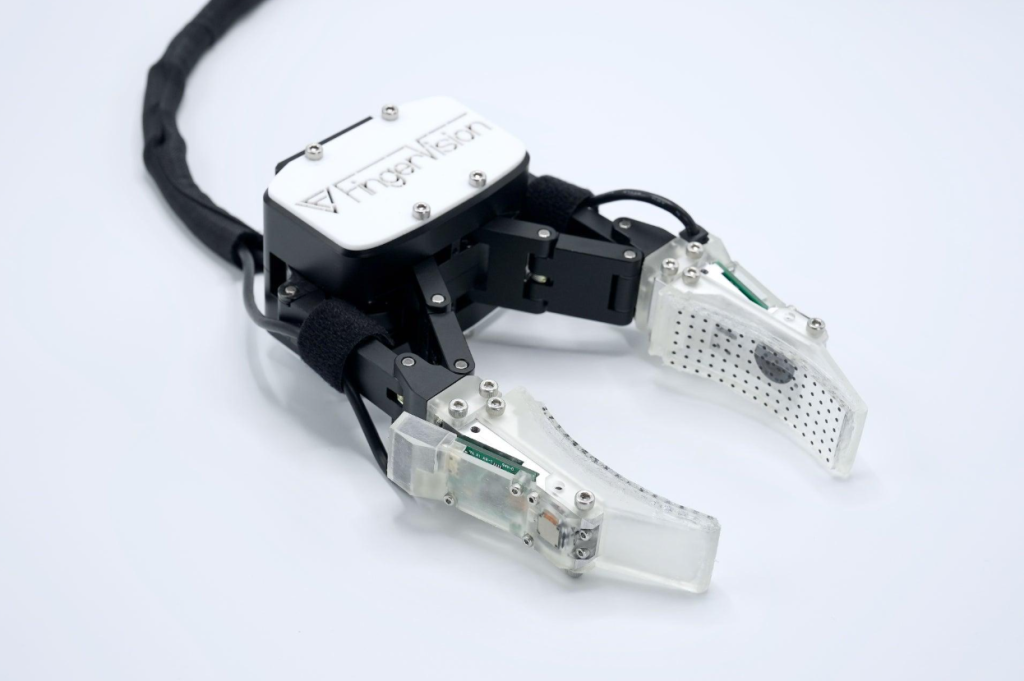
Robot makers have hardware, control systems and access to industrial customers. Universities and research institutes bring capabilities in model development and validation. FingerVision provides tactile perception technology. ABEJA plays a role in dataset design and data ecosystem development.
ABEJA’s role is not limited to building AI models. More important is how factory data should be collected, secured, anonymized, authorized, managed and provided to other parties.
For manufacturers, data governance is often more difficult than model development itself.
NEDO materials also point to the need to define different levels of disclosure and access rights depending on the user, purpose of use and sensitivity of the data. The datasets may also be divided by use case, while paid provision of the data is explored.
This means the project is not simply about creating datasets for research. The aim is to build a sustainable data ecosystem.
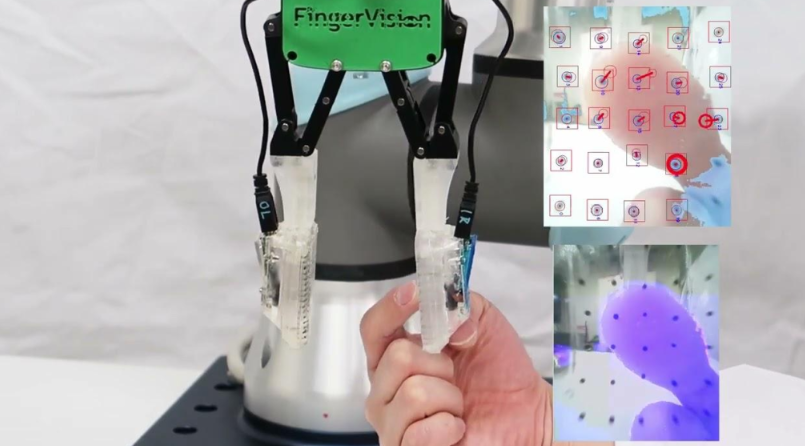
FingerVision’s involvement is also important. As tactile data becomes more critical, the value of robot grippers, end effectors, tactile sensors, force sensors, image processing systems and control software will rise.
In the future, robot competition will not be measured only by payload, speed or repeatability. It will also be measured by what the robot can sense, what it can record and whether that data can be used for learning.
The Role of System Integrators Will Also Change
The impact of the project will not stop with robot manufacturers.
In real factories, robots do not enter production lines by themselves. System integrators design the process, combine robots, grippers, end effectors, jigs, cameras, safety equipment and supporting machinery, and then handle installation, testing and adjustment.
If Physical AI moves into real deployment, the role of system integrators will also change.
Until now, their core strength has been engineering design and site-specific customization.
Going forward, that role could expand to data collection, model tuning, management of learning data inside factories and the transfer of experience from one production site to similar processes elsewhere.
In other words, system integrators may no longer be just companies that install systems. They could become connectors between shop-floor data and AI models.
This shift would affect a wide range of supporting markets, including robot grippers, end effectors, tactile sensors, force sensors, image processing equipment, control software, data acquisition systems and AI implementation services for factories.
If such data infrastructure is established, the impact would not be limited to Kawasaki, FANUC and Yaskawa. It could spread across the entire manufacturing automation ecosystem.
For manufacturing hubs such as India, Southeast Asia and other emerging industrial markets, this is not a distant issue. Automotive, electronics, food and consumer goods factories all face pressure from increasing product variation, efficiency demands, shortages of skilled workers and the rising cost of line changeovers.
Japan’s Strength Lies in Factory Experience
In the accelerating global competition in AI and robotics, Japan may not necessarily hold the strongest position in large language models or computing power.
But when it comes to data from real factories, Japan still has distinctive assets.
Japanese manufacturing has accumulated reliable production processes, strict quality control, experienced operators and industrial robot systems that have been running in real factories for many years.
This kind of experience is not public internet data. It is difficult to copy and cannot be quickly generated in a laboratory.
It is exactly this kind of shop-floor experience data that Physical AI needs.
In the future, the value of a robot will not be determined only by the performance of its arm. It will also depend on how many tasks it has learned, how many contact conditions it has encountered, what failure patterns it has experienced and whether those experiences can be transferred to new production sites.
The challenges are also clear.
Factory data is part of a company’s competitiveness. Process sequences, jig designs, part shapes, operating conditions, takt time and early signs of defects are all types of information that many companies are reluctant to disclose.
Therefore, the project must answer more than the question of whether 5,000 hours of data can be collected. The more important question is how to distinguish between data that can be shared and data that must remain inside each company.
How can business secrets be protected while still preserving enough learning value in the data?
If this boundary is not designed well, data from factories will not continue to flow into the system.
This collaboration will not be completed simply because the one-year NEDO-supported project ends. The central issue is whether data can continue to accumulate, whether models can continue to improve and whether the results can return value to real factories.
The main battlefield of industrial robots is expanding. It is no longer only about arm performance, price and service networks. It is also about the ability to collect and reuse shop-floor experience data.
The collaboration among Kawasaki, FANUC and Yaskawa is an important test for Japan’s robot industry. Can the strengths built over decades in hardware and real manufacturing sites be transformed into a data infrastructure advantage in the AI era?
Future robot competition will not be decided only by who has the stronger body. It will also be decided by who has more experience from real factories to learn from, adapt and reuse.