A Japanese Machinery Maker Plans China Output of Ultra-Precision Moulding Machines, Targets Threefold Shipments by 2028
Japan's Sodick plans to raise output of the ultra-precision injection moulding machines used to make optical communication parts for artificial intelligence (AI) data centres. The company will also st…
Japan's Sodick plans to raise output of the ultra-precision injection moulding machines used to make optical communication parts for artificial intelligence (AI) data centres. The company will also start producing them in China, and it aims to triple total injection moulding machine shipments by 2028 from the 2026 level. Its order backlog has surged, but the industrial machinery business that houses these machines earns less than half the profit margin of its main machine tool business. The central question is whether higher volumes can lift margins despite capacity constraints and tough competition.
Key points
- Sodick will increase production of three ultra-precision injection moulding models used to make the optical connector part known as the MT ferrule, among other products, and will begin producing them in China.
- The company aims to triple total injection moulding machine shipments by 2028 from 2026. Shipments in fiscal 2026 (the company's year ends in December) are about 900 units.
- The injection moulding machine order backlog stood at about four times its end-December 2025 level as of August 2026.
- For the year ending December 2026, the industrial machinery business is forecast to post sales of ¥11.5bn and a segment profit of ¥800m, a margin of just 7.0%. The machine tool business is forecast to post a 15.1% margin.
- The segment's targets for the year ending December 2029 are sales of ¥13.0bn and a 10% margin. The company says it will consider revising its medium-term plan in light of this year's results.
Three Optical Models Scale Up, but the Tripling Target Covers All Injection Moulding Machines
The machines Sodick is scaling up are three ultra-precision injection moulding models used to make the MT ferrule and other parts that connect optical fibres. An injection moulding machine forms parts by forcing molten resin into a mould. The MT ferrule is a resin part that joins multiple optical fibres in a single connection. According to media reports, Sodick will also start production in China and raise total injection moulding machine shipments to three times the 2026 level by 2028.
Shipments in fiscal 2026 are about 900 units across all models. Simple arithmetic puts the 2028 figure at around 2,700 units. The tripling applies to all injection moulding machines, not only those for optical communications, and it is a plan rather than a result.
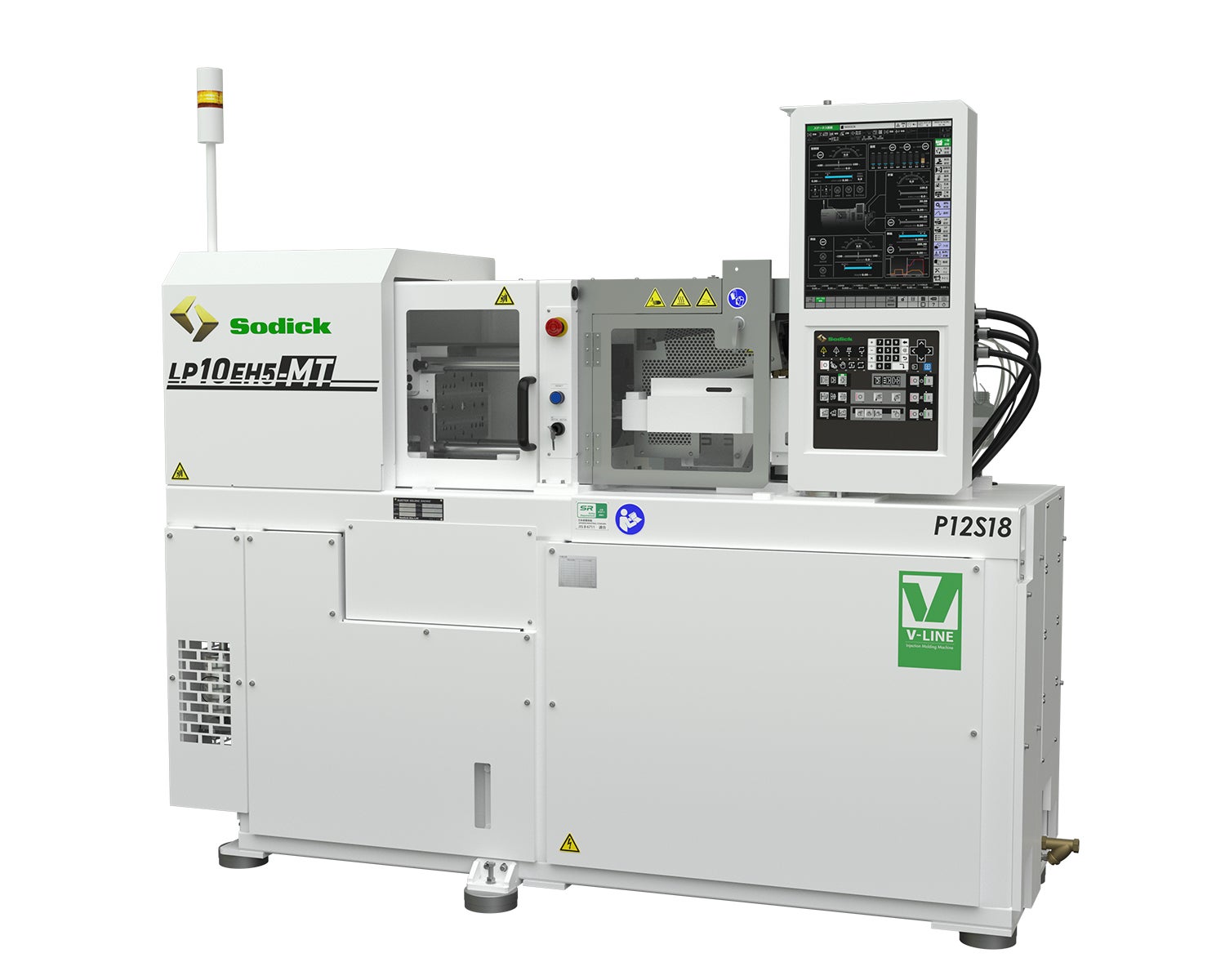
On 28 September 2026, Sodick announced two models: the "LP10EH5-MT" for MT ferrules and the "LP10EH5" for ultra-precision small parts. It said it would begin accepting orders in November. The maximum clamping force is 98 kilonewtons (about 10 tonnes), and the combined production target for the two models is 120 units a year. The "LP10EH5-MT" will be shown at the IPF Japan plastics fair at Makuhari Messe in Chiba from 1 to 5 December 2026.
Backlog Has Quadrupled, and Capacity Now Caps Sales
The immediate reason for the expansion is that production cannot keep up with orders. According to the company, the injection moulding machine order backlog in August 2026 was about four times its end-December 2025 level. At a press briefing in August, President Yuji Akutsu described injection moulding machine orders as being at a level the company had never experienced, and said the task was to strengthen production.
The capacity squeeze extends across the company. The situation varies by model, but lead times for some models exceed one year. Sodick also says certain mechanical components are becoming a procurement bottleneck. Success therefore does not depend on its own factory capacity alone.
Demand originates in data centres. Generative AI is increasing data traffic, and connectors are moving to higher fibre counts, bundling more fibres into each connector. In June, Akutsu said fibre counts had reached around 72. More fibres mean more microscopic holes, which demands higher precision in both the mould and the moulding process.
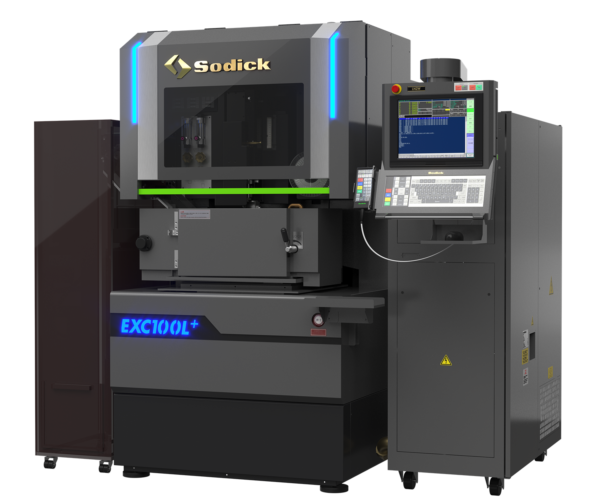
Sodick supplies machines for several steps of this process. Moulds are machined with its "K3BL" small-hole electrical discharge machine (EDM) and "EXC100L+" ultra-precision wire EDM, and its injection moulding machines then form MT ferrules with those moulds. EDM removes metal using electrical sparks. Output of the "EXC100L+" is being raised from about two units a month in 2025 to about four or five in the second half of 2026, with a target of five to ten a month from 2027.
China Production Could Expand from Entry-Level to Ultra-Precision Machines
The move is notable because it would broaden the role of Sodick's Chinese manufacturing base. Sodick makes injection moulding machines at its Xiamen plant in Fujian province, where a new factory that began operating in January 2023 has capacity of about 1,200 units a year. When construction began, that factory was intended to produce entry-level models. Adding ultra-precision machines would extend Chinese production from mainstream models to high-precision ones. Existing capacity may be used, but the division of production has not been made clear.
Proximity to customers is the likely reason for producing in China. "China moves really fast, investing in equipment one project after another," Akutsu said. The company also explains that Greater China is the largest market for moulds and that EDM demand is rising mainly in that region.
Demand is not confined to China, however. Optical connector demand remains firm, centred on Japan, Greater China and the United States. Demand for MT ferrule injection moulding machines is also rising within Japan, and the backlog there is building. Which regions will receive the added output remains a point to check.
Parts Makers Are Expanding Too, and Micro-Machine Orders Jumped in a Single Month
Wider demand shows up in parts makers' investment and in industry statistics. In June, Hakusan, part of the Furukawa Electric group, announced a new factory in Kahoku, Ishikawa Prefecture, with an investment of about ¥5bn. It plans mass production of ferrules for very small multi-fibre optical connectors from around April 2028, and will increase its equipment count to about 1.5 times the current level or more.
Japanese industry statistics show injection moulding machine orders of 1,728 units in July 2026, up 92.2% year on year, with exports accounting for 1,407 units. The sharpest rise came in micro machines with a clamping force under 20 tonnes, at 9.9 times the year-earlier figure. The "LP10EH5" series falls into this class. Major makers took the view that connector demand for AI data centres was spreading to small machines, with China at the centre. This is a single month's figure, however, and later statistics will need to confirm whether it lasts.
Tripling Volume Does Not Guarantee Higher Profit
This is where a gap with the medium-term plan appears. Under "Grow Forward 2029", detailed in June, the industrial machinery business targets sales of ¥13.0bn and a segment profit of ¥1.3bn for the year ending December 2029. The sales forecast for the year ending December 2026 is already ¥11.5bn, so the target implies growth of only about 13%. It is not possible to tell whether the gap between this target and tripled unit volume reflects a change in model mix or plan assumptions that may no longer fit current conditions. Because average selling prices and model mix are not disclosed, tripled units cannot simply be converted into sales.
At its August results meeting, Sodick said it would not revise the plan for now and would consider doing so after seeing this year's results. In June, Akutsu had described data-centre-related demand as "crazy" and said the plan had been formulated on a balanced basis without relying on that demand. The new expansion plan can be read as a step beyond that cautious premise.
The earnings challenge is already visible in the figures. The industrial machinery business raised its sales forecast for the year ending December 2026 from ¥10.5bn to ¥11.5bn, yet left its profit forecast at ¥800m. Sodick says competition is tough, mainly in general-purpose machines. Akutsu, for his part, cited price optimisation, cost reduction, higher productivity and shorter delivery times through stronger capacity as ways to improve the quality of orders.
China production could affect these four items in different ways. Building close to customers could help shorten delivery times, and local production may leave room to reduce costs. On the other hand, launching ultra-precision machines carries a cost, and price optimisation may become harder as delivery times shorten. Price rises are easier to push through while backlogs build, but that premise changes once supply increases.
Will Capacity Stay Useful When Demand Cools? The 6 November Results Are the First Test
The company has offered a qualified view of how long demand will last. Akutsu expects it to continue until at least 2030, yet at the results meeting Sodick said it was difficult to answer clearly on how long investment would continue. The added capacity must remain usable even when optical investment cools.
The first checkpoint is the results for the third quarter of the year ending December 2026, scheduled for 6 November 2026. The points to watch are the level of the backlog, the timing and scale of the expansion, and any explanation of how the medium-term plan will be treated.
The measure of the tripling plan is the industrial machinery margin rather than shipment volume. The gap of about eight percentage points with the machine tool business partly reflects differences in business structure, so the first question is whether the 7% range can rise to the 10% target for the year ending December 2029. If the expansion merely clears the existing order backlog, more machines will ship without any change in earning power.