What DMG MORI’s ¥800 Billion Bet Means for Advanced Manufacturing in India
Japan’s DMG MORI is trying to change the way a machine tool maker creates value.
Japan’s DMG MORI is trying to change the way a machine tool maker creates value.
The core of the shift is not simply to sell more machines. DMG MORI wants to move deeper into its customers’ manufacturing processes: machining strategy, automation, maintenance, service engineering and the use of shop-floor data.
For India, where electronics, electric vehicles, aerospace, defence manufacturing and semiconductor-related investments are expanding, this shift offers a useful lens. It shows how advanced manufacturing competitiveness is moving from machine ownership to process capability, service support and data-driven operations.
In other words, DMG MORI is trying to move from being a machine tool supplier to becoming a process partner for advanced manufacturing.
This shift is particularly relevant for sectors such as semiconductor equipment, aerospace, defence, medical devices and energy. These industries require high-precision machining, difficult-to-cut materials and stronger integration between machines, tools, fixtures, automation and maintenance.
DMG MORI has expanded its ultrasonic machining plant in Germany, is preparing a new European headquarters in Munich, and is embedding AI into design, service and machining support. President Masahiko Mori has set a target of reaching ¥800 billion each in revenue, total assets and market capitalisation around 2030.
The goal is not just about scale. It is about redefining the business model of a machine tool manufacturer.
The real challenge is margin, not only revenue
DMG MORI’s business is already showing signs of recovery.
In 2025, the company posted revenue of ¥515 billion, EBIT of ¥19 billion and an EBIT margin of 3.7%. In the first quarter of 2026, orders reached ¥155.4 billion, a quarterly record. Revenue was ¥135.5 billion, while EBIT stood at ¥3.4 billion.
A recovery in orders is positive. But the gap to the ¥800 billion target remains significant.
To lift revenue from the ¥500 billion range to ¥800 billion, DMG MORI cannot rely only on selling more machine tools. It needs to raise the value per machine, expand automation and turnkey projects, and increase recurring income from MRO, spare parts, engineering services and digital services.
Turnkey projects are particularly important because they go beyond supplying a machine. In such projects, a machine tool maker provides a more complete production solution, including process design, automation, tooling, setup and support.
MRO refers to maintenance, repair and operations. In the machine tool business, it matters because the customer relationship does not end when the machine is delivered. Service quality, spare parts availability, preventive maintenance and process support can become long-term sources of revenue.
Mori has indicated that if sales are around ¥500 billion, the operating margin would be roughly 6%. At ¥650 billion, it could reach around 8%. At ¥700 billion, 10% becomes possible. With further growth, a margin of 12–13% may also come into view.
That means DMG MORI’s ¥800 billion ambition is not simply a volume target. It is a plan to reach a scale where prior investments in factories, people, MRO, European operations and AI can be absorbed, while margins recover.
For manufacturers in India, this is an important signal. In high-end capital equipment, profitability increasingly comes not from hardware alone, but from process know-how, service networks, automation and data-driven support.
From automotive dependence to high-difficulty machining
Machine tool demand has long been closely linked to investment cycles in the automotive industry.
But the automotive sector is undergoing structural change. Electrification, shared mobility and changing patterns of vehicle ownership are weakening the old logic that rising vehicle sales automatically lead to rising machine tool investment.
Mori’s view of the automotive sector is notable. He does not see current difficulties only as a short-term demand issue. He argues that the way vehicles are used is changing. Just as machine tools aim to consolidate multiple machining steps into one machine, the automotive sector also needs to think about how to improve utilisation and operating efficiency.
Against this backdrop, DMG MORI is shifting attention to semiconductors, aerospace, defence, medical devices and energy.
These industries have a common feature: the workpieces are becoming larger, materials are becoming harder to machine, and precision requirements are rising. Titanium, nickel-based superalloys, CFRP, ceramics and glass are becoming more important.
Such markets do not require low-cost general-purpose machines. They require complete machining solutions: 5-axis machining, multitasking machines, ultrasonic machining, measurement, automation, cutting tool selection and fixture design.
DMG MORI’s concept of MX, or Machining Transformation, should be understood in this context. The company is trying to move beyond selling individual machines and towards optimising the customer’s entire machining process.
Why the German ultrasonic plant matters
A key example is the expansion of DMG MORI’s Stipshausen plant in south-west Germany.
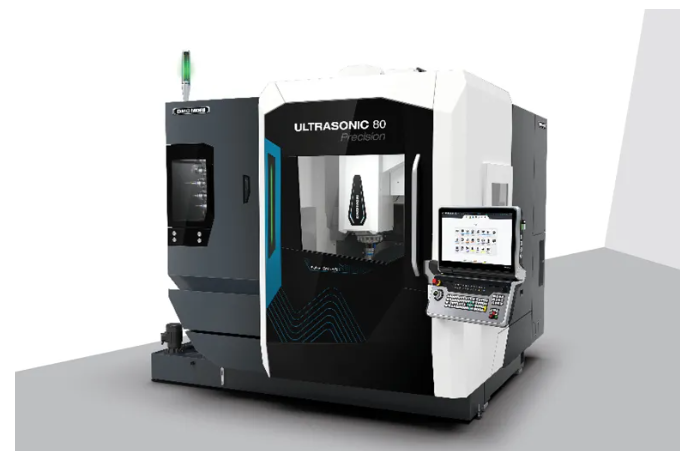
This plant is the group’s production base for ultrasonic machine tools. These machines combine 5-axis machining centres with ultrasonic vibration to process hard and brittle materials such as glass and ceramics.
After the expansion, the plant’s floor area reached about 4,400 square metres, an increase of roughly 47%. Production capacity doubled. The new ULTRASONIC 80 Precision can handle workpieces with a diameter of 800 mm, height of 400 mm and maximum weight of 350 kg. Compared with the previous model, which handled a diameter of 600 mm, height of 400 mm and maximum weight of 300 kg, the new machine is clearly aimed at larger workpieces.
One target is ceramic and glass components for semiconductor manufacturing equipment.
As demand for AI servers and data centres expands, demand for high-precision components used in semiconductor equipment is also likely to grow. The semiconductor industry has investment cycles, but the long-term direction toward miniaturisation and three-dimensional stacking remains intact. That means demand for difficult, high-precision machining of equipment components will remain important.
Mori uses the phrase “Just in Case” to describe semiconductor-related demand. This differs from the “Just in Time” logic familiar in automotive manufacturing. Semiconductor-related supply chains often need to prepare capacity before the next investment wave arrives.
The Stipshausen expansion is DMG MORI’s move to position itself ahead of that wave.
The competition is no longer only about machine performance
DMG MORI’s shift also reflects a broader change in global machine tool competition.
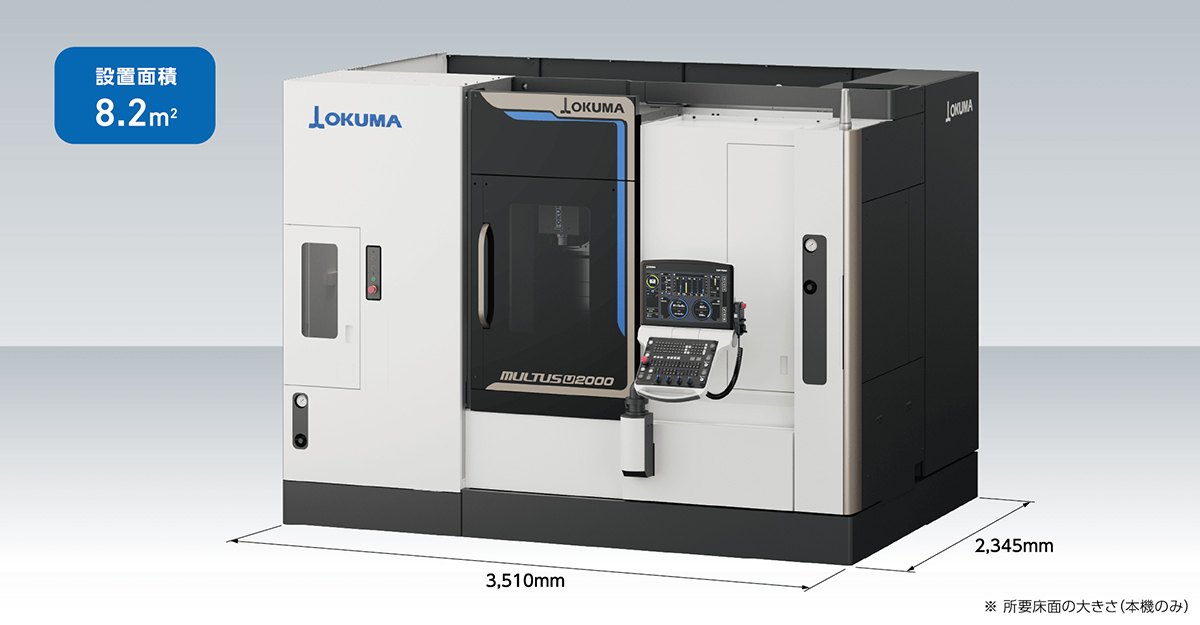
In Japan, companies such as Okuma, Mazak and Makino are also strengthening high-precision machining and automation. European machine tool makers have strong customer bases in aerospace, medical and precision engineering. Cost-competitive Asian manufacturers are also improving rapidly, backed by large domestic markets and stronger local supply chains.
But in high-precision sectors such as aerospace, semiconductor equipment components and medical devices, customers do not choose machines on price alone. They also evaluate process experience, long-term maintenance capability and global service networks.
DMG MORI’s advantage lies in its Japanese-German integration, its European base, its 5-axis and multitasking machine portfolio, its global MRO network, and the machining and maintenance data it has accumulated.
According to Mori, DMG MORI’s market share in Japan is around 10%, while in Germany it is close to 30%. He also says that about half of the DMG MORI machines sold in the United States are made in Germany.
That means DMG MORI is a Japanese company, but its business structure is deeply embedded in European technology customers and US aerospace and defence demand. This is very different from simply exporting machine tools from Japan.
The future competition in machine tools will not be decided only by spindle performance or machine rigidity. It will be decided by the ability to understand the customer’s process and integrate machining conditions, cutting tools, fixtures, measurement, automation and maintenance services.
The competitive focus is shifting from the ability to build machine tools to the ability to design machining processes.
Munich as a front line for technology customers and regulation
DMG MORI’s European expansion is also part of this transformation.
The company plans to open a new European headquarters in Munich in 2027. The first floor will include a technology centre of about 1,500 square metres, displaying 20 advanced machine tools, 10 automation solutions and digital technologies.
This is not just a sales office expansion.
Europe is home to many customers with difficult machining needs in aerospace, medical devices, precision machinery and energy. The more difficult the material, workpiece and process challenge, the more opportunity a machine tool maker has to accumulate process knowledge. For DMG MORI, Europe is not only a sales market. It is also a technology development market.
Regulation is another factor.
The European Union is advancing the Cyber Resilience Act. As machine tools become connected to networks for remote monitoring, predictive maintenance, machining data collection and AI support, they are no longer purely mechanical products. They also become digital products.
To expand in Europe, mechanical precision alone is not enough. Software capability, data management and cyber security will also matter. The new Munich headquarters will help DMG MORI connect with technology customers, respond to regulatory change and attract skilled talent.
Pfronten’s AGV line points to margin improvement
If Munich is the front line, the Pfronten plant in Germany is the centre of DMG MORI’s European manufacturing capability.
The plant covers about 150,000 square metres, has around 1,600 employees, produces more than 50 machine models and has annual output of about 1,000 units. As a development and production base for 5-axis machining centres, it represents DMG MORI’s manufacturing strength in Europe.
One notable feature is the use of an AGV-based flow line for assembling monoBLOCK 5-axis machining centres. AGV stands for automated guided vehicle. It is an automated transport vehicle used inside a production facility.
Machine tool assembly is usually based on cell production. Because the machines are large and heavy, the machine bed is typically fixed in one place, while workers move around it to assemble parts. The drawback is that delays and missing parts can be difficult to detect.
At Pfronten, DMG MORI uses 34 dedicated AGVs. Machine tools are placed on AGVs and move through the assembly process at a fixed rhythm. If one stage falls behind, the problem becomes visible immediately. Parts required for the next process are prepared next to the machine, making shortages easier to identify.
The concept is similar to applying automotive line-production thinking to machine tool assembly. But it is not simple mass production. Machines with different specifications, such as spindle, table and tool magazine configurations, can be assembled in the same mixed-production line.
The meaning of this system is clear: produce high-value machine tools with a more visible and stable process. For DMG MORI, this is not only a manufacturing innovation. It is also a foundation for margin improvement.
AI is about reusing shop-floor knowledge
DMG MORI’s AI strategy should not be seen only as adding AI features to machines.
Of course, AI inside machine tools will increase. Examples include AI-based chip removal, optimisation of spindle speed based on vibration during machining, and collision avoidance. These are direct use cases of AI in machine tools.
But the bigger value lies in reusing knowledge about machining, maintenance and design.
Machine tool programming is complex. Cutting tool selection, fixture design and workholding all require experience. If AI can refer to past machining cases and repair histories, then suggest machining conditions, cutting tools and troubleshooting steps, it can become an important tool in an era of skilled-labour shortages.
DMG MORI has data from connected machine tools around the world. It also has maintenance data collected by MRO engineers at customer sites. Test machining data and digital twin data are also accumulating. A digital twin is a digital model used to simulate a machine or production process.
Mori suggests that an AI agent for each machine tool user could become a standard practice around 2030.
This would change the competitive logic of machine tool makers.
In the future, differentiation will not come only from mechanical precision and machine rigidity. It will also come from how much shop-floor data a company has, and how well it can turn machining conditions and maintenance knowledge into AI capability.
Machine tools will gradually move from being standalone equipment to becoming repositories of shop-floor data and manufacturing knowledge.
Why this matters for India
India is expanding its manufacturing ambitions across electronics, semiconductors, electric vehicles, aerospace, defence production and medical devices. Many of these sectors require higher-precision machining than traditional mass-production industries.
The lesson is especially relevant for Indian auto component suppliers, aerospace tier suppliers, defence manufacturers, EMS companies, medical device makers and precision engineering firms that are trying to move up the value chain.
For Indian manufacturers, the key question is not only which machine to buy, but how to build a repeatable process around it: tool life management, fixture standardisation, preventive maintenance, operator training and data collection.
This is where the DMG MORI case is useful. The next phase of manufacturing competitiveness will not depend only on buying advanced machines. It will depend on whether companies can design the right process around those machines.
For India’s machine shops and component suppliers, this means supplier evaluation should go beyond machine price. Long-term service capability, process engineering support, automation readiness and digital connectivity will matter more.
As global supply chains look for reliable manufacturing partners, the ability to manage complex machining processes will become a source of differentiation.
The next decade will redefine machine tool makers
DMG MORI’s recent moves should not be viewed as separate news items.
The Stipshausen expansion prepares the company for difficult machining demand in semiconductor equipment components. The new Munich headquarters connects it with European technology customers and digital-product regulation. The AGV line at Pfronten improves the production efficiency of high-value machines. The AI agent strategy is about reusing machining and maintenance knowledge from the field.
The common logic is a shift from selling machine tools to becoming involved in the customer’s machining process and maintenance data.
Manufacturing floors are becoming more complex. Materials are becoming harder to machine. Precision requirements are rising. Skilled labour is becoming harder to secure. Machines must be connected. Regulations are becoming stricter.
If machine tool makers remain only hardware manufacturers, it will become harder to build long-term advantage.
DMG MORI’s ¥800 billion target is therefore not only a test of whether market demand can continue to recover. It is a test of whether the company can move from being a machine tool manufacturer to becoming a designer of manufacturing processes.
That shift will define how DMG MORI is valued over the next decade.