JTEKT Brings Chrome-Plating Work In-House with a Laser-Cladding Composite Grinder, Due in October
Japan's JTEKT will launch two new cylindrical grinders in October. One is the "LC2000," which the company calls the world's first composite grinder to combine laser cladding — forming a metal coating with a laser — and grinding in a single machine. The other is the "G5 Series,"…
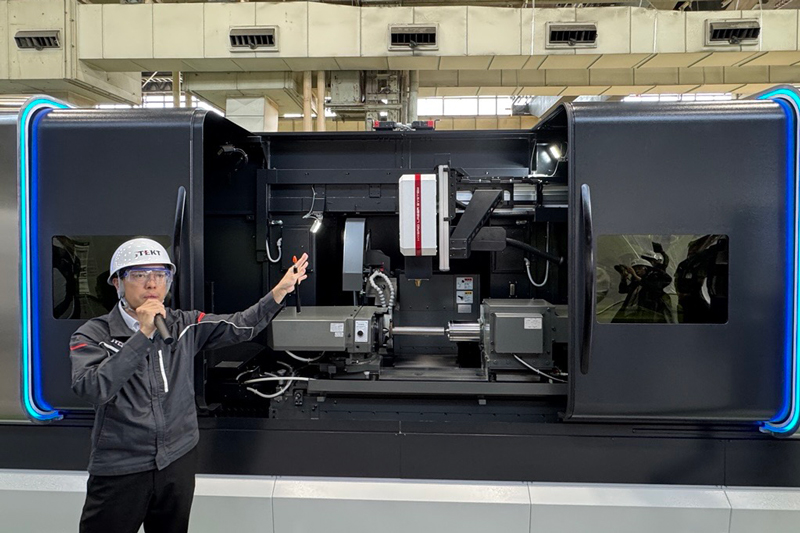
Japan's JTEKT will launch two new cylindrical grinders in October. One is the "LC2000," which the company calls the world's first composite grinder to combine laser cladding — forming a metal coating with a laser — and grinding in a single machine. The other is the "G5 Series," a large grinder that raises the maximum workpiece weight supported between centres by 50% to 1,500 kilograms. JTEKT says the LC2000 can cut the lead time for the surface treatment that replaces hard chrome plating — as long as several months when outsourced — to a single day in-machine. They are the company's first new machine-tool products in about four years; pricing is undisclosed. The key question is whether the investment can compete with the total cost of outsourced plating.
Key points
- JTEKT has developed two new cylindrical grinders, to launch in October — its first new machine-tool products in about four years. Pricing is undisclosed.
- The "LC2000" performs laser-cladding surface treatment and grinding in a single set-up. JTEKT calls it a world first and begins sales on 26 October.
- As a substitute for hard chrome plating, the company says a surface treatment that takes months when outsourced can be done in-machine in a day. The process also avoids hazardous substances such as hexavalent chromium.
- The "G5 Series" is a large cylindrical grinder supporting workpieces of 1,500 kilograms between centres (up 50%), with a maximum centre distance of 4,000 millimetres. It automates work-rest adjustment.
- Both machines will be shown at JIMTOF 2026 (Tokyo Big Sight), which opens on 26 October.
JTEKT brings plating in-house with a composite grinder
JTEKT has developed two new cylindrical grinders for launch in October. They are the company's first new machine-tool products in about four years, and pricing is undisclosed for now.
The first is the "LC2000," a composite grinder with a laser-cladding surface-treatment function. Laser cladding melts metal powder with a laser to form a coating on the workpiece; the machine performs this and grinding in a single set-up. JTEKT describes this configuration as a world first. Sales begin on 26 October.
The second is the "G5 Series" large cylindrical grinder. It supports workpieces of up to 1,500 kilograms between centres, 50% more than the previous model. With a maximum centre distance of 4,000 millimetres, it extends grinding to large workpieces in construction machinery, industrial machinery and steelmaking that exceeded the previous model's weight capacity.
Replacing hard chrome plating: months of outsourcing, or a day in-machine
The LC2000's main use is as a substitute for hard chrome plating.
Hard chrome plating is a standard surface treatment that hardens the surfaces of cylindrical parts such as rolls, but it is usually outsourced to specialists and can take months. The LC2000 replaces that treatment with in-machine laser cladding. JTEKT says the lead time of the conventional process, outsourcing included, can be cut from months to a day.
There is an environmental difference too. Hard chrome plating unavoidably handles hazardous substances such as hexavalent chromium, carrying regulatory and wastewater burdens. Laser cladding melts and deposits metal, forming a coating without using such substances.
Because material can be added locally to a damaged area and then finish-ground on the same machine, JTEKT also lists repair and reconditioning of rejected cylindrical parts and used rolls among the uses — building the surface back up rather than scrapping the whole part.
A single set-up saves time; laser cladding sets the conditions
The LC2000's technical distinction is completing coating and finish grinding in one machine and one set-up. But the time saving works in two separate ways.
A single set-up eliminates the re-positioning and inter-machine transport involved when a workpiece is re-mounted between processes. Grinding on the same datum immediately after coating reduces positioning error and set-up effort. The bulk of the lead-time cut, however, comes from replacing outsourced plating with in-machine laser cladding. Process consolidation and the elimination of outsourcing stack up as two distinct effects.
That said, because laser cladding applies heat to melt metal into the base material, coating adhesion and thermal effects depend on the workpiece material and dimensions, as well as the laser-cladding parameters. The intended scope is mainly cylindrical parts such as high-precision rolls; it does not replace every surface treatment. What decides whether it can be adopted is the range of base and coating materials it can handle, the parts that can tolerate the heat, the volume of treatment required, and the break-even against outsourcing costs, including powder-material cost and utilisation. Without a disclosed price, however, the economics of adoption cannot yet be assessed.
The larger G5 automates a skill-dependent rest adjustment
The G5 Series tackles the deflection and run-out that have long challenged the grinding of large workpieces.
Large workpieces over a long centre distance deflect under their own weight and cutting forces, and tend to run out as they rotate. The work rest — a support that holds the workpiece from its outer surface — counters this, but its adjustment has depended on the intuition and knack of skilled operators. The G5 automates that adjustment, narrowing the variation from one operator to another and aiming to reduce lengthy set-ups and the re-adjustment needed whenever the operator changes.
From order-taking to process proposals, price decides adoption
JTEKT positions the two machines as the first step in a shift from an order-taking business to one that proposes processes. An executive officer called the shift a "proactive" move and said the machines were developed by drawing out needs that customers had not fully articulated.
Against a model that responds only after an order, what JTEKT calls "solutions" selling means proposals that reshape the customer's own processes and cost structure — bringing plating in-house, or repairing and reconditioning parts. It sells not a standalone machine but a way to bring an entire outsourced process in-house.
What will decide adoption is not the novelty of a claimed world first. It is whether JTEKT can ensure a sufficient volume of parts suitable for laser cladding, and beat the total cost of outsourced plating once powder cost and utilisation are counted in. Whether the shift to process proposals succeeds will show only after that. The pricing and case studies presented at JIMTOF 2026 in October will provide the first basis for judging its prospects.