Japan's Sodick to Take November Orders for "MT Ferrule" Moulding Machines as AI Data-Centre Demand Moves Upstream
Japan's Sodick said on 28 September 2026 that it would begin taking orders in November for two injection moulding machines designed for ultra-precision parts. The machines target "MT ferrule" components for the optical connectors used in AI data centres, where positional…
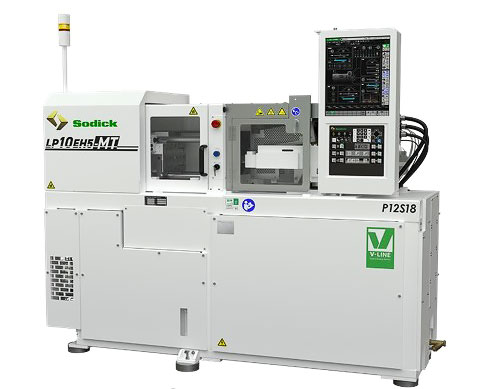
Japan's Sodick said on 28 September 2026 that it would begin taking orders in November for two injection moulding machines designed for ultra-precision parts. The machines target "MT ferrule" components for the optical connectors used in AI data centres, where positional accuracy on the order of one ten-thousandth of a millimetre (0.1 micrometre) must be held across continuous production. The feasibility of mass production depends on reproducing that accuracy from shot to shot while controlling the load on the mould. Sodick has set a combined annual sales target of 120 units for the two models.
Key points
- Sodick will begin taking orders in November 2026 for two ultra-precision injection moulding machines, the "LP10EH5-MT" and the "LP10EH5", with a combined target of 120 units a year. Prices have not been disclosed.
- The "LP10EH5-MT" is a dedicated machine for the ultra-precision moulding of "MT ferrules", multi-fibre optical-connector parts that join several optical fibres at once.
- Its proprietary "V-LINE" method separates the plasticising unit from the injection unit to secure the injection consistency that micro-hole moulding requires.
- "Invar" components and a support structure at the platen centre curb thermal expansion and mould distortion, aiming to extend mould life and hold quality over the long run.
- Both machines will be shown at the 11th IPF Japan 2026 (International Plastics Fair) at Makuhari Messe in Mihama Ward, Chiba, from 1 to 5 December 2026.
Two machines with a divided role: a connector specialist and a small-part generalist
Sodick has announced two models: the "LP10EH5-MT" for "MT ferrules" and the "LP10EH5" for ultra-precision small parts. The two share a common base machine but are configured for different production applications. The "LP10EH5-MT" is dedicated to the mass production of "MT ferrule" components, while the "LP10EH5" covers a broad range of ultra-precision small parts such as electronic and medical components. Orders open in November 2026, with a combined sales target of 120 units a year. Prices have not been disclosed.
An "MT ferrule" is a multi-fibre optical-connector part that joins several optical fibres in a single component. Made of resin, it carries a row of fine holes through which the fibres pass. Typical fibre counts include 12 and 24, and each hole must be positioned to an accuracy on the order of one ten-thousandth of a millimetre, or 0.1 micrometre. If a hole shifts even slightly, the optical signal attenuates at the joint and transmission quality falls. The ability to achieve that accuracy in resin moulding, and to hold it through mass production, has long decided the competitiveness of the parts makers.
Why more fibres per part raise the bar for mass production
Why a dedicated machine now? Behind it lies the expansion of AI-oriented data centres. Because training and inference for generative AI move vast volumes of data between servers, optical communication is being pushed to higher speeds while more circuits are bundled into a single connector part, a trend towards higher fibre counts. Sodick says demand is rising, against the backdrop of AI, for injection moulding machines capable of ultra-precision work as high-speed optical networks spread.
Higher fibre counts raise the moulding difficulty on two fronts. First, as the holes per part rise from 12 to 24, the number of holes that must meet 0.1-micrometre positional accuracy simply increases. Second, optical connectors are high-volume consumable parts, so that accuracy must be held through round-the-clock production. Achieving high precision once is a different problem from repeating it across tens of thousands of shots. Conventional mass-production machines may struggle in this area, which helps explain Sodick's decision to develop a dedicated model.
Taming injection variation and the load on the mould
The technical core of the "LP10EH5-MT" rests on two things: injection consistency and control of the load placed on the mould.
For the first, injection consistency, Sodick relies on its proprietary "V-LINE" method. A typical injection moulding machine combines the unit that melts the resin with the unit that meters and pushes it into the mould. The "V-LINE" method separates the two, metering and injecting the molten resin through a thin plunger. By decoupling melting from injection, it becomes easier to hold down shot-to-shot variation in resin volume and pressure. The company says it has sped up the control cycle from a conventional 100 microseconds to 50 microseconds, improving the reproducibility of how resin fills the fine holes.
The second is control of the load and displacement at the mould. In ultra-precision moulding, the machine and mould deform and wear slightly as moulding is repeated, and accuracy gradually deteriorates. The machine combines a structure that supports the centre of the platen, the plate on which the mould is mounted, with "Invar", an alloy that expands little with temperature, to curb thermal expansion. It also raises the straightness of the mould's opening and closing, and adopts a "double nozzle-touch mechanism" that seats the nozzle against the mould at two points, reducing uneven loading and displacement of the mould. This, the company says, extends mould life and sustains moulding quality over long periods.
The other model, the "LP10EH5", is a general-purpose machine for a broad range of ultra-precision small parts. It newly adopts a "tie-bar-less" design, which does not hold the platen with the tie bars that clamp the mould, curbing uneven load and twist during opening and closing to raise straightness. Its hydraulic unit is now servo-controlled to speed up start-up motion, balancing moulding speed with stability. By announcing a part-optimised MT machine and a broad-coverage small-part machine together, Sodick is moving to address a wider range of demand for ultra-precision moulding.
In continuous operation, mould life drives the cost of mass production
The announcement is also one example of how far the benefits of AI-oriented investment reach. While servers and semiconductors draw attention, demand is also flowing to the fine parts that make the optical wiring between them possible, and to the machines that mass-produce those parts. An "MT ferrule" can only be mass-produced where ultra-precision resin moulding and mould-adjustment skills come together; entry barriers are high, and Japanese firms have held the top global shares in this part. Sodick supplies the machines used to make the component, and the new model appears intended to capture downstream demand generated by AI investment.
The basis of competition here is not single-shot moulding accuracy alone. For parts moulded continuously in large volumes, such as optical connectors, mould life and maintenance effort directly drive the cost of mass production. Sodick has put mould-life extension and lower maintenance load to the fore because it treats meeting precision, productivity and maintenance at once as the basis of competition. What matters in this market is not headline peak performance but whether a machine can hold accuracy for long stretches without stopping.
The test: real orders, and holding accuracy over the long haul
The 120-unit figure is a combined sales target for the two models, not a result. The first thing to watch is how far actual orders build towards it after orders open in November. That will be the first gauge of how strongly AI-oriented investment has materialised as demand for parts-moulding machines.
Beyond that, the essential test is whether the "long-run quality retention", "extended mould life" and "lower maintenance load" the company has cited are borne out on the production floor. As fibre counts rise to 24 and 36, the number of holes that must meet positional accuracy grows, and holding accuracy through continuous moulding becomes harder still. The decisive test will be whether the machine can retain positional accuracy across tens of thousands of shots, not merely achieve peak accuracy once. That is where the true value of this dedicated machine will be settled.