Japan's FANUC Edges Towards Robots That Need No Vision Teaching: AI Picks Workpieces Without Shape Registration
Japan's FANUC, a leading industrial robot maker, has developed "AI Masterless Vision", which removes the need to register the shape of each workpiece. When an object is specified in everyday terms, a pre-trained AI recognises its three-dimensional shape. Shipping is planned for…
Japan's FANUC, a leading industrial robot maker, has developed "AI Masterless Vision", which removes the need to register the shape of each workpiece. When an object is specified in everyday terms, a pre-trained AI recognises its three-dimensional shape. Shipping is planned for January 2027, but accuracy, speed and range of application have not been disclosed. The key question is whether it merely reduces vision-configuration work or also cuts total process changeover time.
Key points
- What: "AI Masterless Vision", a physical AI (AI that perceives and acts in the real world) system for industrial robots. Announced on 27 October 2026, with shipping planned for January 2027
- What changes: According to the company, an instruction in general terms such as "cylindrical part" lets the robot visually identify and carry workpieces that have not been individually taught. "Vision teaching", the registration of each workpiece's shape so the robot can recognise it, is no longer needed
- How it works: A camera and AI recognise an object's three-dimensional shape. The AI has learned in advance how objects look under different lighting, and how transparent and glossy objects appear
- What is not disclosed: How three-dimensional information is captured, the range of shapes supported, and whether gripping methods and motion paths also become setup-free
- The open question: How far the time from changeover to stable operation can be cut compared with conventional teaching
Instructing "cylindrical part" and moving stock without individual teaching
FANUC announced on 27 October 2026 that it had developed "AI Masterless Vision" for industrial robots. Shipping is planned to start in January 2027.
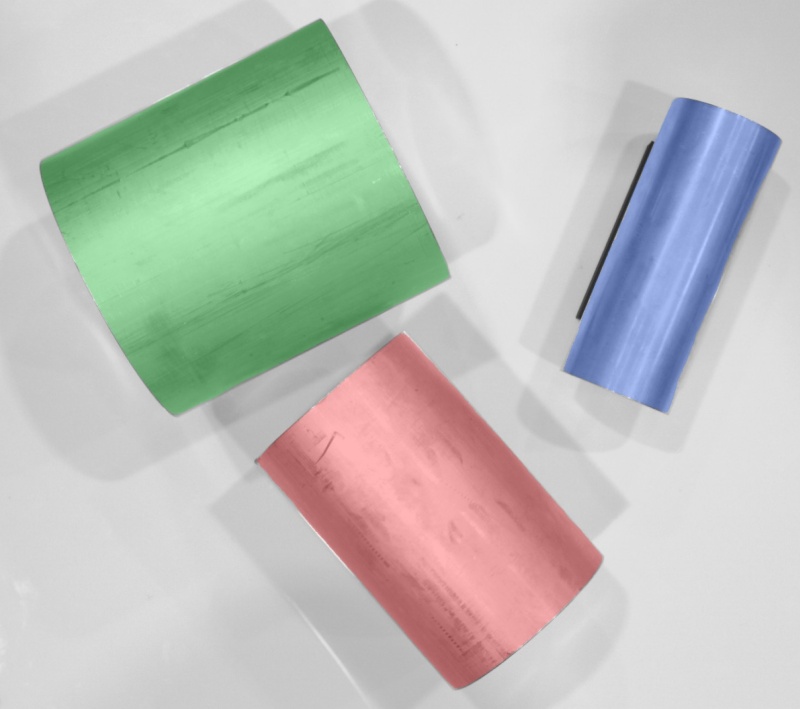
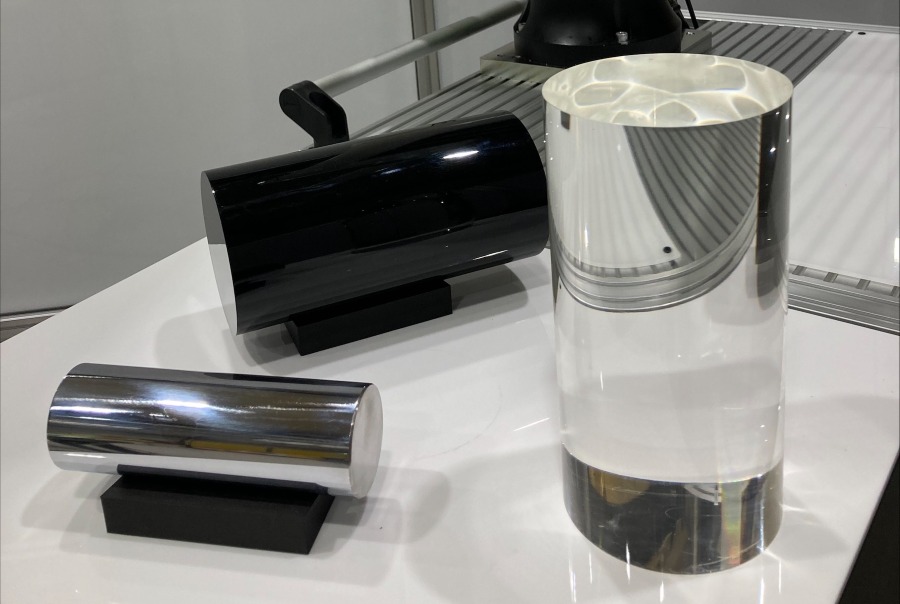
According to the company, it has equipped its AI robots with what it calls "common sense about objects", so that they can recognise an object specified in general terms by viewing it through a camera. Told to find a "cylindrical part", for example, the robot can pick out cylindrical machining stock from an image and carry it, even if no vision teaching has been done for that stock. The company bills the system as "zero setup, zero teaching, just place the workpiece".
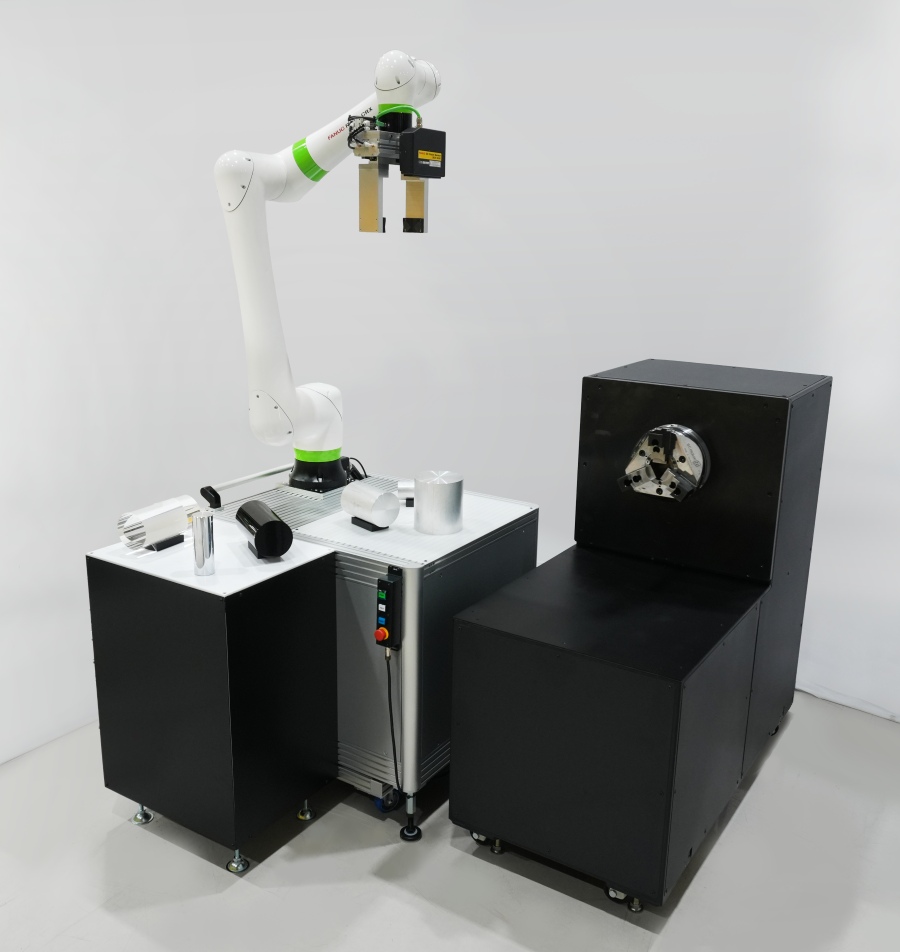
At JIMTOF2026, the Japan International Machine Tool Fair, which opened at Tokyo Big Sight on 26 October, the company is demonstrating the robot picking up various cylindrical stock pieces without prior setup or teaching and loading them into and unloading them from a mock lathe. It is pitching automation that needs no one in attendance once the stock is laid out.
Why vision teaching was needed at every changeover
In high-mix, low-volume and variable-mix, variable-volume machining, the type, shape and placement of stock change each time production switches to a different product. According to the company, every time a robot had to handle a differently shaped piece of stock, its shape had to be taught to the robot one piece at a time. The company calls this task vision teaching.
FANUC's earlier three-dimensional vision also includes a method that compares data captured by a camera with a shape model taught in advance to find a workpiece's position and orientation. "Masterless" in the product name appears to refer to doing away with the registration of such a reference model, or "master".
Lighting was another headache on the shop floor. The company says that metal parts with glossy surfaces, even if not mirror-like, were hard for conventional vision sensors to locate accurately, and that sites had to rely on trial and error, such as adjusting the lighting.
The disclosed principle stops at "camera and AI recognise three-dimensional shape"
AI Masterless Vision recognises an object's three-dimensional shape using a camera and AI. Because the AI has learned in advance how objects look under various lighting conditions, it can reportedly recognise their three-dimensional form reliably even where brightness changes with the time of day or the season. The company has also trained the AI on how transparent and mirror-like objects appear, and says it can now recognise transparent and glossy workpieces that conventional cameras could not.
That is as far as the disclosed principle goes. The company has not said how image and depth information are combined, what range of shapes a phrase such as "cylindrical part" is tied to, or what information the AI infers or compensates for when handling transparent or mirror-like objects. It cannot be judged at present whether the system recognises objects within a set of pre-learned shape categories or can handle unfamiliar shapes broadly.
If the company's explanation holds, pre-training done by the maker takes over part of the work that sites have done by registering shapes workpiece by workpiece. What is unclear is whether the burden on sites disappears, or merely changes form into checking that a target falls within the learned categories and handling exceptions.
The company says robots mounted on AGVs (automated guided vehicles) or carts moving around the factory can also find and carry target objects regardless of changes in their surroundings.
Welding and Hitachi: a shared push to reduce teaching
The new product is part of the "physical AI on an open platform" that FANUC set out at the International Robot Exhibition in December 2025. The company has released drivers for ROS 2 (a development framework for robots), built Python in as standard and moved to support US-based NVIDIA's simulation platform. It says it has received many customer inquiries about physical AI since then.
In September 2026, FANUC announced the "AI Welding Agent", which uses the generative AI of US-based Google Cloud to read part drawings and automatically generate welding conditions and robot motions. Shipping is scheduled to start at the end of December 2026. On 30 September, it also formed a strategic partnership with Japan's Hitachi. Under the plan, Hitachi's operations in the Ibaraki area will serve as "customer zero" (the first proving ground), where AI will continually learn site-specific rules for part picking and for changeovers when products change. The two companies plan to extend the initiative to their customers from fiscal 2027.
Set side by side, these point to a strategy that layers general-purpose pre-training, to reduce initial setup, with a layer that keeps learning a site's exceptions on site. This, however, is an inference from the disclosed initiatives, not a strategy confirmed by FANUC. The company has not shown how the two layers connect technically, or whether results from the Hitachi trial will be fed into AI Masterless Vision.
The robot division is FANUC's largest, with sales of ¥194.3 billion in April to September 2026, about 41% of consolidated sales. Its sales growth of 12.6%, however, was below the 16.2% for the group as a whole. The product's strategic value will depend on whether it can expand robot adoption in general manufacturing and high-mix processes where skilled staff for robot teaching are scarce. Price and the form in which it will be offered have not been disclosed.
Likely candidates are processes where vision teaching holds back changeover
Benefits appear most likely in processes where the target can be specified by a common shape name and where vision teaching at each product change accounts for a large share of changeover time. Conversely, where dedicated grippers, complex machine-tool integration or tight cycle-time requirements dominate, cutting only the recognition setup would bring limited return on the investment. However, the compatible robot and camera configurations, processing time and recognition success rate have not been disclosed, so this assessment remains provisional given the limited disclosure.
The cylinder demonstration also needs careful reading. A cylinder looks the same when rotated about its axis, which makes it easier to narrow down candidate orientations and gripping positions than for a complex irregular part. Loading and unloading cylindrical stock alone cannot show how well the system tells similar shapes apart, or copes with irregular parts that offer few surfaces to grip. The company says it can also recognise transparent and glossy workpieces, but has not shown the materials, backgrounds or lighting conditions, or whether the robot successfully carried them under actual operating conditions.
Gripping, equipment integration and fault recovery still need separate verification
The announcement does not say that hand selection, gripping positions, paths that avoid surrounding equipment, signal exchange with machine tools, safety design and recovery after a recognition failure will all become setup-free. It is unclear whether "zero setup, zero teaching" refers only to vision setup or extends to the complete system into which the robot is integrated.
After shipping, what matters is not whether a cylinder can be recognised. The decisive measure will be how much the system reduces the total time from a changeover instruction to stable operation, including retries and fault recovery, compared with the conventional method. Without a meaningful reduction, "masterless" would amount only to a lighter vision-configuration workload. Its ability to shorten total process changeover will determine whether the product justifies capital investment.