Japan's DMG MORI President Calls Orders "Surprisingly Good"; With ¥328 Billion Backlog, Unmanned Operation Is the Next Test
Masahiko Mori, president of Japan's DMG MORI, a major machine tool maker, has reportedly described the company's order situation as "surprisingly good". Consolidated orders for January to September rose 36.7% year on year to ¥522 billion, and the machine order backlog has…
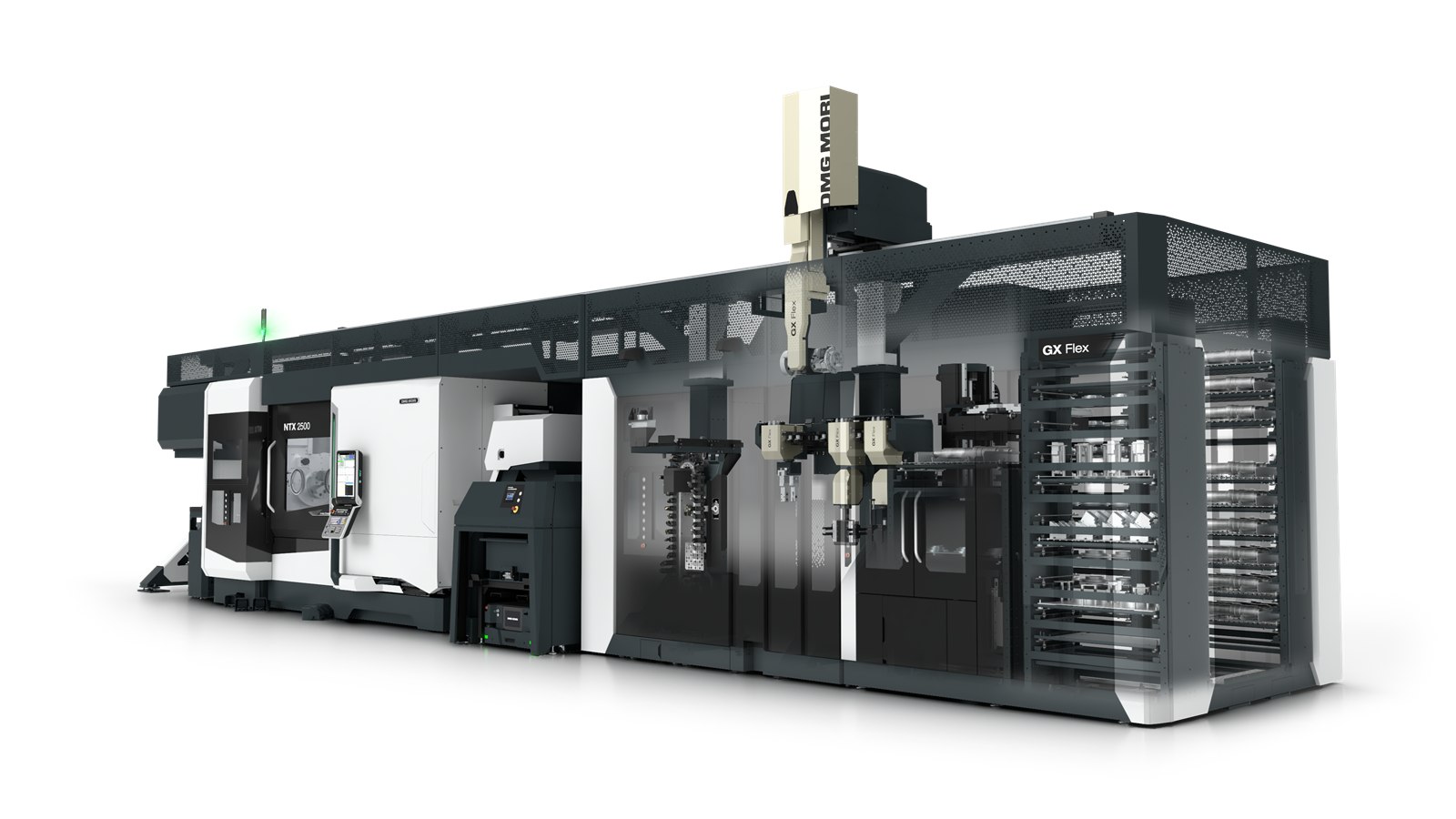
Masahiko Mori, president of Japan's DMG MORI, a major machine tool maker, has reportedly described the company's order situation as "surprisingly good". Consolidated orders for January to September rose 36.7% year on year to ¥522 billion, and the machine order backlog has swelled to ¥328 billion. At its trade-fair stand, the company put a new loader that automates even product changeover front and centre. A demonstration, however, does not guarantee results on a factory floor, and the question now is whether strong orders can be turned into profit and machine utilisation.
Key points
- Orders: Consolidated orders for January to September 2026 were ¥522 billion, up 36.7%. The ¥186.8 billion booked in July to September is the highest for any quarter. The full-year orders forecast was raised again, to ¥650 billion or more
- Backlog: The machine order backlog stood at ¥328 billion at the end of September, up ¥88 billion from the end of December 2025. Projects with long lead times are also increasing
- First hurdle: Based on the full-year plan, the calculated EBIT (earnings before interest and tax) margin required for October to December is 8.3%, against 4.0% in January to September
- Unmanned pitch: At JIMTOF, the company demonstrated an integrated cell configuration linking tool assembly with chip collection. The new "GX Flex" loader automates changeover set-up between product types
- The open question: How long the system runs without stopping at a customer's plant. Hours of continuous operation and the number of human interventions have not yet been given
Orders of ¥522 billion for January to September, up in every region
Masahiko Mori, president of DMG MORI, was reported in late October to have called the order situation "surprisingly good". The context of the remark could not be confirmed, but the strength of orders can be checked against the results announced on 30 October.
Consolidated orders for January to September 2026 came to ¥522 billion, up 36.7% year on year. After ¥155.4 billion in January to March and ¥179.8 billion in April to June, July to September reached ¥186.8 billion (up 40.1% year on year), a quarterly record. On this basis, the company raised its orders forecast for the year to December 2026 from ¥630 billion to ¥650 billion or more.
By region, orders rose 98% in China, 51% in Asia, 38% in the Americas, 30% in Europe, the Middle East and Africa (EMEA) and 26% in Japan, so every region grew. By industry, increases came from aerospace, space and defence, medical, data processing including semiconductor manufacturing equipment, power and energy, shipbuilding, moulds and others. The company says it is seeing signs that even small and medium-sized firms previously cautious about capital investment are beginning to adopt high-precision, high-productivity machines.
Machine backlog up ¥88 billion in nine months
The order backlog for machines themselves rose from ¥240 billion at the end of December 2025 to ¥303 billion at the end of June and ¥328 billion at the end of September. The company explains that, although it is raising output, orders are growing faster than expected and the backlog is trending upward. Projects with long lead times are also increasing, and these are expected to contribute to earnings in the second half of fiscal 2027 and in fiscal 2028.
Consolidated orders exceeded revenue of ¥422.7 billion for January to September by ¥99.3 billion. Because consolidated orders also include after-sales and group-company business, however, that gap cannot be read directly as the increase in the machine backlog. The announcements also do not give the extent of the increase in unit output or capacity.
An EBIT margin of 8.3% in October to December is the first hurdle
Profit recovery lags the strength of orders and is still to come. EBIT for January to September was ¥16.9 billion, a margin of 4.0%. Based on the full-year EBIT plan of ¥30 billion, the October-to-December quarter would need revenue of ¥157.3 billion and EBIT of ¥13.1 billion. These calculated figures imply a margin of 8.3%, more than double the January to September level.
The company expects efficiency gains from higher output, reduced customer discounting, and contributions from its after-sales business and group companies. Against that, higher personnel costs (¥8 billion), higher depreciation (¥3 billion) and currency effects (¥2.8 billion) weighed on January to September earnings. The 23.2% rise in revenue also includes a lift of about ¥32 billion from the weaker yen. On a simple calculation excluding that currency benefit, revenue growth would have been about 13.9%.
For the year to December 2027, the company plans revenue of ¥630 billion and EBIT of ¥51 billion, a margin of 8.1%. The first test of whether that plan is realistic is the October to December margin.
The JIMTOF demonstration: from tool assembly to chip collection
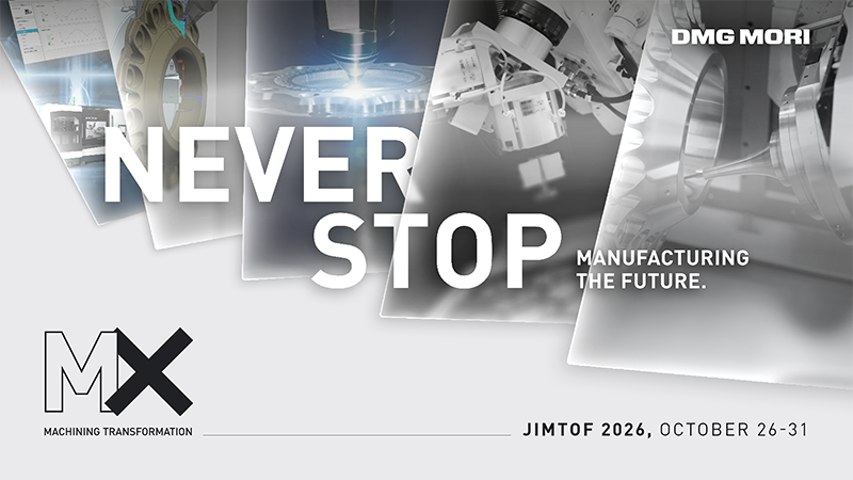
The company's theme at JIMTOF2026 was "NEVER STOP MANUFACTURING THE FUTURE". At the show it demonstrated a set-up positioned as automating the whole process, including the work before and after machining.
First, an automated cell from Germany's HAIMER assembles cutting tools. The finished tools are carried by an autonomous mobile robot (AMR), the "AMR 2000", which replenishes the tool magazine of the "GX Flex" gantry loader, unveiled publicly for the first time at the show. Machining is done by an "NTX 2500" multitasking machine. Chips are crushed and collected in a bucket, which the AMR swaps when it is full. Worn tools are also collected by the AMR.
This was a demonstration linking specific machining cells, not an entire unmanned factory. Nor does the GX Flex, announced on 23 October, explain the rise in orders through September. It is better viewed as a display of where the company intends to extend its offering next, against the backdrop of strong orders.
GX Flex cuts manual work at product changeover
The GX Flex is a loader that uses the space above the machine as its travel path. It exchanges not only workpieces but also chuck jaws (the parts that grip the workpiece) and cutting tools within the same system. It handles workpieces up to 750 millimetres long and 300 millimetres in diameter, with a mass of up to 40 kilograms.
Conventional gantry loaders have mainly served applications that move the same workpiece at high speed, again and again. On lines running many product types, set-up during product changeovers can interrupt continuous operation. The GX Flex automates the changeover process by replacing the loader's gripper head automatically. The company says it supports long continuous runs, including nights and holidays, raising machine utilisation and easing the burden on operators. In the demonstration, turning tools that were conventionally changed by a person opening the door were also exchanged automatically from the magazine on the loader side.
Each product type needs advance preparation
The GX Flex can switch automatically only between product types for which the gripper heads, workpieces, chuck jaws and tools have been prepared in advance in stockers and magazines. There are also upper limits on workpiece size and mass.
The AMR link was demonstrated at the show, but the product announcement says AMR connection is to be supported in stages. That something worked in a particular exhibition set-up is not the same as customers being able to buy it as standard. The announcements do not give the price, shipping date or compatible models.
Recovery after a stop, and maintenance, remain
Another machine in the demonstration monitored load through a spindle sensor and stopped when cutting force changed sharply because a tool edge chipped. Stopping, though, is not the same as recovering without human intervention. The company does not say it automates removing the cause of a stop or restarting. Unexpected workpiece conditions, quality abnormalities, cleaning and maintenance may still need people.
The company says the shortage of operators is pronounced worldwide. The GX Flex appears to form part of the company's "MX" strategy, which combines tools, workholding equipment, transport systems and software to widen what it offers beyond the machine alone. If customers increasingly select equipment based on overall utilisation across machining, changeovers and internal logistics, the basis of competition could widen from machining accuracy and speed to connectivity with peripheral equipment and the ability to recover from faults. Automation-related revenue and profitability, however, have not been disclosed.
The test is not the label "unmanned". It is hours of continuous running at a customer's plant, the number of human interventions per shift and the time taken to recover from a fault. Until such results are shown, the GX Flex is a promising demonstration, not a product proven as a pillar of earnings.