Could Extruders Change PET Recycling? Japan's Kirin and JSW Report Depolymerisation Within Ten Minutes
Japan's Kirin Holdings and The Japan Steel Works (JSW) have demonstrated, using actual production-type equipment, a technology that breaks PET (polyethylene terephthalate) down to the molecular level inside a twin-screw extruder normally used for plastics processing. The…
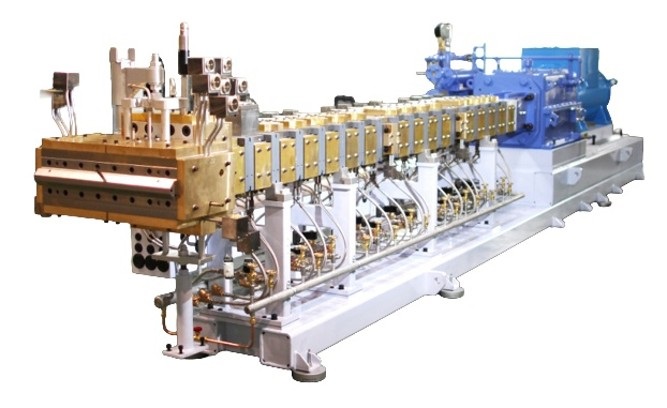
Japan's Kirin Holdings and The Japan Steel Works (JSW) have demonstrated, using actual production-type equipment, a technology that breaks PET (polyethylene terephthalate) down to the molecular level inside a twin-screw extruder normally used for plastics processing. The depolymerisation rate reached 95% or higher, and according to Kirin, the time needed falls from about four hours with conventional methods to within ten minutes. What will decide commercialisation, however, is the cost of the entire process, including purification.
Key points
- In September 2026, Kirin Holdings and JSW announced a successful demonstration, on actual equipment, of "alkaline depolymerisation", which breaks down PET using aqueous sodium hydroxide, in JSW's "TEX" series twin-screw extruder. They achieved a depolymerisation rate of 95% or higher and established conditions for stable operation at 250 kilograms per hour or more. The companies describe it as Japan's first demonstration of this kind designed with a mass-production process in mind
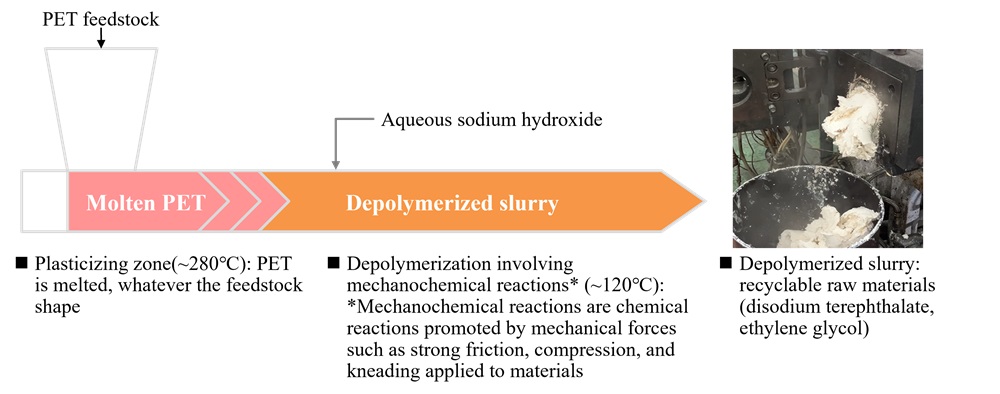
- According to Kirin's research team, depolymerisation that takes about four hours with conventional technology is completed in within ten minutes. The process uses a "mechanochemical reaction", in which the screws rub, crush and mix the material to drive the chemical reaction, and the heat generated by the reaction is also used for decomposition
- One extruder is expected to be able to process 10,000 tonnes of PET products a year, with much smaller equipment than existing plants. However, the demonstration confirmed 250 kilograms per hour, and no construction or installation timeline for mass-production equipment has been announced
- The next challenge is the cost of purification: removing sodium and impurities from the disodium terephthalate and ethylene glycol produced by depolymerisation
A plastics compounding machine turned into a reactor
On 2 September 2026, Kirin Holdings' Package Innovation Research Laboratories and JSW announced that they had demonstrated alkaline depolymerisation of PET on actual equipment designed with mass production in mind. Kirin developed the core technology, while JSW handled equipment design and the study of operating conditions. The results were a depolymerisation rate of 95% or higher and stable operation at 250 kilograms per hour or more. The companies say this has given them the knowledge of equipment specifications and operating conditions needed to design a mass-production process.
The equipment is a twin-screw extruder that JSW sells commercially. It conveys material forward while two screws mix it, and is normally used to make plastic materials, for example by compounding additives into resin. Kirin repurposed it for a decomposition reaction, a use quite different from its original purpose.
According to Kirin's research team, depolymerisation takes within ten minutes, compared with about four hours using conventional technology. The extruder is only a few metres long and processes material continuously.
Time and energy: what has held chemical recycling back
PET recycling falls into two broad approaches. "Mechanical recycling" washes, shreds and remelts used bottles. "Chemical recycling" breaks the material down to the molecular level and removes impurities.
Mechanical recycling, the mainstream method for beverage PET bottles in Japan, can only use beverage bottles as feedstock. In Japan's soft-drink industry, the "bottle-to-bottle" ratio, the share of used bottles turned back into bottles, rose to 37.7% in fiscal 2024. But PET products other than bottles, such as fibres and films, are hard to include. Because chemical recycling can remove impurities such as pigments and metals, it can turn a wide range of PET products into resin of the same quality as virgin, petroleum-based material.
Chemical recycling of PET has been in commercial use since the 2000s. However, conventional methods decompose PET over long periods at high temperature and pressure, consuming a great deal of energy and pushing up the cost of recycled resin. Kirin itself already uses recycled PET material produced by chemical recycling at the JEPLAN group in some of its beer bottles. The Kirin Group aims to source 50% of the PET resin used in its alcoholic-drink and soft-drink bottles in Japan from recycled material by 2027. Cost will be critical to increasing its procurement of recycled resin.
Rubbing and crushing instead of heating: a continuous reaction
Kirin focused on the mechanochemical reaction. Chemical reactions are generally accelerated by heat, whereas a mechanochemical reaction is triggered and promoted by applying mechanical force.
Tatsuro Naruse, the group leader in charge of the research, reasoned that rubbing, crushing and mixing PET with aqueous sodium hydroxide using the extruder's screws would trigger this reaction. Experiments showed that depolymerisation was indeed accelerated, and that the heat generated by the reaction could be used for the decomposition itself. Heat is still needed to melt the PET, but no external heat has to be added for decomposition. Kirin says this leads to lower energy use and cost. However, figures for energy intensity (energy consumed per unit processed) and equipment cost have not been disclosed, so the size of the savings cannot yet be assessed.
The process could also change plant design. Conventional depolymerisation loads material into a reaction vessel, heats it and lets it react over time. An extruder is a continuous system: material flows through it, is mixed intensively over a short section, completing the reaction as it passes through the extruder. The shorter the reaction time, the smaller the equipment can be. According to Kirin, one extruder could process 10,000 tonnes of PET products a year, and equipment could be substantially smaller than existing chemical recycling plants.
10,000 tonnes a year requires about 4.6 times the demonstrated capacity
That figure needs to be read separately from the demonstration results. What the demonstration confirmed was stable operation at 250 kilograms per hour or more. Even assuming round-the-clock operation every day of the year, that works out to about 2,190 tonnes a year. Processing 10,000 tonnes a year would require about 1.14 tonnes per hour on a calendar-day average, about 4.6 times the demonstrated rate, and more once downtime for scheduled maintenance is factored in. The 10,000-tonne figure appears to be a projection for mass production, and no construction or installation timeline for mass-production equipment has been announced.
Kirin provides the process technology, JSW the equipment expertise
The division of roles also points to how the business might take shape. Kirin has developed the core decomposition technology and is also developing the purification process. In 2023, in joint research with Waseda University, it announced a purification method using electrodialysis that regenerates the alkali during purification. How this would be combined with the extruder process has not been explained. JSW holds the know-how in extruder design and operating conditions. It has already established, using the same extruders, a continuous recycling technology that turns used acrylic resin back into its monomer feedstock. JSW appears to be aiming to extend sales of its extruders, mainly used for resin production and processing, to recycling companies.
If compact continuous equipment becomes practical, it could also open up new options for where plants are sited. Besides large centralised plants, units could be placed near textile mills or collection and sorting sites. On the other hand, economies of scale in purification and the need for stable feedstock supply may keep plants centralised.
The two companies plan to develop the whole process, from collection and depolymerisation through to recovery as reusable feedstock, and to test the technology on a wide range of PET feedstock, including non-food applications. Once the technology is in practical use, Kirin envisages processing all kinds of PET products, not just bottles but also fibres and films.
Next focus: the cost of recycled resin, purification included
What comes out of the extruder is disodium terephthalate and ethylene glycol. Turning these back into PET feedstock requires removing sodium and impurities. In alkaline decomposition, terephthalic acid is generally recovered by neutralising with acid, which produces a salt by-product. Purification technologies exist but face cost challenges, and Naruse says the team intends to resolve this through technical development.
There are three points to verify. First, whether a depolymerisation rate of 95% or higher and continuous operation can be maintained at commercial scale, about 4.6 times the demonstrated rate. Second, whether the same performance can be achieved with fibres and films, which contain more pigments and additives. Third, whether the cost per kilogram of recycled resin, including purification, chemical recovery and disposal of the salt by-product, can compete with virgin petroleum-based resin and mechanically recycled material.
By cutting decomposition to within ten minutes, the technology has charted a path through one barrier facing chemical recycling: reaction time and equipment size. But the price of recycled resin is set by the whole process. The true test is whether a commercial unit can run stably at the 10,000-tonne-a-year scale and show the full production cost, including purification and chemical recovery.