CNC at the Centre: Japan's Mitsubishi Electric Moves Early to Link Humanoid Robots with Machine Tools
Japan's Mitsubishi Electric announced on 21 October 2026 that it has developed a machining system in which humanoid robots and CNC (computer numerical control) machine tools work together through physical AI, meaning AI that controls and optimises physical actions in the real…
Japan's Mitsubishi Electric announced on 21 October 2026 that it has developed a machining system in which humanoid robots and CNC (computer numerical control) machine tools work together through physical AI, meaning AI that controls and optimises physical actions in the real world. The point is not the robot itself. The company aims to cut, from the CNC side, the custom integration work that each robot model has needed to connect with a machine tool. The company aims to put the system into practical use in 2030.
Key points
- Mitsubishi Electric has developed a machining system that links humanoid robots with CNC machine tools. The company describes it as the industry's first NC system designed for humanoid robot collaboration (based on its own research as of 21 October 2026)
- The system has three elements: (1) an "AI machining task planner" that generates machining tasks from natural-language instructions and assigns work to the machine and the robot; (2) a CNC machine tool equipped with physical AI; and (3) a standard humanoid robot
- The physical AI in the planner and the CNC was newly developed using "Maisart", the company's AI technology brand. According to Mitsubishi Electric, the CNC and the robot exchange operating information in natural language and can work together regardless of robot model
- The system is at the development stage. A demonstration will be shown at "JIMTOF2026" (the 33rd Japan International Machine Tool Fair), which opens on 26 October in Tokyo. The company plans further functional upgrades and verification trials, aiming for practical use in 2030
Breaking natural-language instructions into machine and robot tasks
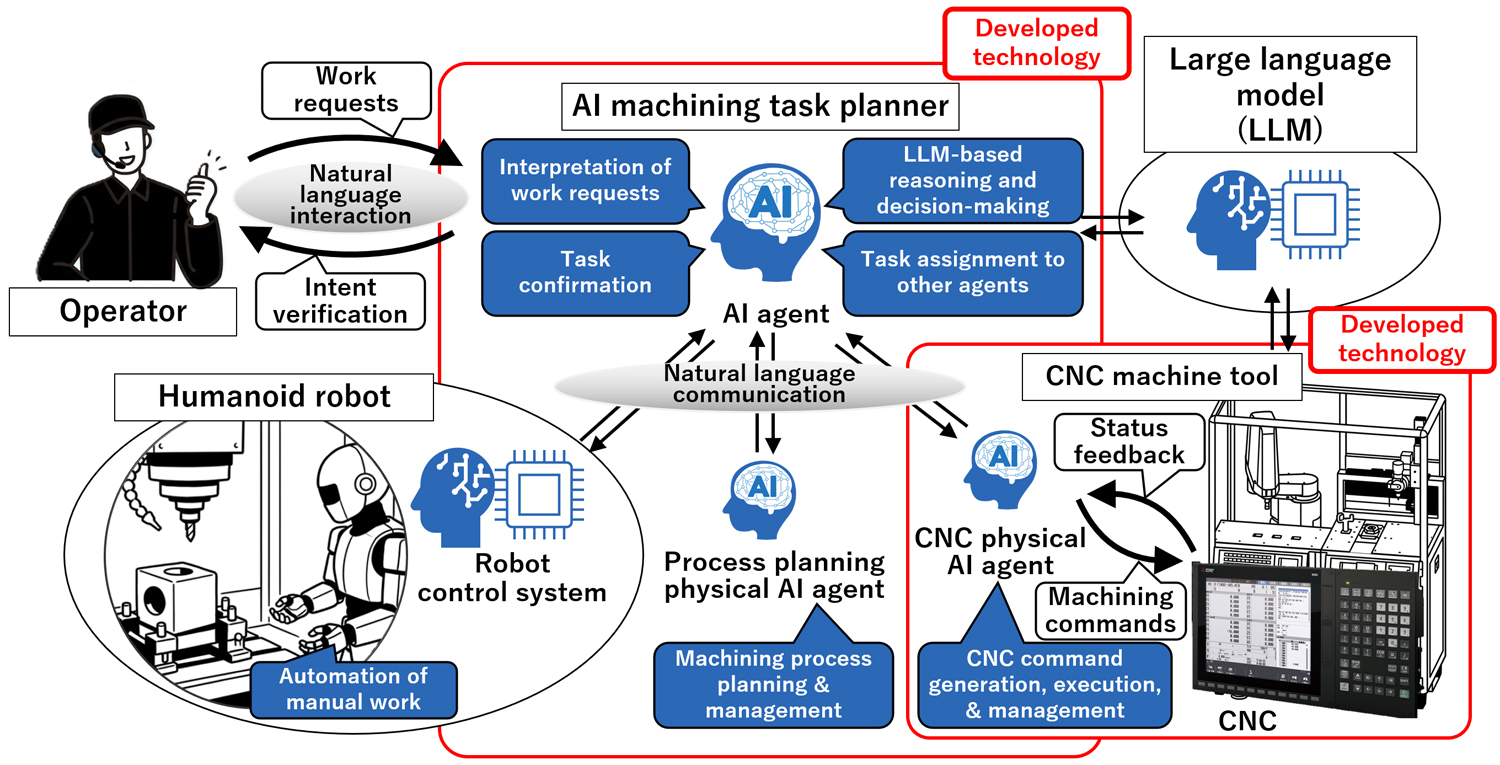
The workflow runs as follows. An operator gives an instruction in natural language. The AI machining task planner interprets it, selects the necessary items from a pre-registered list of work tasks and combines them into a task plan automatically. Following that plan, the planner assigns work to the CNC machine tool and the humanoid and manages the machining process the two carry out together.
In a system diagram published by the company, an "AI agent" sits at the core of the planner. It uses a large language model (LLM) to interpret instructions and make decisions, and confirms the operator's intent. The AI agent communicates in natural language with a "process planning physical AI agent" that designs the machining process, a "CNC physical AI agent" on the machine side, and a "robot control system" on the humanoid side. The diagram labels the planner and the CNC side as "Developed technology", meaning the elements developed by Mitsubishi Electric, and places the LLM outside that boundary. Mitsubishi Electric has not disclosed the LLM's provider or which model it uses.
According to the company, the system works regardless of robot model and removes the need for advanced system integration (the work of turning combined equipment into a functioning production cell) for each robot. It also says the time to deployment can be shortened substantially, but it has not given the size of that reduction or a comparison with conventional methods.
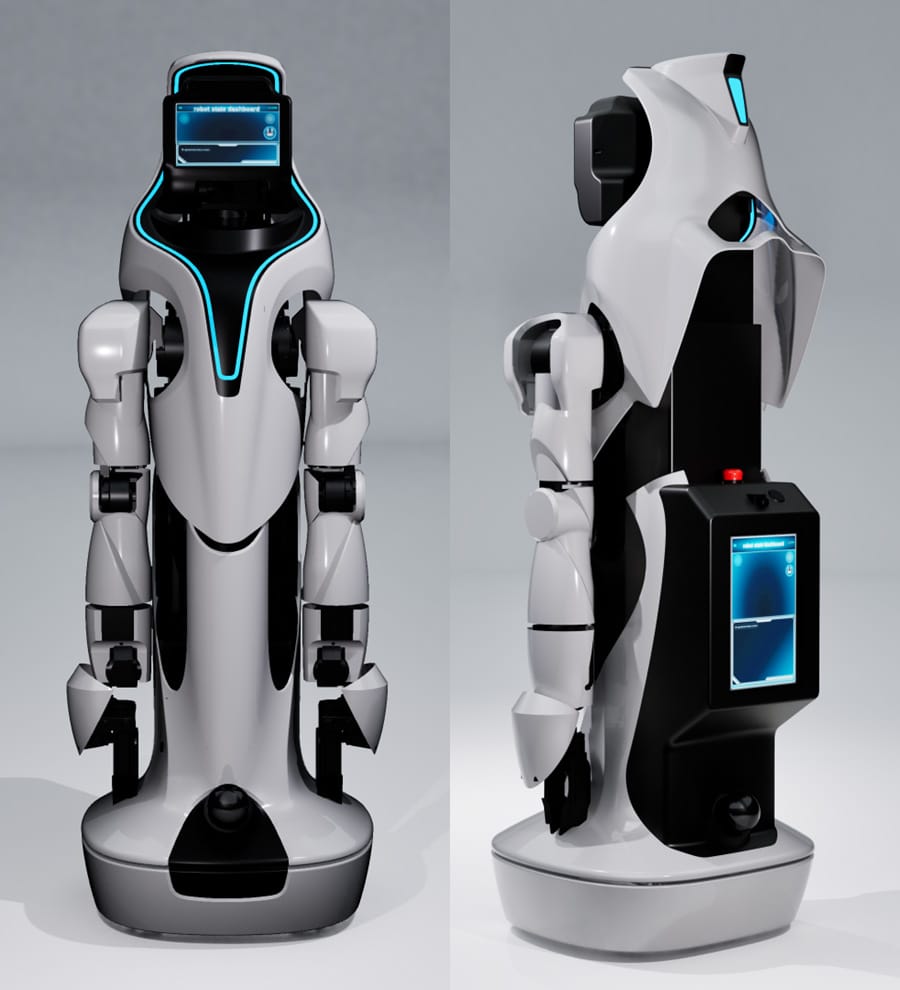
The tasks the company says humanoids could take over are set-up, cleaning, tidying, removal of finished parts, transfer, inspection and troubleshooting, all work that operators have traditionally handled. Mitsubishi Electric has not disclosed which humanoid model will be used in the demonstration, nor pricing or a specific release date.
The barrier to adoption: model-by-model integration, not robot performance
Mitsubishi Electric cites two barriers behind the development.
The first is the limit of conventional industrial robots. Set-up, which involves mounting a workpiece inside the machine tool, and cleaning the machine interior are tasks built around the shape and movement of the human body. Replacing them with conventional industrial robots requires investment in the production line to suit the robot. A humanoid, being human-shaped, could make use of equipment designed for people and limit line modifications. That is why expectations for humanoids are rising.
The second barrier is the one this development targets. For a humanoid to understand the status of a CNC machine tool, and vice versa, and to work in coordination with it, a dedicated communication function and control sequence (the program that sets the order in which equipment operates) had to be developed for each robot. This integration step is what Mitsubishi Electric has set out to address.
From G-code links to a natural-language gateway
Mitsubishi Electric is one of the major suppliers of CNC units to machine tool builders. It has long developed functions that make the CNC the starting point for linking machines and robots.
One example is "Direct Robot Control", described in a 2021 company technical paper. It connects the CNC and the robot controller via Ethernet and moves the robot using G-code, the programming language used for machining. This removed the need for a separate higher-level controller and sequence program, and let users unfamiliar with robots operate them from the CNC screen. The company said robots from its own "MELFA" series and from Germany's KUKA could be controlled with the same G-code.
Where the 2021 function made G-code the common operating method, the new system makes natural language the entry point for instructions and machine-to-machine communication. The scope of coordination has also expanded from arm-type industrial robots to humanoids. Mitsubishi Electric has not explained the internal relationship between the two technologies, or the format of the final CNC commands. Even so, both share the idea of designing robot collaboration from the CNC side, and the new system can be read as an extension of that approach.
How far does natural language reach into machine control?
On the shop floor, getting the order of steps wrong, such as stopping the spindle, opening and closing the door or clamping the workpiece, can damage equipment or cause accidents. Natural-language instructions are flexible but open to interpretation. Having the planner combine pre-registered tasks, rather than generate work from scratch, appears to be a design that makes it easier to limit what the system executes.
In the diagram, the CNC physical AI agent receives natural-language communication, then generates, executes and manages work commands for the CNC, and receives status feedback from it. The structure for converting natural-language instructions into CNC work commands is shown, but the company has not disclosed the command format, the safety systems, or how roles are divided with conventional CNC control.
The robot side raises similar questions. The company has not said who provides the "robot control system" that communicates with the AI agent in natural language, or what connection settings or conversion functions each robot model will need. Nor is it clear at which stage an instruction misread by the LLM would be stopped. These points are central to judging the conditions under which "model-independent" collaboration actually applies, and therefore to any decision to adopt it on the shop floor.
Whether a humanoid can do the work at all depends on the robot itself. Working inside a machine where chips and cutting fluid remain, lifting heavy workpieces and positioning precisely in tight spaces are challenges the robot has to meet on its own.
How the roles of machine tool builders and system integrators could change
The route by which this system reaches factories differs from that of robot sales. What Mitsubishi Electric supplies is not the machine tool itself but its brain, the CNC unit. Whether the approach of building collaboration functions into the CNC spreads depends on whether machine tool builders adopt the function in their machines and offer it to customers.
If it does spread, the work of system integrators, who have built communication and control routines for each machine-robot combination, could shift towards defining tasks and applying them on site. For humanoid makers, the more standardised the connection to machine tools becomes, the more competition will turn on the robot's own working capability and cost.
One of the organiser's special exhibits at JIMTOF2026 focuses on how machine tool technology can overcome the barriers to mass production and cost reduction of humanoids, treating the humanoid as something to be machined and built. Mitsubishi Electric's exhibit takes the opposite angle, trying to make the humanoid a worker on the machining floor.
The test: switching robots without redoing the integration
The system is still at the development stage. The demonstration is scheduled to go on display from 26 October, and verification trials and the goal of practical use in 2030 still lie ahead. The yardsticks for practicality are clear: the man-hours needed to reconfigure when switching to a robot from a different maker, the time for one machining cycle, the frequency of abnormal stoppages and the time needed for recovery, and how far situation-dependent work such as troubleshooting can be registered as tasks.
Above all, the value of this development comes down to one question: can it show that a humanoid or a machine tool can be switched to a different maker or model without redoing the integration from scratch? If it can, the CNC could become a common gateway between machines and robots. If it cannot, natural-language instruction will remain a new operating screen layered on top of custom integration. As 2030 approaches, the measure to watch is not how polished the demonstration looks, but how many companies adopt this approach and how many robot and machine models it ends up supporting.