Can Lunar Excavators Be Electrically Actuated? Nabtesco and Komatsu Study Drive Systems for Extreme Conditions
Japan's Nabtesco, which holds a leading global share in precision reduction gears, is beginning a two-year joint study with Komatsu into electric actuators for construction machinery on the Moon. The research will test how far the drive technology honed in industrial robots and…
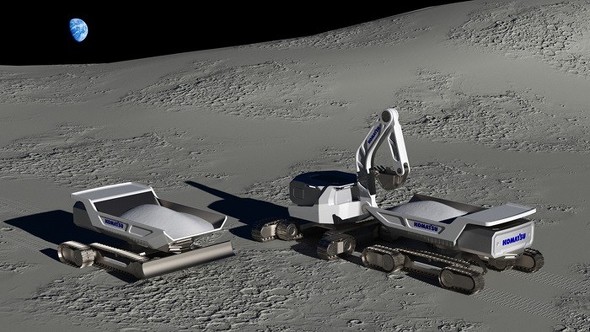
Japan's Nabtesco, which holds a leading global share in precision reduction gears, is beginning a two-year joint study with Komatsu into electric actuators for construction machinery on the Moon. The research will test how far the drive technology honed in industrial robots and construction equipment on Earth can hold up where conventional hydraulics are hard to use. No timing has been given for putting the hardware on the Moon or for commercialisation. It is a case of testing whether a component specialist's core technology can be extended, as a continuation of its terrestrial work, into an extreme environment.
Komatsu said in May 2026 that three of its proposals — including research on a next-generation lunar logistics rover — had been selected under the 13th call for proposals of "Moon to Mars Innovation", a joint-research scheme run by the Japan Aerospace Exploration Agency (JAXA). In one of them, it will work with Nabtesco to develop an electric actuator that can operate in a vacuum and withstand the loads of excavation. The research period is two years.
Key points
- Nabtesco is joining Komatsu to develop, through joint research, an electric actuator for lunar construction machinery that can work in a vacuum
- Because the hydraulic systems used by construction machinery on Earth are hard to use on the Moon, an electric drive mechanism is being studied as an alternative
- Three of Komatsu's proposals, including a lunar logistics rover, were selected under JAXA's "Moon to Mars Innovation" joint-research scheme; the work with Nabtesco is part of this, over a two-year research period
- Nabtesco holds a high global share in the precision reduction gears used in the joints of industrial robots, and is testing whether drive technology refined on Earth can be adapted to an extreme environment
- This is a research phase at present; no timing has been given for actual lunar operation or commercialisation
What was announced
The starting point is Komatsu's selection under JAXA's research scheme.
On 8 May 2026, Komatsu said that three proposals — including "research and development of a payload-enhanced logistics rover for next-generation lunar logistics" — had been selected as joint-research subjects under the 13th call for proposals of JAXA's "Moon to Mars Innovation" scheme. They are a group of studies looking ahead to hauling materials and carrying out construction on the Moon.
In one of them, Komatsu will work with Nabtesco. What the two will tackle jointly is the development of an electric actuator that can operate in a vacuum and withstand the loads of excavation. An actuator is a drive component that converts electrical power into rotational or linear motion, and moves the joints of a robot or the working parts of construction machinery. The research period is two years.
For now, only the framework of this research has been set out. No timing has been given for when the drive mechanism developed would be carried to the Moon, or for commercialisation.
Why "electric"
Construction machinery on Earth generates large forces hydraulically to dig soil and lift heavy loads. But hydraulics are hard to use on the Moon.
The Moon is close to a vacuum, with large temperature swings between day and night. A hydraulic system works by sealing hydraulic fluid to transmit pressure — but under a vacuum or extreme temperatures, problems such as fluid leakage, changes in the fluid's properties and degradation of seals become more likely. A mechanism that works as a matter of course on Earth cannot simply be carried over.
So an electric actuator is being studied as a drive to replace hydraulics, because it avoids the weaknesses of hydraulics, which relies on sealed fluid to transmit pressure. That does not mean going electric solves everything, however. Heat is harder to shed in a vacuum, making thermal design difficult; the large day-night temperature swing affects the choice of materials and the design of clearances between parts; and regolith — the fine, sharp dust of the lunar surface — can cause wear and failure if it works its way into moving parts, leaving the challenge of maintaining lubrication, sealing and dust protection for the reduction gears and bearings. On top of all this, the biggest hurdle is how far an electric drive can withstand the widely varying loads of excavation. Replacing, with electric drive, the heavy work that construction machinery on Earth has handled hydraulically calls for strength in the drive components and precision in control.
Where Nabtesco's technology fits
In this project, Nabtesco contributes its expertise in precision reduction gears, at the core of the drive.
Nabtesco holds a high global share in the precision reduction gears used in the joints of industrial robots. A reduction gear slows a motor's rotation to increase force and produce precise motion — the key to a robot moving heavy objects with precision. The company has built up volume production and quality in this field over many years.
What terrestrial robots and construction machinery have demanded — large force, precise positioning, and long-lasting durability — overlaps at its root with what a lunar excavator's drive needs: withstanding heavy loads, moving precisely, and not breaking down under harsh conditions.
Still, a product built for Earth cannot simply be carried over. Materials, lubrication and seals must be redesigned to suit the conditions of vacuum, temperature swing and dust. It is a matter of taking the drive technology honed on Earth as a base and rebuilding it under the new constraint of an extreme environment.
It is precisely because the company has accumulated volume production and quality in drives that it has room to apply its core technology in a different environment. That said, a track record on Earth does not necessarily carry over to the Moon. Working out what can be transferred from existing technology, and what must be newly overcome, is itself the substance of this research.
What an extreme environment means
The space market does not generate large sales overnight. Even so, developing for an extreme environment has meaning that feeds back to Earth.
The know-how gained in building a drive that withstands vacuum, temperature swings and dust could be useful at harsh sites on Earth. Durable electric drives can have value for machinery operating in dusty mines, or in high- and low-temperature environments. No specific plan for such transfer has been disclosed, however; at most, the lunar work could serve as a proving ground for sharpening the technology.
The shift from hydraulic to electric is not confined to space, either. On Earth, too, the electrification of construction machinery is advancing amid the drive to decarbonise. Experience in making an electric drive work under the demanding conditions of the Moon also connects to the electrification of construction machinery on Earth.
These are all future possibilities rather than settled results. This is a two-year research effort, and how far the drive mechanism reaches practical standards there depends on validation still to come.
What to watch next
What is confirmed so far is the framework of joint research by Komatsu and Nabtesco on an electric actuator for lunar construction machinery. Three things are worth watching from here.
First, how far an electric drive can withstand the heavy, widely varying loads of excavation. Overcoming the difficulty of replacing, with electric drive, the heavy work hydraulics has handled is the technical crux.
Second, how far the design of materials, lubrication and seals can cope with the conditions of vacuum, temperature swing and regolith. Whether the know-how gained feeds back into products for harsh sites on Earth also bears watching.
Third, how such extreme-environment development fits into the business of a precision-component specialist. Even if the space market itself is small, if the drive technology sharpened there serves the electrification of construction machinery and the sophistication of robots on Earth, the meaning of the investment extends beyond space.
Developing a drive for the still-distant prospect of a lunar excavator is also a test of how far a Japanese precision-component specialist that has mastered a component on Earth can extend that strength into a new environment.