Advantages and Disadvantages of Line Production
POINT: The line production method is a system suitable for low-mix high-volume production, but for small-lot production responding to the diversification of customer needs, problems such as decreased productivity and increased inventory easily occur. The Toyota Production System…
Q
The production method at Leader Koishi's workplace is to arrange lathes, drilling machines, etc., by machine, and produce according to orders while watching the availability of each machine. Leader Koishi has increasingly found himself troubled when a bulk order for assembled parts arrives. Therefore, he wants to know about the line production method, which is suitable for mass production.
A
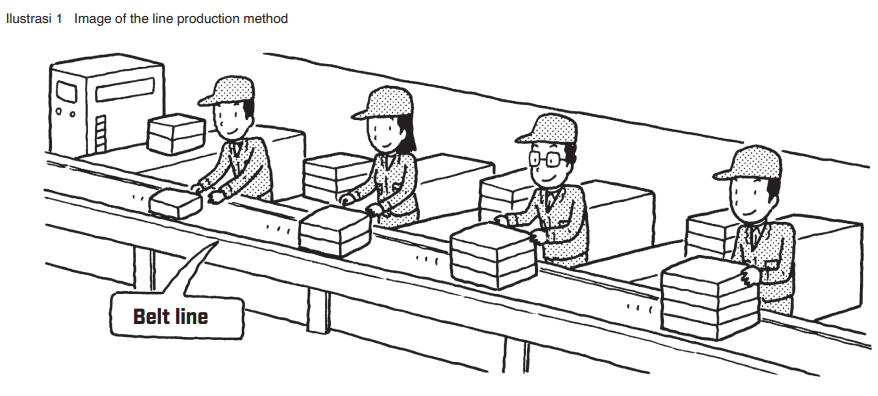
The belt-conveyor style line production method is a common production method in traditional manufacturing industries, and is suitable for low-mix, high-volume production. In this method, workers, parts, tools, etc. are arranged on both sides of the belt conveyor flow to produce, and the workers' tasks are also limited in scope.
(1) Advantages of the line production method
The characteristics of the production line at Ford Motor Company, the originator of belt conveyor production developed for low-mix high-volume production, lie in product standardization, parts standardization, and subdivision of manufacturing processes. These characteristics are still carried on today, and there are advantages as follows:
① In single-product or low-mix production, production speed can be increased, improving productivity.
② Standardization of parts and assembly simplifies work, prevents assembly errors, and stabilizes product quality.
③ Subdivision simplifies work, allowing non-skilled workers to handle it.
④ Mechanization and automation are easier for simplified work, and labor costs can be reduced by introducing robots, etc.
(2) Disadvantages of the line production method
Due to the simplification of work and diversification of customer needs, the following disadvantages have arisen in the line production method:
① Because the manufacturing process is extremely simplified, workers are prone to being forced into dehumanizing labor.
② Every time the model is changed, time and effort are spent replacing line jigs, reducing productivity.
③ Trying to reduce the number of model changes leads to increased inventory of raw materials, products, and work-in-progress; long-term inventory in particular becomes dead stock and leads to huge losses.
④ A massive investment is required to construct a manufacturing line.
⑤ Manufacturing new models or new products requires technical staff to study line modifications.
Commentary
The disadvantages of the line production method are as above, but the Toyota Production System was developed to improve this, aiming for zero inventory without dropping productivity even in the case of high-mix production, adopting the following techniques.
(1) Introduction of JIT
Introduce JIT (Just In Time) based on production instructions as shown in Figure 1. This means making "what is needed, when it is needed, and in the amount needed." Reduce setup times to level production, maintaining high productivity even in small-lot production.
(2) Adoption of Jidoka (Autonomation)
Adopt Jidoka. This is not simple "automation (自動化)", but "autonomation with a human touch (自働化)". That is, no human is needed when the machine is working normally; humans respond when it stops due to an abnormality.
Tetsuo Oishi (Oishi Consultant)
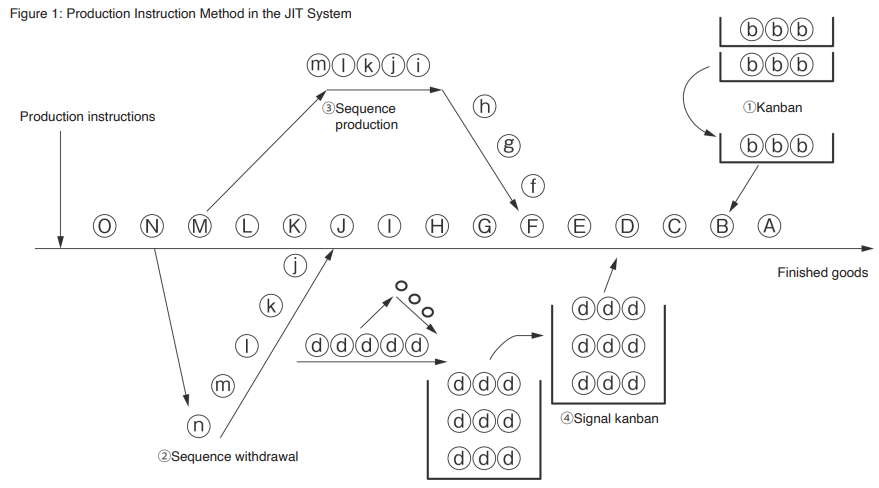
Types and symbols of production instruction information
Symbol | Description |
|---|---|
Ⓐ Ⓑ Ⓒ ・・・ | Represents the main body; production instructions are issued to the head of the final assembly line. |
① Kanban | A method where the "kanban" is removed when the parts box is emptied, triggering the next withdrawal. It is the most famous part of the Toyota Production System. Applied to general-purpose parts. |
② Sequence withdrawal | Instructs from the required process on the final line to the head of the sub-line for semi-finished products. |
③ Sequence production | Applied to important parts with long production periods. |
④ Signal kanban | Applied to auxiliary materials that require lot production. |