Advantages and Disadvantages of Cell Production
POINT: Cell production is a production method where one person or a team of several people processes and assembles parts from start to finish, and is a system suitable for high-mix low-volume production. To operate this system more smoothly, training multi-skilled workers is…
Q
Leader Koishi is increasingly asked by sales staff who receive customer requests to produce new models, and is troubled about how to incorporate these into the production process. Therefore, he wants to learn about the cell method suitable for high-mix production, and if possible, consider implementing it.
A
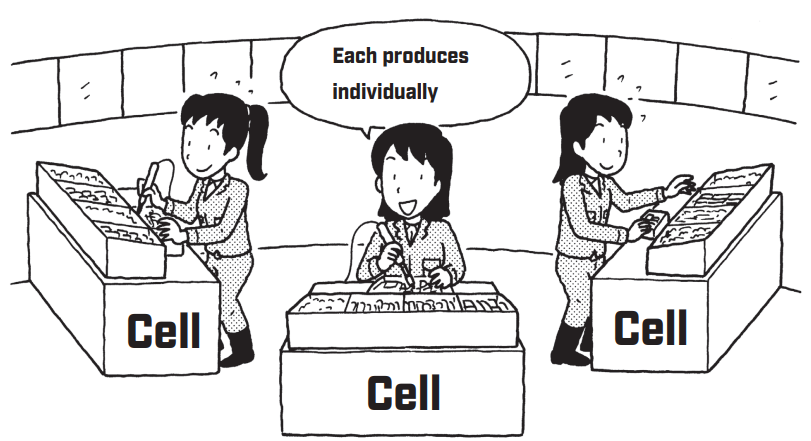
Cell production is a production method where a team of one or a few people handles the processing and assembly of parts from start to finish. In the conventional line production method, switching production models takes time, and if productivity is low at any process, the whole line is constrained by it, lowering overall productivity. The cell method is advocated to solve this problem and respond to variable-mix, variable-volume production and timely product supply.
(1) Advantages of the cell production method
Just by changing the worker's work sequence and parts used, the production item can be easily changed, and fluctuations in production volume can be easily handled by adjusting the number of cells and people. It has the following advantages:
① Productivity can be improved by enhancing worker capabilities.
② Since only the necessary parts are supplied to each cell, work-in-progress inventory can be reduced.
③ Since one person or a small team handles a series of tasks, problems and areas for improvement are easy to see, improvement proposals are easier to make, and their effects can be expected.
④ Adjusting the number of cells allows handling sudden orders or order changes, reducing product inventory.
⑤ Because workers handle a series of tasks, their awareness of quality assurance improves.
(2) Disadvantages of the cell production method
While it is a production method suitable for high-mix production as described above, it is necessary to pay attention to the following points.
① The range of processes handled by the worker is broad, and work efficiency varies depending on the worker's proficiency and ability, making it essential to improve overall capability through training. There is a view that not directly linking individual worker productivity to performance evaluation actually improves the productivity of the workplace as a whole.
② Long-term training is required to master the operations of a series of processes as a multi-skilled worker. In addition, extensive skills as a multi-skilled worker are demanded.
③ While the worker's responsibility is clear, it can cause mental stress for some workers.
Commentary
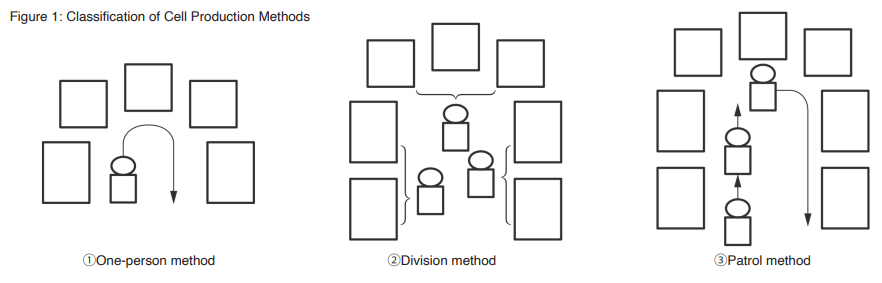
As shown in Figure 1, the cell production method can basically be classified into the following three types. By properly selecting or combining these methods, productivity can be increased.
① One-person method: A method where one worker completes the product; multi-skilled workers are necessary.
② Division method: A method where the work is shared among several people to complete it; highly multi-skilled workers are unnecessary, but the same problems as line production may occur.
③ Patrol method: A method where one worker moves around to assemble.
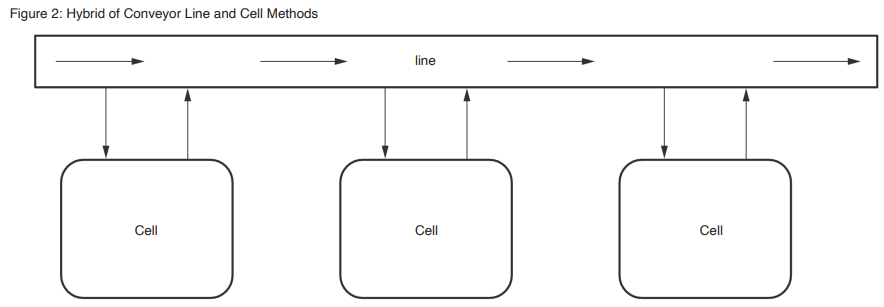
Figure 2 shows a hybrid of the conveyor line and cell methods.
Tetsuo Oishi (Oishi Consultant)