FANUC Develops an AI That Reads Drawings and Skips Teaching, Aiming to Automate High-Mix, Low-Volume Welding
Japan's FANUC said on 11 September 2026 that it had developed the "AI Welding Agent", a new system for arc welding. It reads the drawing of the part to be welded and automatically generates the welding parameters and the robot's motion programme, then runs them. The burden of…
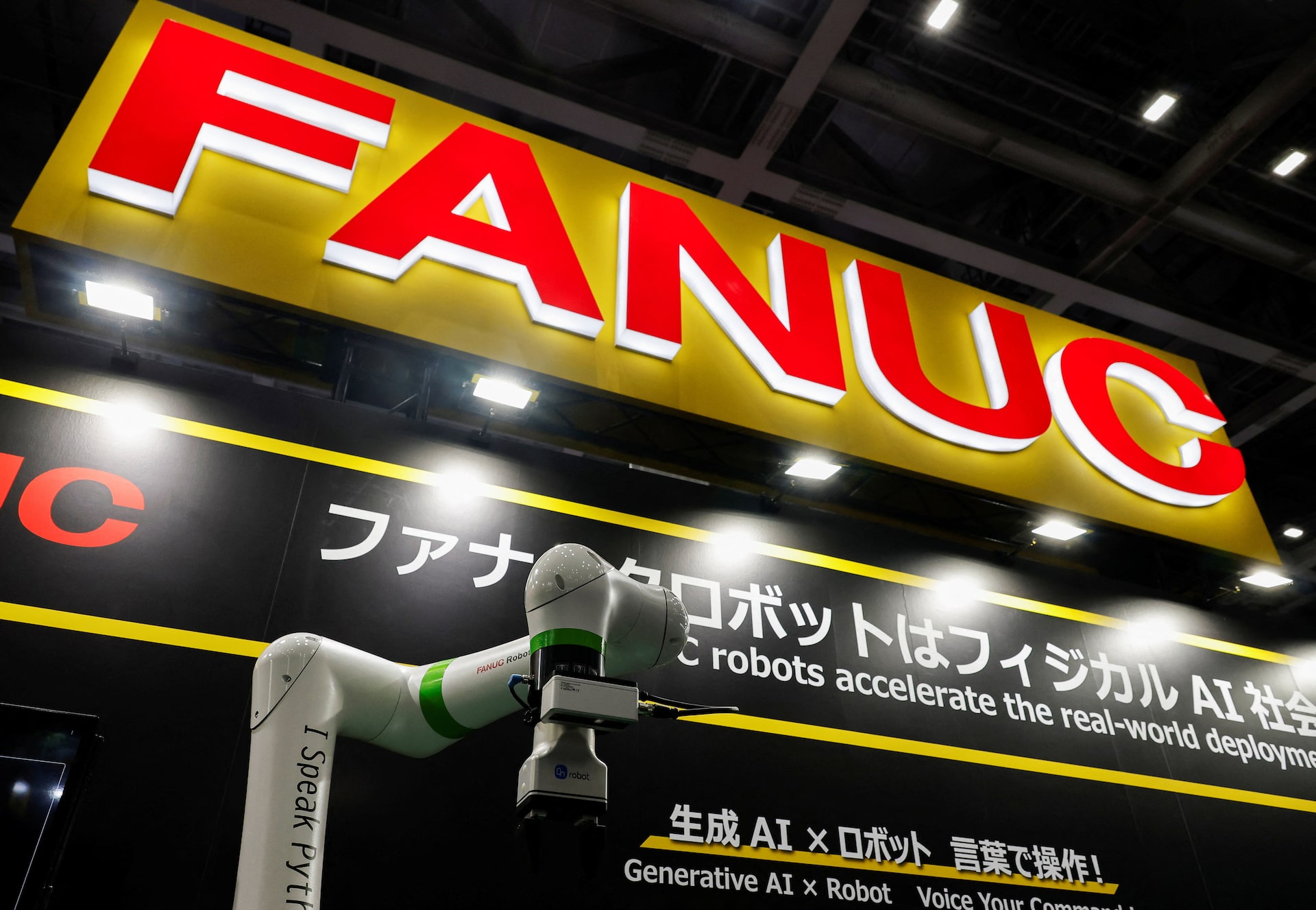
Japan's FANUC said on 11 September 2026 that it had developed the "AI Welding Agent", a new system for arc welding. It reads the drawing of the part to be welded and automatically generates the welding parameters and the robot's motion programme, then runs them. The burden of "teaching" — guiding a robot point by point each time the part changes — has long made high-mix, low-volume welding hard to automate. FANUC's aim is to hand that workload to AI. The system will be demonstrated from 16 September, with shipments planned by year-end; its real test lies ahead.
Key points
- FANUC has developed the "AI Welding Agent", which generates welding parameters and robot motion from a drawing (announced 11 September 2026), removing the teaching and programming steps that were previously essential.
- It runs on "Gemini Enterprise", Google Cloud's enterprise generative-AI platform. Drawings are captured by the camera built into the teach pendant of the "CRX" collaborative robot, so no extra hardware is needed.
- It will be shown from 16 September at the International Welding Show at Tokyo Big Sight; FANUC plans to begin shipments by the end of December 2026, and evaluation on production floors is still to come.
- The system turns the physical-AI collaboration with Google, announced in May 2026, into a single, concrete process.
A drawing goes in, a weld comes out — with no teaching
According to the announcement, the AI Welding Agent reads the drawing of an arc-welded part, understands its material and final shape, then automatically generates the welding parameters (current, voltage, travel speed and the like) and the robot's motion programme, and executes the weld. The drawing is captured by the camera built into the tablet teach pendant of the "CRX" collaborative robot; no dedicated scanner or other added equipment is required. FANUC describes this as "zero-setup, zero-teaching" welding.
The system rests on "Gemini Enterprise", Google Cloud's generative AI. Yet how much of the chain — reading the drawing, setting the welding conditions, generating the path, executing the weld — is handled by the generative AI, and how much by FANUC's own robot control and welding know-how, has not been disclosed in detail. That division of labour is the crux of judging just how "teaching-free" the system really is.
Why teaching has blocked automation
Robotic welding is already widespread in mass production, such as welding car bodies. The flip side is that it has paid off there precisely because the same path can be reused again and again. On frames for construction and industrial machinery, on steel structures, and on high-mix, low-volume parts, re-teaching the path every time the model changes is heavy work; the time and cost of changeovers break the economics of automation. That is why manual welding still persists in these areas.
Teaching has been carried by skilled welders and system integrators (SIs). But the ageing and shortage of skilled welders is severe, and the handover of skills is not keeping up. Welding, with its awkward postures and limited sightlines, is also under strong pressure to cut labour on working-environment grounds. If a robot can set its own conditions and start welding from nothing but a drawing, automation could reach the small and mid-sized shops and the variable-mix lines it has so far missed. It is this "teaching wall" that the AI Welding Agent takes on.
The Google partnership takes shape in one process
The announcement sits on the line of FANUC's physical-AI strategy — AI that judges and acts in the real world.
On 13 May 2026 the company had unveiled a collaboration with Google: a demonstration in which Gemini Enterprise understood human instructions, recognised objects, and coordinated a collaborative robot and a standard industrial robot to work autonomously. FANUC also joined Google DeepMind's "Gemini Robotics Trusted Tester" programme, advancing research into foundation models for robots. Where May was a general-purpose demo driven by natural language, the AI Welding Agent brings it down to a single process: reading drawings and auto-programming for arc welding. A general-purpose showcase has narrowed into an application for a concrete task.
What emerges is a sourcing structure that combines outside strengths. Generative AI and cloud come from Google; the simulation base from NVIDIA, with which FANUC also works to build digital twins of virtual factories. FANUC, meanwhile, keeps the robot's own control, the welding process expertise itself, and its sales network to robot users worldwide. Even with the "brain" outsourced, whether it can keep in-house the real-world control that melts metal — and the customer relationships — will shape FANUC's standing in the physical-AI race. The company says it has shipped more than 1,000 physical-AI-related robots since its December 2025 robot exhibition, a sign that demand in the field is beginning to move — though not a track record for the AI Welding Agent itself.
Welding SI work will not vanish; it will change
As teaching-free operation spreads, the business structure of welding automation will feel the effect too.
Until now, a large share of the cost and lead time of a welding-robot installation has gone into the teaching and condition-setting done by SIs. If programmes are generated automatically from a drawing, that workload is compressed. But the work does not disappear wholesale. Checking whether the AI's conditions are sound, handling unexpected joints and defects, and fitting to the actual part all remain. The SI's centre of gravity is likely to shift from simple teaching towards process design, quality assurance and difficult welds. For robot makers, too, the axis of differentiation may move towards proposals that bundle AI software rather than hardware alone.
Where it tells on the economics is high-mix, low-volume and near-one-off welding. With no extra hardware and shorter teaching time at each changeover, the numbers can start to add up even at the mid-sized and smaller shops that have held back. That said, if the AI's conditions bring frequent rework, the hours saved will be spent again on post-weld repair. The payoff turns not only on "how much teaching can be cut" but on "how much rework can be avoided".
The test: how far can the human hand be pulled back?
For now the AI Welding Agent is at the "developed" stage. After the demonstration at the International Welding Show from 16 September, shipments are due to begin by the end of December, and evaluation on production floors lies ahead.
Three questions will decide it. First, how stable a quality the AI's generated conditions can hold on real parts — with their plate-thickness scatter, heat distortion and joints that need fitting on the spot. Second, how far the range of weld types, materials and joint shapes can extend. And third, since the system claims "zero teaching", how much human involvement the checking and correction of its output still requires; if intervention piles up in the exceptions, the teaching-free banner will lack substance.
Welding automation was long "a thing for mass production". Whether this move — an AI that reads a drawing and skips the teaching — can hold quality, pull back the human hand and make high-mix, low-volume welding pay is the real question. The strength of the picture FANUC has drawn will be settled by the weld beads that stack up on the floor from the year-end onwards.